What if the best AI workflow engine isn’t the one with the longest feature checklist, but the one whose underlying architecture actually matches your problem?
As Generative AI transitions from weekend hackathons into core production environments, the real challenge isn’t choosing a model; it’s managing the architecture around it. This need for simplification has pushed two visual, node-based platforms to the forefront of the engineering conversation. When evaluating options, the n8n vs langflow debate inevitably takes center stage for development teams.
At a casual glance, they seem interchangeable.
Both feature slick drag-and-drop visual editors, both interface natively with LLMs, and both promise to save you from writing miles of boilerplate glue code. But looking at n8n vs langflow purely based on UI layout is deceptive; if you treat them as identical, you’re setting yourself up for an architectural dead end. Under the hood, they were engineered with fundamentally opposing philosophies.
n8n approached this space from the outside in. It built its reputation as a battle-tested backend automation engine, designed to sync CRMs, handle webhooks, and orchestrate complex business logic.
Its recent evolution – adding advanced AI nodes, native agents, and Model Context Protocol (MCP) support – makes n8n an absolute powerhouse for operational automation.
Langflow, by contrast, was built from the inside out. Born directly from the LangChain ecosystem, it is a Python-native playground designed explicitly for AI engineering.
It doesn’t care about your corporate CRM; it cares about the granularity of your cognitive logic – giving you fine-grained control over Retrieval-Augmented Generation (RAG) pipelines, prompt chunking, vector embeddings, and multi-agent reasoning.
The core of the n8n vs langflow comparison comes down to intent: one is an integration engine with AI superpowers, while the other is an AI development sandbox. Choosing the wrong platform here slows you down and can lead to fragile workarounds and scalability bottlenecks.
Let’s skip the surface-level marketing feature lists and look at the langflow vs n8n dynamic from a practical engineering perspective: where they break, where they shine, and how to know which belongs in your stack.
This blog on n8n vs langflow will break down:
- The Paradigm Split: The fundamental design choices that separate a backend workflow manager from a Python-native AI sandbox.
- The Real-World Boundaries: Where each tool shines out of the box, and exactly where they hit a hard technical ceiling when pushed to scale.
- The Replacement Question: A realistic look at whether you can actually force one platform to do the other’s job without accumulating massive technical debt.
- The Hybrid Architecture: How engineering teams decouple the execution layer from the reasoning layer to get the best of both worlds.
By the end of this guide, you will know what these tools do and understand why they were engineered that way, giving you the clarity to pick the right architecture for your stack.
What are n8n and Langflow?
While the tech community often lumps these two tools into the same visual AI bucket, the langflow vs n8n comparison often assumes they are drop-in substitutes. Both utilize a node-based visual grid, but the data flowing through those nodes is entirely different. One passes corporate data packets; the other passes cognitive tokens.
Inside the n8n Engine
At its core, n8n is a battle-tested event router. Born as a self-hostable, fair-code alternative to traditional integration tools, it was engineered to act as the central nervous system for business operations.
It sits patiently waiting for an event – a webhook fire, a database change, an incoming email, or a scheduled CRON job – and executes structural logic across a sprawling network of external APIs.
Recently, n8n underwent a massive evolution. Instead of forcing developers to build separate microservices for AI processing, they introduced native AI nodes and deep integrations inspired by modern LLM orchestration patterns.
With native support for the Model Context Protocol (MCP), vector database inserts, and direct nodes for giants like OpenAI, Anthropic, and Ollama, n8n treats an LLM as a highly intelligent worker sitting right inside your existing operations pipeline.
The bottom line: n8n excels at orchestrating business logic, where the AI is simply a powerful step in a much larger machine.
Inside the Langflow Engine
Langflow approaches the canvas from the exact opposite direction. It doesn’t care about your corporate SaaS stack. Built as a visual extension of the LangChain ecosystem, Langflow is a Python-native environment built explicitly to manage the chaos of AI cognitive architecture.
Instead of connecting decoupled applications, Langflow nodes represent the granular primitives of an LLM’s thought process. On this canvas, you are visually manipulating text splitters, chunk sizes, token overlap variables, embedding models, semantic retrievers, and memory states. It is a playground designed to let data scientists and AI engineers structure how a model reasons, handles context, and guards against hallucinations.
The bottom line: Langflow is built to orchestrate AI reasoning, where traditional business automation is treated as a secondary concern.

n8n vs Langflow: The Core Difference
Now that we’ve looked at what these platforms are designed to do on paper, it’s time to explore the n8n vs Langflow comparison in a real production environment.
While both tools can sit comfortably inside an AI-driven stack, they handle things like error management, custom scripts, third-party integrations, and token routing completely differently.
To see where the architectural lines are drawn, let’s look at a side-by-side comparison of how they handle the core requirements of a live deployment.
| Sr. No | Feature | n8n | Langflow |
| 1 | Primary Purpose | Enterprise automation and multi-system data routing. | Engineering AI reasoning loops and cognitive pipelines. |
| 2 | Core Philosophy | Move data reliably between APIs, databases, and services. | Build, test, and tune how an LLM handles context and logic. |
| 3 | Workflow Focus | Business logic, APIs, databases, and SaaS integrations | Prompts, retrievers, vector stores, memory, and AI agents |
| 4 | Role of AI | AI is one step within a larger automation workflow | AI is the core of the application |
| 5 | Architecture | An event-driven, JavaScript-based asynchronous workflow engine. | A Python-native visual execution layer built directly on LangChain. |
| 6 | Primary Users | Infrastructure teams, DevOps, and backend automation engineers. | AI developers, data scientists, and engineers hacking on LLMs. |
| 7 | Best For | Moving data around, cron-based tasks, web scrapers, and smart routing. | Deep context applications, multi-agent frameworks, and vector search. |
| 8 | Typical Trigger | Webhooks, CRON schedules, Kafka topics, or database mutations. | Direct chat interactions, user prompts, or application API calls. |
| 9 | Integration Ecosystem | Hundreds of pre-built enterprise SaaS connectors (Salesforce, SQL, ERPs). | Vector databases, embedding models, tokenizers, and custom Python agents. |
| 10 | Learning Curve | Easier for developers familiar with automation tools | Requires understanding of LLMs, RAG, embeddings, and LangChain concepts |
| 11 | Extensibility | Custom nodes, JavaScript/Python code, REST APIs | Custom components, Python integrations, LangChain ecosystem |
| 12 | Deployment | Self-hosted via Docker, Kubernetes, or cloud platforms; also available as a managed cloud service. | Self-hosted via Docker, Kubernetes, or cloud platforms; typically deployed with AI services and infrastructure. |
| 13 | Primary Goal | Connect systems and automate business operations | Build intelligent AI applications with sophisticated reasoning |
In short, n8n is optimized for orchestrating business operations, while Langflow is optimized for orchestrating AI reasoning.
If your workflow revolves around APIs, SaaS platforms, and operational automation, n8n is the stronger fit. If it revolves around prompts, retrieval, memory, and agent execution, Langflow provides a more specialized development environment.
When to Deploy: Matching the Tool to the Objective
Choosing between n8n vs Langflow is about defining what sits at the center of your architecture. An automation engine is the right fit for you when the priority is moving data reliably between systems, whereas an AI sandbox is better suited to engineering how a machine reasons.
Real-World n8n Use Cases:
Instead of using AI to build a standalone application, n8n is where you drop a model into an existing business process to handle boring tasks.
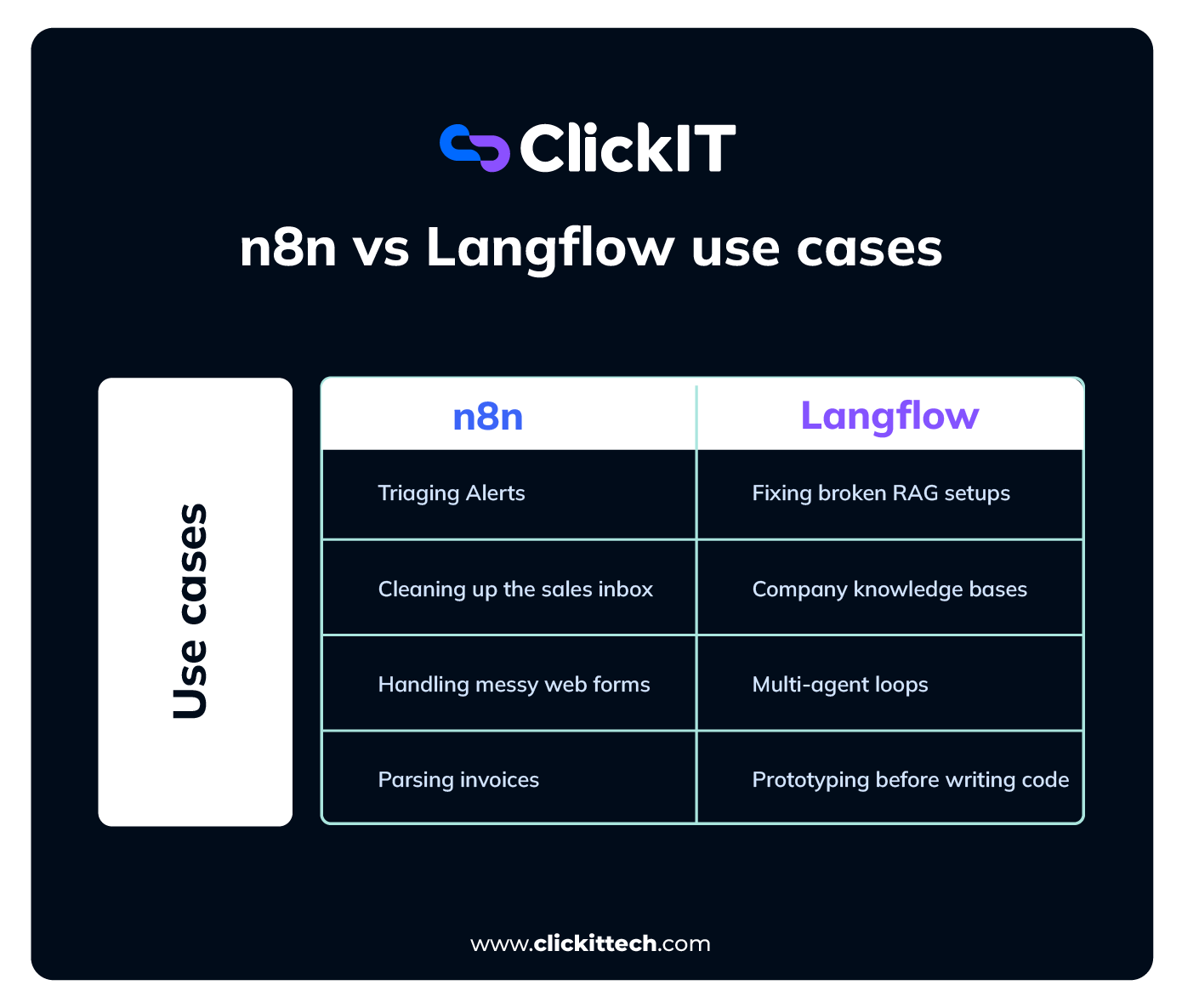
- Triaging Alerts: You hook a webhook to GitHub or your monitoring stack. When a production alert fires, the LLM reads the raw log, figures out if the site is actually down or just warning you, and automatically handles the ticket routing in Jira or Zendesk.
- Cleaning up the sales inbox: You have a public [email protected] email address getting slammed with spam and leads. n8n monitors the inbox, passes the email text to a fast model to categorize it, converts the data into a clean JSON object, and drafts a reply that sits waiting for a human to click “send.”
- Handling messy web forms: A user fills out a form on your site. n8n grabs it, checks your Salesforce or HubSpot records to see if they already exist, updates their profile, and pings a Slack channel. All without you writing custom API integrations.
- Parsing invoices: A PDF invoice hits an AWS S3 bucket. An n8n workflow detects the new file, hands it to a vision model to pull out line items and totals, and sends that structured data straight into your ERP software.
The takeaway:
When your ultimate goal is making sure System A talks to System B, and the AI is just a smart filter in the middle, use n8n.
Real-World Langflow Use Cases:
With Langflow, you aren’t trying to orchestrate business systems; you’re orchestrating the AI’s actual thought process, building the application inside the canvas.
- Fixing broken RAG setups: If you are working on a document search tool and the LLM keeps hallucinating, use Langflow to experiment with how you slice up text, adjust token overlaps, swap embedding models, or wire up semantic re-rankers to force accurate answers with citations.
- Company knowledge bases: Building an internal bot that can read through complex company wikis, HR policies, and technical manuals, giving employees answers based on actual semantic intent rather than simple keyword matching.
- Multi-agent loops: Designing advanced setups where different models talk to each other – like an execution agent running a custom Python script, passing the output to a critic agent to verify the math, and holding state throughout the loop.
- Prototyping before writing code: Standing up a quick visual environment to benchmark how different models (like Claude vs. GPT-4o) handle your specific prompts, memory windows, and system instructions before you lock them into a production codebase.
The takeaway:
If your project hinges on raw LLM reasoning, and you need granular control over chunking, retrieval, memory, or custom agent behavior, go with Langflow. It’s built specifically for AI engineers, ML teams, and developers who need to fine-tune the inner workings of intelligent applications.
On the other hand, if you’re a business user or an operations team trying to automate day-to-day workflows across your existing tech stack, n8n is much easier to pick up and get running.
Architectural Decision Matrix
If you need a quick heuristic to align your engineering team, use this simplified framework:
| Sr. No. | If your core technical goal is to… | your architectural choice is … |
| 1 | Automate business processes across disparate SaaS tools | n8n |
| 2 | Build advanced RAG apps, custom chatbots, or agent loops | Langflow |
| 3 | Inject an LLM into an existing operational workflow | n8n |
| 4 | Experiment with prompt chains, embeddings, and tokenizers | Langflow |
| 5 | Coordinate webhooks, relational databases, and CRON jobs | n8n |
| 6 | Design deeply stateful AI applications with complex reasoning | Langflow |
Can They Replace Each Other?
When you look at the feature lists, it’s tempting to think you can just choose one tool and force it to do everything. Let’s look at why that approach usually blows up in production.
Can Langflow replace n8n?
Short answer: No.
Yes, Langflow can trigger an API or run a basic tool node. But it was never built to be a full-fledged enterprise event router. If you try to force Langflow to handle CRON schedules, manage webhook retries, parse multi-part file transfers, or coordinate stateful approval chains, you will spend weeks writing custom Python code just to recreate basic features that n8n handles out of the box.
Take a classic invoice processing loop: you need to poll an inbox, download a PDF, dump it into an S3 bucket, extract the line items with an LLM, push the data to an ERP, and ping the finance team on Slack. Langflow can handle the extraction beautifully, but using it to manage the rest of the operational plumbing is like trying to drive a screw with a hammer.
Can n8n replace Langflow?
Short answer: Only until your AI needs to think.
n8n’s Advanced AI nodes and native Model Context Protocol (MCP) support are incredibly capable. If your goal is straightforward – like summarizing incoming emails, routing support tickets based on sentiment, or running basic document extraction – n8n can do it seamlessly. You don’t need a secondary tool.
But the moment you push past basic automations into advanced AI development, n8n hits a steep architectural wall.
If you are building a system that requires routing queries across multiple semantic retrievers, managing complex conversation memory windows, evaluating output quality, or coordinating self-correcting agent loops, n8n’s visual canvas quickly turns into unmaintainable spaghetti. It lacks the microscopic debugging controls you need to figure out why a model is hallucinating.
The Rule of Thumb: Use n8n when AI is a feature enhancing your workflow. Use Langflow when the AI reasoning loop is the application.
The Hybrid Blueprint: How to Use Them Together
The most sophisticated production stacks don’t treat this as a zero-sum game. Instead of compromising, mature engineering teams use a hybrid architecture: n8n acts as the central nervous system (the hands), while Langflow acts as the cognitive engine (the brain).
By exposing your Langflow pipeline as a clean API microservice, you can let n8n handle all the messy business integrations and data traffic control.
Step-By-Step Data Flow: How the Hybrid Stack Actually Runs
Let’s look at how a single incoming customer request actually moves through this pipeline from end to end.
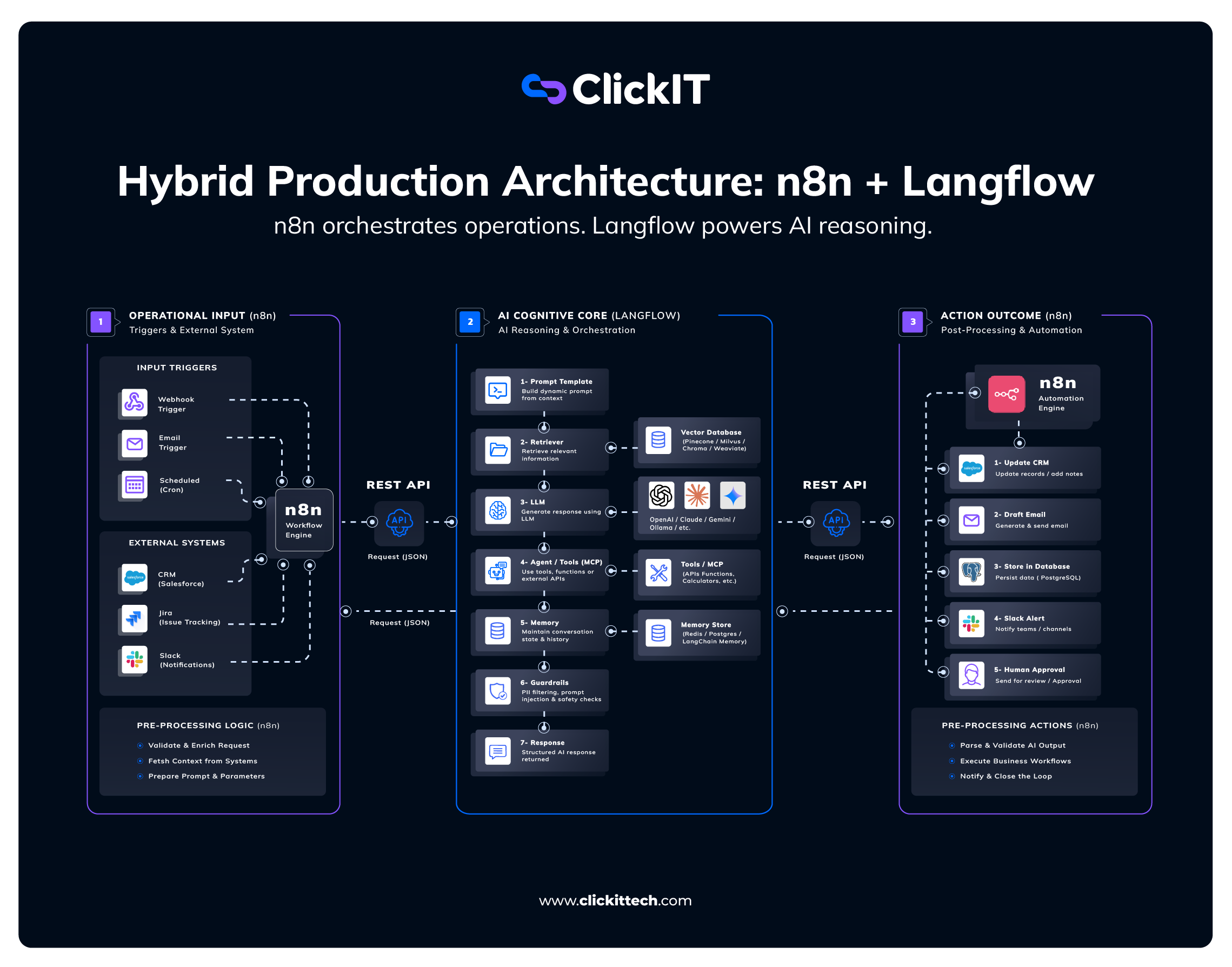
- Ingestion and Sanitization (n8n)
- Everything starts when a user drops:
- a chat message,
- hits a public API,
- or files a ticket.
- n8n sits at the very edge of your network, acting as the primary webhook receiver. Before passing anything downstream, it:
- cleans up the mess:
- validates the incoming payload,
- checks API tokens or authentication headers,
- strips out weird whitespace or broken formatting,
- and sets up the initial environment variables for the run.
- Everything starts when a user drops:
- Gathering the System Context (n8n)
Hitting an LLM with a raw customer query is a recipe for a generic, unhelpful response. Before n8n talks to the AI, it:- hunts down the background data,
- runs concurrent API calls to your stack – grabbing the user’s customer profile from Salesforce,
- pulling their last three closed tickets from Zendesk,
- checking their active subscription tier, and fetching recent order history,
- packages all this raw operational data into a clean, structured JSON payload.
- The Cognitive Deep Dive (Langflow via API)
n8n fires that enriched JSON payload directly at your self-hosted Langflow API endpoint. This is where the hands pass the baton to the brain. Inside Langflow, the visual AI graph takes over, and:- parses the incoming payload and maps the data into specialized prompt templates.
- passes the user’s intent to a semantic retriever, querying a vector store (like Milvus or Pinecone) to pull exact documentation paragraphs.
- injects the conversation history to keep the context coherent.
- lets an autonomous agent run sub-queries or execute local Python tools if something needs mathematical verification.
- Finally, the LLM processes this hyper-contextualized prompt and reasons out an exact solution.
- Getting the Response Back (Langflow → n8n)
Once the LLM finishes execution, Langflow sends the output right back to n8n over the open HTTP connection andw hands back:- a clean JSON object packed with extra context: the actual response string,
- a confidence score,
- a sentiment tag (like frustrated),
- and a simple boolean flag telling n8n whether a human needs to take over the ticket immediately.
- Executing the Operational Side Effects (n8n)
With the structured AI response back in its possession, n8n handles the deployment of real-world actions. It:- maps the Langflow output to your business systems simultaneously,
- logs the full conversation history into a PostgreSQL database,
- updates the status field inside your CRM,
- drafts a contextual email reply that sits in a queue waiting for team review,
- and maps a critical notification to a Slack channel if the user’s sentiment score flagged a severe escalation.
Why This Separation Scales
This architectural layout succeeds because it completely decouples the reasoning layer from the action layer.
- n8n stays entirely in its lane: managing network retries, dealing with third-party rate limits, executing CRON schedules, and handling OAuth handoffs. It never has to worry about token windows or high-dimensional vector math.
- Meanwhile, Langflow can exist purely as an isolated, deterministic AI microservice focused entirely on document chunking, semantic retrieval accuracy, and prompt evaluation.
By separating the brain from the hands, you create a modular architecture where you can swap out embedding models or re-index your vector databases without ever risking a break in your upstream corporate data integration pipelines.
In this architecture, each tool plays to its absolute strength. n8n doesn’t have to struggle with vector embeddings, and Langflow doesn’t have to worry about OAuth tokens, rate limits, or database connections.
Framing the n8n vs langflow dynamic as a direct head-to-head competition misses the point entirely. While both give you a visual grid and both hook into modern LLMs, they are designed to anchor completely separate parts of your infrastructure.
If your project’s success is defined by operational reliability – getting business systems to talk to each other, handling webhooks safely, scheduling CRON jobs, and routing data between APIs without breaking – n8n is the tool you want. It treats the AI as a highly capable processing step inside a larger machine.
However, if success is defined by building and fine-tuning AI workflows – whether that’s advanced RAG pipelines, prompt engineering, agent orchestration, or memory management – Langflow is your sandbox. It gives you the specialized granularity required to build an AI application inside the canvas itself.
The most valuable takeaway from this n8n vs Langflow comparison is that you don’t actually have to pick a side.
In real-world production setups, the smartest architecture is a hybrid one: let n8n serve as the central nervous system handling your workflows, and use Langflow as the dedicated reasoning engine behind the scenes.
At the end of the day, stop looking at the n8n vs langflow dilemma as a competition you win by checking off boxes on a feature matrix. Look at what your system actually spends most of its time doing.
If your biggest headache is API plumbing, use n8n. If your biggest headache is getting an LLM to stop hallucinating on your data, use Langflow. Better yet, end the n8n vs langflow debate entirely in your stack by hooking them together – let n8n handle the operational grunt work while Langflow manages the actual thinking.
FAQs
It comes down to what flows through the grid. In the langflow vs n8n comparison, the core split is intent. n8n is built to move structured business data packets between APIs, databases, and apps. Langflow doesn’t care about your SaaS stack; it’s a Python-native environment built to manage token routing, context windows, and model reasoning.
One is an integration powerhouse; the other is an AI sandbox.
There is no absolute winner in the n8n vs langflow matchup because they aren’t competing for the same job. If success looks like a bulletproof backend pipeline that triggers on a webhook and updates your CRM, n8n wins hands down. But if success depends on fixing a hallucinating model using custom semantic re-rankers, Langflow is the better tool.
Not a chance. Sure, Langflow can hit an API endpoint or run a basic tool node, but it isn’t an enterprise event router. If you try to force it to handle CRON schedules, manage webhook retries, or hold state for a human-in-the-loop approval chain, you will end up writing miles of custom Python glue code to build features that n8n handles natively out of the box.
Only until your AI actually needs to think. n8n’s Advanced AI nodes and Model Context Protocol (MCP) support are great for simple tasks like parsing an email or running basic document extraction. But if you try to build a deep, self-correcting agent loop or a multi-vector RAG pipeline in n8n, your canvas will quickly devolve into unmaintainable visual spaghetti.