As AI continues to evolve, so does the role of the engineer behind it. That means technical knowledge isn’t enough today, and soft skills for software engineers in the era of AI are becoming what sets us apart.
I’ve seen brilliant engineers struggle to drive impact, not because they lacked expertise, but because they couldn’t communicate their ideas, adapt to fast-changing environments, or work effectively with others.
These “soft skills,” which I would rather call behavioral or foundational skills, are what will prove your role and your work valuable and irreplaceable.
But don’t worry, the resources to strengthen your profile in these areas are just as close as the next big AI update. In this blog, I’ll share my top favorite books that I consider ideal to build up a profile as a software engineer and how to use them to your advantage. Let’s dive in.
What are the Top Soft Skills Every AI Developer Should Master?
I know it may sound like a broken record, but communication is probably the most foundational skill. No matter how advanced your model is, if others can’t understand what it does or why it matters, your work will get lost in translation.
Then there’s collaboration. The most impactful work happens when engineers, data scientists, designers, and product teams align around a shared goal. Critical thinking also rises to the top. Working in AI means dealing with ambiguity, so we can’t just rely on instinct or speed.
Of course, that also takes emotional intelligence. Being able to manage your own emotions, respond thoughtfully, and support the people around you, that’s what keeps teams functioning under pressure.
These skills, and others, show up in subtle ways: how you respond when a model underperforms, how you ask for help, and how you lead a project update.
But it might be easier said than done. So, let’s dive into specific techniques and resources you can implement to make sure you easily dominate these skills.
Communication: Mastering Crucial Conversations
A defining read for you: “How to Win Friends & Influence People”, by Dale Carnegie
Early in my tech journey, I realized that effective communication is more than daily stand-ups, sharing what you’re working on, and letting your leader know if there’s an issue to resolve.
In today’s work, real strong communication gets built even in the smallest chats while you’re making your coffee in the office, and will benefit you even in the most complicated of situations, like debugging a production issue with three teams on a call, just to mention one.
As Dale Carnegie stated, people are more likely to listen, trust, and follow you when they feel respected, seen, and valued.
If you were in the middle of a crisis and needed assistance or guidance from your team, would they show up to help, or would you need to face it alone?
In times like these, you’ll quickly remember either one of the following moments: the day you yelled at your coworker for missing a deadline or the day you showed genuine interest in them and worked together to make it up to the client.
For us to be able to say we are good communicators, the way we build relationships with our team is fundamental.
Smile and remember their names; truly listen to their ideas and concerns; show genuine interest in them; and do your best to make them feel important.
Don’t hesitate to say, “your support today means a lot to the team”, or “your effort in this project really impressed the client”.
I know it might sound small. But in a world where artificial intelligence is surprising us by completing complex, technical tasks, this is the warm, human side that is impossible to replicate.
This will prove helpful in your day-to-day but especially during conflicts, last-minute changes, or disagreements. Which reminds me of a big lesson from another great book, “Mastering Crucial Conversations”: The best communicators focus on the relationship, not “winning” the argument.
As the authors note, “The best at dialogue do not try to win the argument but try to win the relationship.”
Why this matters for tech leads
In a tech leadership role, tough conversations are unavoidable, and your technical point won’t land if you trigger defensiveness or lose trust.
I learned to “start with heart” (as Crucial Conversations puts it) by examining my own motives first, and then to speak honestly but with respect. I also learned the power of listening, truly hearing concerns before responding.
When handled well, open communication strengthens the team more than if no disagreement had occurred at all.
If you’re a tech lead, mastering these communication techniques will enable you to tackle issues head-on while keeping relationships intact, arguably one of the most valuable abilities you can develop.
Emotional Intelligence: Leading with Empathy
My reading recommendation: “EQ Applied” by Justin Bariso
Great communication is built on a foundation of emotional intelligence (EQ), the ability to understand and manage your own emotions, and to recognize and influence others’ emotions.
Earlier in my career, I thought being a strong engineer was all about IQ. I couldn’t have been more wrong. As I stepped into leadership, it became clear that how I related to people often mattered more than the brilliance of my technical solutions.
In fact, research by Daniel Goleman highlights this: Emotional intelligence “accounts for nearly 90 percent of what sets high performers apart from peers with similar technical skills.”
This doesn’t mean technical know-how isn’t important, but EQ is the trait that elevates leaders from good to great.
So what does leading with emotional intelligence look like day to day? The first step is to develop self-awareness and empathy. For me, that meant paying more attention to team morale and individual feelings, not just ticket status.
For example, during a crunch period, I noticed one developer grew unusually quiet. Instead of assuming they’d “deal with it,” I checked in privately and learned they were feeling overwhelmed and hesitant to speak up.
We brainstormed ways to adjust the workload and brought an additional resource to help. Problem solved, and the developer’s trust in me increased. Empathy doesn’t mean indulging or avoiding hard truths; it means showing you care.
When people know you genuinely care about their well-being and growth, they’re more open to feedback, more receptive to change, and generally more engaged.
Emotional intelligence also helps manage our own emotions under pressure. Tech projects can be stressful, and it’s normal to fall into a tendency of absorbing stress and unintentionally spreading it…maybe in a blunt comment or a weird tone. A small action that we might forget, but the client and our team will surely remember.
Our emotions are signals, not instructions. And leaders set the emotional tone for the team; by staying calm and constructive, you’ll find your team remaining calm and solution-focused too.
This also connects with the previous skill of effective communication; the way you deliver feedback is just as important as the content.
In short, developing emotional intelligence is like a superpower for leadership. And the good news is that EQ can be learned and improved continuously.
My advice? Be consistent, stay mindful, and practice empathy in every interaction.
Cognitive Skills for Software Engineers
A must-read: “Thinking Fast & Slow” by Daniel Kahneman
Rationality isn’t a default; it’s a discipline. And in this industry, where complexity is high and assumptions are dangerous, a crucial soft skill for software engineers is making space to slow down our brains when we feel them rushing.
Kahneman refers to this by taking a term originally suggested by the psychologists Keith Stanovich and Richard West, in which our mind can be divided into two systems:
- System 1 – Acts automatically and fast, with no sense of voluntary control.
- System 2 – Pays attention to the mental activities that demand it, complex situations where agency, choice, and concentration are required.
Why does that matter for us in AI and software development?
Simple. When a bug appears, or a model behaves unexpectedly, what’s your first instinct?
To jump to the most obvious explanation, or to slow down and consider the multiple possibilities? Being honest and guided only by instinct, we would probably answer that the first one, which is what System 1 refers to.
But to ensure we choose the right direction and avoid complicating the situation, instead of saying “it must be a config issue” and get working on that, it might be better to pause and walk through the full execution path, logs, or dataset.
Another thing that’s easier said than done, right?
That’s where discipline comes in. In AI development, jumping to conclusions can lead to training models on flawed logic or missing subtle biases in datasets. As an AI engineer, dataset bias isn’t always obvious at first glance. It takes conscious, System 2 analytical thinking to step back, question assumptions, and evaluate data distributions objectively.
By building the cognitive habit of pausing before interpreting results (especially in high-pressure moments) you protect your team from costly rework and ensure that critical decisions are grounded in evidence rather than fast-tracked intuition.
Among the recommended books for software developers, Kahneman’s insights are indispensable for cultivating the rational mindset that modern tech leadership demands.
Deep Work in AI and Software Development
A defining read for you: “Deep Work” by Cal Newport
In an era dominated by real-time alerts, continuous AI updates, and instant messaging, true deep focus is becoming a rare superpower. Yet, mastering soft skills for AI developers demands cognitive depth.
Building complex neural architectures, training custom models, or analyzing high-stakes system bottlenecks can’t be accomplished in fragmented five-minute slices between meetings. Newport defines deep work as the ability to focus without distraction on a cognitively demanding task.
For software developers navigating the AI landscape, deep work is the difference between copy-pasting a quick prompt fix and architecting a sustainable, scalable AI pipeline.
Implementing deep work in day-to-day operations comes down to intentional rituals:
- Focus Blocks: Protect 2- to 3-hour blocks on your calendar specifically for deep technical analysis, model training, or architecting systems, and treat those blocks with the same priority as a client meeting.
- Asynchronous Communication: Reduce context-switching by adopting asynchronous updates rather than demanding immediate replies for non-critical tasks.
- Ritualized Shutdowns: Establish a daily end-of-day process to log open tasks and transition out of work mode, freeing your mind to recharge.
When you protect your attention, the quality and output of your technical work grow exponentially.
Building Daily and Sustainable Habits
Essential reads: “Atomic Habits” by James Clear & “Getting Things Done” by David Allen
When people talk about soft skills for software engineers, they often focus exclusively on personality traits. But we achieve long-term impact thanks to execution, systems, and daily discipline.
As James Clear emphasizes in Atomic Habits, “You do not rise to the level of your goals. You fall to the level of your systems.” For soft skills for software developers, this means turning critical practices into frictionless micro-habits rather than relying on sheer willpower.
Consider small, daily habits that elevate an engineer’s technical practice:
- Spending 10 minutes at the end of every task to clean and document prompt iterations or code comments.
- Routinely auditing sample dataset entries for noise or inconsistent labeling.
- Taking 5 minutes every morning to review task priorities before diving straight into the codebase.
This is where David Allen’s Getting Things Done (GTD) framework seamlessly pairs with habit building. By offloading task management, backlogs, and mental clutter into a reliable external system, you eliminate cognitive overload. You no longer spend mental energy trying to remember what to do next, and you save that energy for solving complex engineering challenges.
Over time, these micro-habits reshape your professional identity. You start operating as an adaptable, proactive engineering leader who consistently delivers high-value results.
The Growth as an Engineer, and as a Human
As artificial intelligence continues to automate technical tasks, the true differentiator for an engineer lies in the behavioral skills that AI cannot replicate: critical thinking, empathy, clear communication, and deliberate focus.
And these are mastered with practice. The best leaders treat soft skill development and emotional growth as a continuous learning journey.
I’m still on that journey myself. So, to my fellow tech leads (and aspiring tech leads): like Dale Carnegie said, “This is an action book”. Invest in your soft skills. Read and learn from others who have been there. Try new approaches even if they feel uncomfortable at first. Ask for feedback on your leadership like you would on your code.
You’ll build happier, more effective teams and find greater fulfillment in your role. In the end, tech leadership is people leadership.
When you level up your ability to inspire, guide, and connect with people, you unlock the full potential of all the hard technical skills you and your team bring to the table.

Soft Skills For Software Engineers FAQ
While technical expertise remains foundational, the top soft skills for software engineers include cross-functional communication, emotional intelligence (EQ), critical cognitive thinking, and disciplined focus. In an AI-driven environment, these behavioral skills are what bridge the gap between complex technical models and real-world business impact.
An engineer’s true value is changing to what AI cannot replicate: human empathy, navigating complex stakeholder disagreements, identifying subtle dataset biases through slow thinking, and leading collaborative multidisciplinary teams.
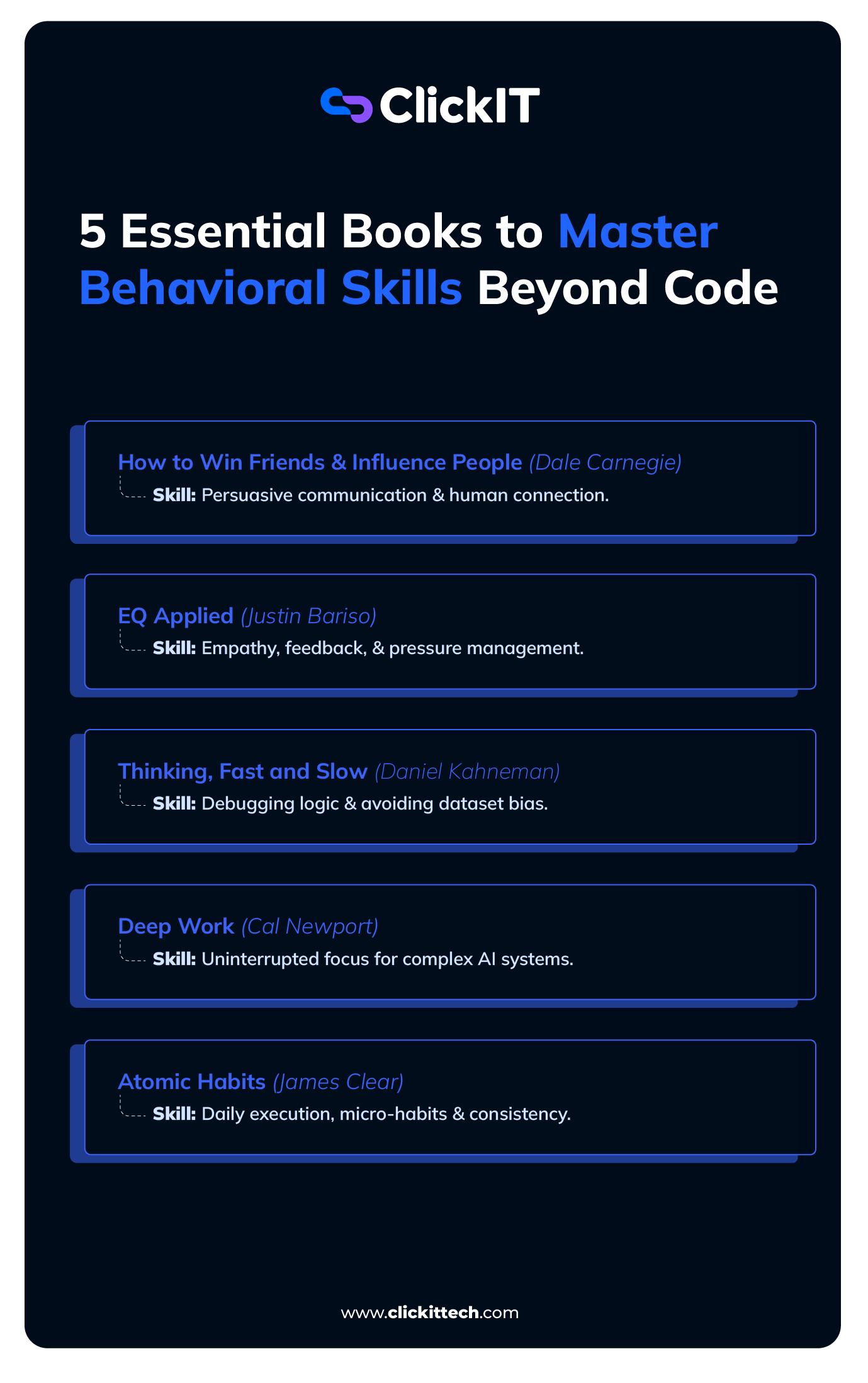
Top recommended books for software developers and tech leads include How to Win Friends & Influence People by Dale Carnegie for communication, EQ Applied by Justin Bariso for emotional intelligence, Thinking Fast & Slow by Daniel Kahneman for cognitive control, Deep Work by Cal Newport, and Atomic Habits by James Clear for execution and consistency.
Engineers can avoid burnout by building reliable daily execution systems. Implementing protected focus blocks for deep technical work and micro-habits for documentation and task management helps maintain high performance and sustainable technical growth without the risk of burnout.