The advent of AI-powered app builders has changed how software is written and delivered. Gone are the days when we had to spend weeks setting up infrastructure, writing boilerplate code, and designing interfaces from scratch.
Now, users can describe an idea in plain English and build a working application within minutes. Lovable stands at the forefront of this transformation. The ability to transform prompts into visually appealing apps with minimal effort makes Lovable highly popular.
Blog Overview
Here is a 5-bullet overview of the blog regarding Lovable alternatives:
- Evolution Toward Production: While Lovable is popular for transforming prompts into visual apps, users are increasingly seeking alternatives to meet production-level demands, including scalability, backend flexibility, and robust security controls.
- Key Limitations of Prompt-Only Tools: Drivers for switching include the need for deeper customization, avoidance of vendor lock-in, and the desire for full code ownership to ensure long-term maintainability and easier infrastructure migration.
- Categorized Tool Selection: The alternatives are grouped by project goals: no-code builders such as Bubble and Bolt for fast MVPs; developer frameworks such as Cursor and Windsurf for full control; and orchestration tools such as Flowise for complex AI pipelines.
- Specialized Use Cases: Different platforms excel in specific niches, such as Retool for internal business dashboards, Dify for open-source full-stack AI development, and FlutterFlow for high-quality mobile applications.
- Strategic Decision Making: Choosing the right alternative depends on the user’s technical level and the project’s intent, whether it is validating a startup idea, automating workflows with AI agents, or building a secure enterprise ecosystem.
Why Users Are Looking for Lovable Alternatives?
While Lovable is a powerful tool for building apps, many users are seeking alternatives, especially for production tasks in recent times.
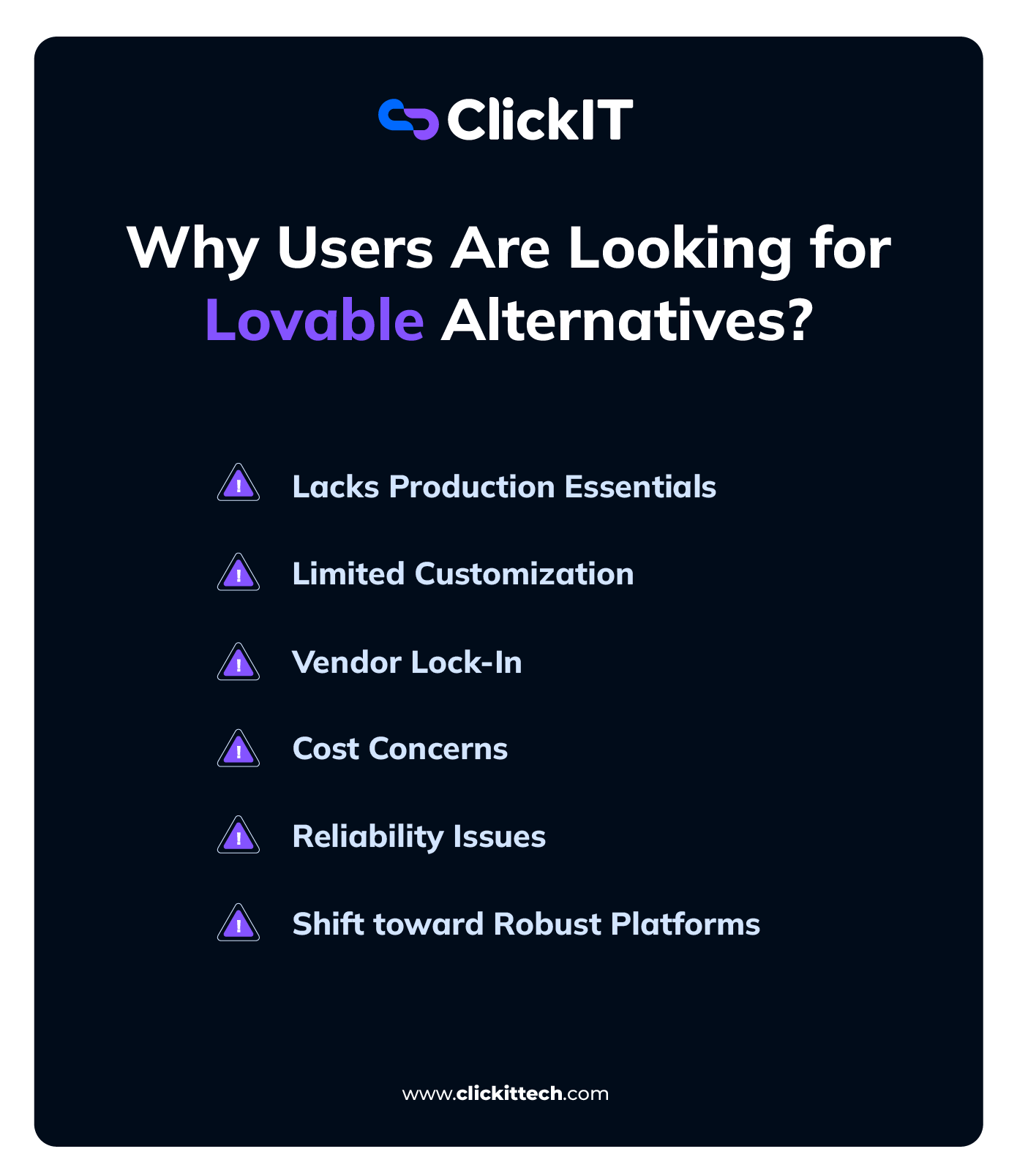
- The reason is that production software requires far more than fast UI generation. Scalability, backend flexibility, security controls, and collaboration workflows are needed.
- One common concern with Lovable is limited customization. While Lovable can generate impressive interfaces quickly, developers often find it difficult to modify the application architecture in depth or implement complex business logic. As projects evolve, users may want more control over databases, APIs, authentication systems, and deployment environments.
- ode ownership and vendor lock-in. Businesses that build long-term products usually want the flexibility to migrate infrastructure, integrate external services, and customize workflows without depending entirely on a single platform.
- Pricing is also a concern for growing teams. AI-powered tools can become expensive as usage scales, especially for projects with frequent iterations, multiple collaborators, or large codebases. So, teams are seeking alternatives that offer better pricing models, open-source flexibility, or more predictable operational costs.
- Developers are also increasingly prioritizing production reliability. Tools designed primarily for rapid prototyping may struggle with larger applications, advanced debugging, version control workflows, or enterprise-grade security requirements.
As a result, many users are moving towards platforms that combine AI-assisted development with stronger engineering foundations.
The AI development ecosystem is rapidly evolving. Today, there are several Lovable alternatives that not only help users build apps quickly but also support real-world production deployments, scalable architectures, and professional development workflows.
Top 10 Lovable Alternatives Comparison Table
| Tool | Best For | Technical Level | Backend Support | Production Ready | Key Advantage |
| Bubble | No-code Web Apps | Beginner | Strong | Yes | Full visual app builder with workflows |
| Bolt.new | Full-stack AI app generation | Beginner to Intermediate | Strong | Yes | Prompt-to-app workflow with editable code |
| Replit | AI-assisted Coding | Intermediate | Strong | Yes | Real coding environment with AI help |
| Retool | Internal AI Tools | Intermediate | Strong | Yes | Instant API and Database Integration |
| Dify | AI-native full-stack Apps | Advanced | Very Strong | Yes | Open-source RAG + Agents + APIs |
| Dust | Internal AI Assistants | Intermediate | Strong | Yes | Fast deployment of polished AI assistants |
| Cursor | AI-powered development workflows | Advanced | Moderate | Yes | Understands and edits entire codebases |
| Flowise | Visual AI Pipelines | Intermediate | Strong | Yes | Drag-and-drop LLM orchestration |
| Windsurf | AI-native software development | Advanced | Moderate | Yes | Context-aware AI agent workflows |
| FlutterFlow | Mobile App Development | Beginner to Intermediate | Moderate | Yes | Strong visual mobile AI builder |
| Claude Code | AI-powered software engineering | AI-powered software engineering | Moderate | Yes | Deep repository understanding and production-grade coding assistance |
Top 10 Lovable Alternatives That Work in Production
Here are the top 10 Lovable alternatives that work well in production:
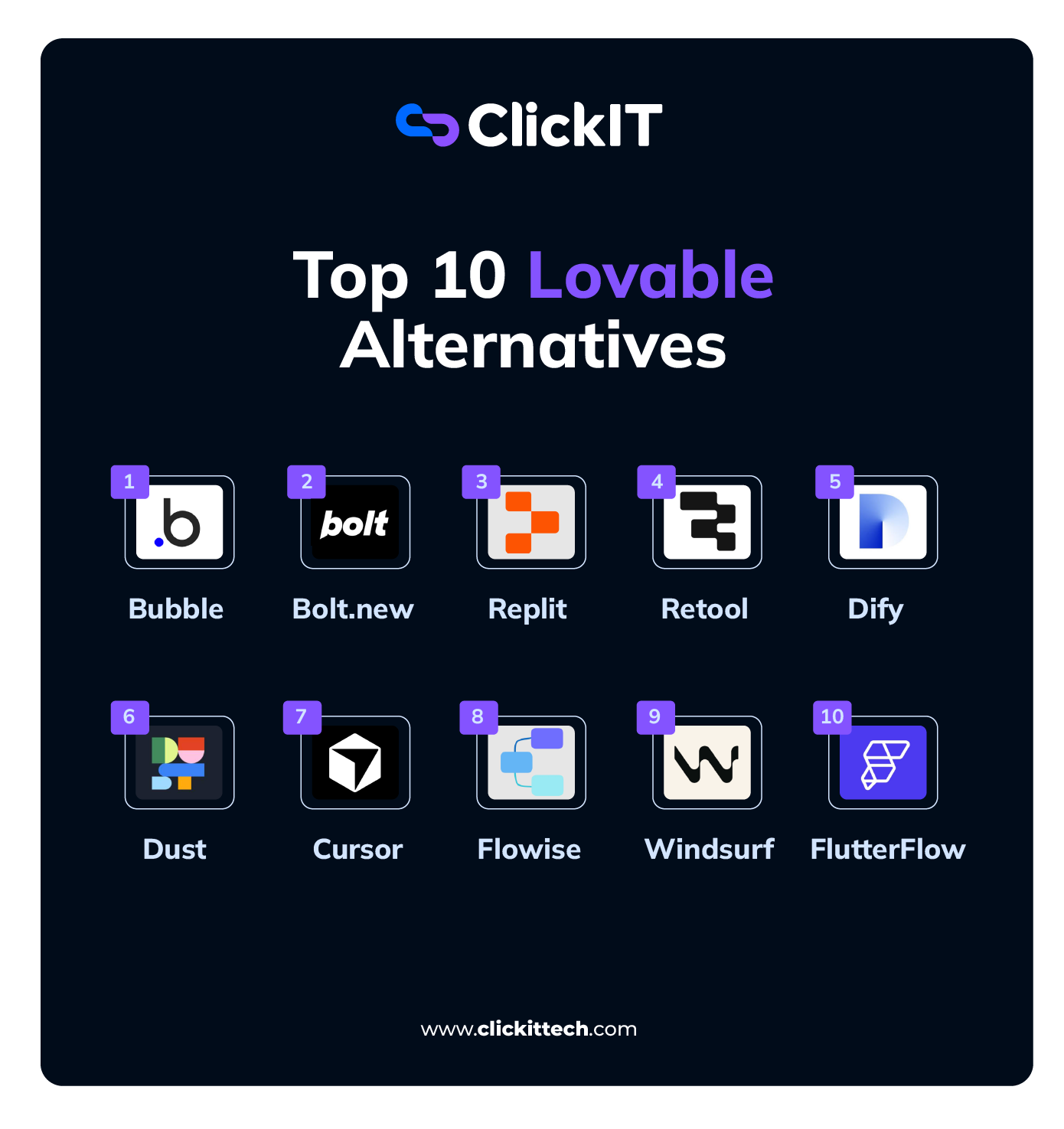
1) Bubble – Best for No-Code Web Apps
Bubble is one of the most established no-code development platforms for users who want to build complete web applications without writing code.
While Lovable focuses heavily on AI-assisted generation and rapid prototyping, Bubble offers a more mature ecosystem for building, managing, and scaling production-ready applications.
Strengths:
a) Visual Builder With Backend Workflows:
Bubble combines a visual drag-and-drop editor with built-in backend workflows, database management, authentication systems, hosting, and API integrations. Users can design interfaces visually while also creating complex business logic using workflow automation tools.
Unlike many AI-first builders that mainly generate frontend experiences, Bubble provides a full-stack environment where users can manage both the application interface and backend operations from a single platform.
Bubble now allows users to generate applications using natural language prompts and then refine them using its visual editor, combining AI speed with manual customization.
b) Large Plugin Ecosystem
One of Bubble’s biggest strengths is its extensive plugin ecosystem. Users can integrate payment gateways, analytics tools, AI models, CRMs, email services, and third-party APIs without extensive coding. This makes Bubble especially attractive for startups and SaaS founders who need production functionality quickly.
This Lovable alternative platform also benefits from a massive community, extensive tutorials, templates, agencies, and third-party resources built over several years. Compared to newer AI-native platforms, Bubble offers a more mature support ecosystem for long-term projects.
c) Better Than Lovable for Full Apps
It offers stronger backend capabilities, workflow management, database handling, and deployment infrastructure out of the box. Many founders use Bubble not just for prototyping, but for running real businesses and production applications.
Bubble is particularly strong for non-technical founders who want more control than AI-only builders typically provide. Instead of relying entirely on prompts, users can visually customize almost every aspect of the application.
Limitations: Not Fully AI-Native
Despite its growing AI capabilities, Bubble was originally designed as a no-code platform rather than an AI-native development environment. As a result, some workflows can still feel more manual compared to newer AI-first tools like Lovable, Bolt.new, or Cursor.
Complex applications may also become difficult to manage visually over time, especially as workflow logic expands. Performance optimization and scalability can require careful planning for larger apps. Additionally, some developers prefer code-first solutions because Bubble applications are tied to the Bubble ecosystem.
2) Bolt.new – Best for Full-Stack AI App Generation
Bolt.new is one of the closest alternatives to Lovable as it follows a similar prompt-to-app workflow while offering greater visibility into the development process. Users can simply describe an idea in natural language and generate working applications directly inside a browser-based coding environment.
Strengths
AI Chat with Browser-Based IDE
Bolt combines conversational AI with an integrated development environment. This allows users to generate, edit, preview, and deploy applications without switching tools. It, in turn, delivers a fast workflow for building prototypes and MVPs.
Similar Experience to Lovable
Bolt emphasizes speed and simplicity, similar to Lovable. Users can generate interfaces and application logic from prompts, which makes it attractive for startup founders and rapid product experiments.
More Control Over Generated Code
Compared with Lovable, Bolt offers greater transparency into the underlying code. Developers can directly inspect, edit, and customize generated output, which makes the transition from prototype to production easier.
Limitations
Complex applications may still require manual coding and architectural decisions. Token usage can also increase costs for larger projects with frequent iterations.
3. Replit – Best for AI-Assisted Coding
Replit is a strong Lovable alternative for users who want AI assistance inside a real coding environment rather than a fully abstracted no-code builder. It offers cloud development, hosting, collaboration, and AI-powered coding in a single platform.
According to Business Insider, Replit reached a $9 billion valuation in 2026.
Strengths:
Ghostwriter AI
Replit’s AI assistant, previously known as Ghostwriter, helps developers generate code, debug errors, explain functions, and accelerate development workflows. Instead of only generating interfaces from prompts, it supports real software engineering tasks across the development lifecycle.
Real Coding Environment
Unlike Lovable’s heavily AI-driven abstraction layer, Replit gives users direct access to the underlying codebase and development environment. Developers can work with multiple languages, install packages, connect APIs, manage databases, and deploy applications directly from the browser.
This makes Replit more flexible for developers who want AI productivity without sacrificing engineering control.
Faster Transition from MVP to Production
Replit is especially useful for teams moving from rapid prototypes to production-ready applications. Because users work inside an actual coding environment from the beginning, scaling and customizing applications become easier later.
Limitations
While Replit is excellent for AI-assisted coding, it is less optimized for polished visual app generation compared to Lovable or Bubble. Larger enterprise-scale systems may also require external infrastructure and deployment tooling.

4. Retool – Best for Internal AI Tools
Retool is one of the best Lovable alternatives for building internal business applications, operational dashboards, and workflow automation systems. It is widely used by companies to create tools for support teams, operations, analytics, and internal management workflows.
Strengths:
Connect to APIs and Databases Instantly
Retool’s biggest advantage is its ability to quickly connect with databases, APIs, spreadsheets, cloud services, and enterprise systems. Teams can integrate PostgreSQL, MySQL, REST APIs, GraphQL services, and third-party platforms without extensive backend setup.
This dramatically reduces development time for operational tools.
Build Dashboards and Workflows
The platform provides drag-and-drop components for creating dashboards, admin panels, CRUD apps, approval systems, and workflow automations. AI features can also be integrated into workflows for summarization, search, automation, and decision support.
Strong for Operations Use Cases
Retool is especially valuable for companies building tools used internally by employees rather than customer-facing SaaS applications. It excels in operations-heavy environments where speed, integrations, and workflow efficiency matter more than pixel-perfect frontend design.
Limitations
Retool is less suitable for public-facing consumer apps and highly customized frontend experiences. Pricing can also become expensive for larger organizations with many users.
5. Dify – Best Overall Open-Source Replacement
Dify is one of the most complete open-source Lovable alternatives available today. It offers AI app development, workflow orchestration, RAG pipelines, agents, APIs, and deployment capabilities inside a single platform.
Strengths:
Open-Source and Full Stack
Unlike many AI builders that focus mainly on frontend generation, Dify supports full-stack AI application development. Users can build AI chatbots, agent workflows, retrieval-augmented generation (RAG) systems, knowledge bases, and AI-powered applications with much greater flexibility.
Being open-source, the platform can be self-hosted, allowing teams to maintain full ownership of the infrastructure and data.
Built for AI-Native Applications
Dify is particularly strong for teams building AI-first products rather than traditional websites or dashboards. It includes support for prompt orchestration, multi-model management, vector databases, APIs, memory systems, and agent-based workflows.
This makes it far more suitable for advanced AI applications than many simple AI app generators.
Better Production Flexibility
Compared to Lovable, Dify offers deeper backend capabilities and stronger support for production AI systems. Developers can customize workflows, integrate external tools, and scale applications more effectively.
Limitations
Dify has a steeper learning curve than beginner-focused no-code builders. Non-technical users may find setup and orchestration workflows more complex, especially when dealing with infrastructure and AI pipelines.
6. Dust – Best for Internal AI Assistants
Dust is one of the closest alternatives to Lovable for teams building polished internal AI tools and workplace assistants. It focuses heavily on user experience, fast deployment, and AI-native workflows for business productivity.
Strengths:
Fast to Ship
Dust allows teams to quickly create AI assistants connected to company knowledge, documents, databases, and internal tools. Its interface and workflow design feel very similar to modern AI-native builders like Lovable.
Built for Internal AI Workflows
Dust excels in enterprise search, knowledge assistants, support automation, and team productivity use cases. Businesses can deploy AI copilots without building complex infrastructure from scratch.
Limitations
Dust is more specialized for internal AI assistants rather than general-purpose app development. Teams needing full frontend customization or large SaaS applications may require additional tooling.
7. Cursor – Best for AI-Powered Development Workflows
Cursor is an AI-native coding environment that helps developers build software faster using intelligent code generation, editing, and project-wide understanding.
A good thing about Cursor is that it doesn’t replace coding entirely but acts like an AI pair programmer integrated directly into the development process.
Strengths
AI-Native Coding Experience
Cursor goes beyond autocomplete. It understands large codebases and assists with debugging, refactoring, and feature implementation. It means developers can interact with projects using natural language prompts while still maintaining full code ownership.
Works Across Entire Projects
Unlike basic AI builders that focus on generating screens or prototypes, Cursor can reason across multiple files and understand project context. This makes it suitable for maintaining and expanding production applications.
Better for Scaling Beyond MVPs
While Lovable is great for quickly creating early prototypes, Cursor provides a smoother path toward long-term development and production workflows. As such, teams can continue building on generated applications without changing platforms.
Limitations
Cursor requires development knowledge and is less suitable for non-technical users seeking drag-and-drop or prompt-to-app experiences.
8. Flowise – Best for Visual AI Pipelines
Flowise is a powerful Lovable alternative for users building AI-native workflows and LLM applications visually.
Strengths:
Drag-and-Drop AI Flows
Flowise allows you to visually create AI pipelines using drag-and-drop nodes for prompts, memory, vector databases, APIs, agents, and model orchestration.
More Flexible for LLM Apps
Compared to Lovable, Flowise offers deeper flexibility for AI workflows, especially for retrieval-augmented generation (RAG), autonomous agents, and multi-step reasoning systems.
Open-Source Flexibility
Being open-source, Flowise allows developers to self-host and customize workflows more extensively than many commercial AI builders.
Limitations
Flowise focuses mainly on AI orchestration rather than complete frontend application development. It means additional tools may still be required for production UI design.
9. Windsurf – Best for AI-Native Software Development
Windsurf is an AI-powered coding platform that empowers developers to build applications through intelligent agents and context-aware workflows. Unlike traditional IDE assistants, it understands the project structure and automates larger parts of the development process.
Strengths
AI Agent Workflows
Windsurf supports AI-driven development flows that can generate, modify, and reason across multiple files. It doesn’t just offer code snippet suggestions but acts more like an AI collaborator.
Better for Large Projects
Compared to Lovable, Windsurf offers stronger support for larger codebases and more complex engineering workflows. It can maintain context across projects and assist with debugging, refactoring, and implementation tasks.
Strong Transition from Prototype to Production
For users moving beyond MVPs, Windsurf offers greater developer control as it integrates naturally into production engineering workflows.
Limitations
Windsurf is more developer-focused than Lovable and requires coding knowledge. It is less suitable for non-technical users who expect pure prompt-to-app generation.
10. FlutterFlow – Best for Mobile Apps
FlutterFlow is one of the best Lovable alternatives for visually building mobile applications.
Strengths:
Build iOS and Android Apps Visually
FlutterFlow uses Google’s Flutter framework to help users create cross-platform mobile apps with drag-and-drop workflows, Firebase integrations, and visual UI design tools.
Better UI Control Than Lovable
Compared to Lovable, FlutterFlow provides stronger mobile-focused customization and finer control over layouts, animations, navigation, and responsive design.
Production-Friendly Mobile Development
Developers can export Flutter code, integrate APIs, and deploy production mobile applications while still benefiting from visual development workflows.
Limitations
FlutterFlow is primarily focused on mobile development rather than general-purpose web applications or AI workflow orchestration.
11. Claude Code – Best for AI-Powered Software Development
Claude Code is an AI-native coding assistant developed by Anthropic that helps developers build, modify, debug, and understand software directly from their codebase.
Unlike Lovable, which focuses on generating complete applications from prompts, Claude Code operates inside real development workflows, helping engineering teams accelerate production software development while maintaining full ownership of their code.
Strengths:
a) Deep Codebase Understanding
Claude Code can analyze large codebases, understand project architecture, trace dependencies, and make changes across multiple files simultaneously.
Instead of generating isolated screens or prototypes, it works directly with existing applications, making it useful for teams maintaining production software.
Developers can ask Claude Code to implement features, refactor modules, fix bugs, generate tests, update documentation, and explain complex sections of code using natural language instructions.
b) Strong Engineering Workflow Integration
One of Claude Code’s biggest advantages is its ability to fit naturally into modern software engineering workflows.
It can help with code reviews, debugging, testing, architecture decisions, infrastructure automation, and repository-wide changes without requiring developers to leave their existing development environment.
This makes Claude Code particularly valuable for engineering teams working on large-scale applications where maintainability and code quality are critical.
c) Better Than Lovable for Production Engineering
While Lovable excels at rapid prototyping and idea validation, Claude Code is often a stronger choice for teams building and maintaining production systems.
Developers retain full control over application architecture, deployment pipelines, security practices, testing strategies, and infrastructure decisions.
Many engineering teams use Claude Code to accelerate development while still following standard software engineering practices such as Git workflows, CI/CD pipelines, automated testing, and code reviews.
It is particularly useful for startups and enterprises that want AI assistance without sacrificing flexibility or code ownership.
Limitations: Not a Visual App Builder
Claude Code is not designed for non-technical users.
Unlike Lovable, Bubble, or Bolt.new, it does not generate complete applications through a visual interface. Users still need development experience and a solid understanding of software architecture to get the most value from the platform.
It also focuses primarily on software development rather than providing built-in hosting, databases, authentication systems, or deployment infrastructure. Teams must still select and manage those components themselves.
How to Choose the Right Lovable Alternative?
Not every AI app builder serves the same purpose. Some tools focus on helping non-technical management launch MVPs quickly while others are designed for experienced developers building scalable production systems.
Before selecting a platform, think about what you actually need from an AI development tool.
- Are you trying to validate an idea quickly?
- Build a production SaaS application?
- Automate workflows with AI agents?
- Create secure enterprise software with team collaboration and governance features?
If You Want Fast MVPs, Use No-Code AI Builders
If your primary goal is speed, no-code and low-code AI builders are often the best choice. These platforms allow users to generate interfaces, workflows, databases, and even backend logic using prompts and visual editors. They are ideal for startup founders, marketers, and small teams that want to launch quickly without hiring a large engineering team.
These tools prioritize ease of use over deep customization. You can rapidly build landing pages, dashboards, customer portals, internal tools, and lightweight SaaS products in hours instead of weeks. For instance, Bolt.new, Bubble, and Base44 are popular platforms in this space that help in validating business ideas, building prototypes, and testing early user demand.
However, no-code AI builders can become limiting as application complexity increases. For advanced backend logic, performance optimization, and infrastructure customization, you may eventually require a more developer-centric stack.
If You Want Full Control, Use Developer Frameworks
For developers and engineering teams, code ownership and architectural flexibility are often more important than rapid generation alone. For this requirement, AI-native developer tools and frameworks provide a better long-term solution.
Platforms like Cursor, Windsurf, and v0 work best for users who want AI assistance while still maintaining full control over their codebase, deployment pipeline, and infrastructure decisions. These tools integrate with modern software engineering workflows rather than replacing them entirely.
Developer-first platforms are usually better suited for production SaaS products, large codebases, API-heavy applications, and systems requiring long-term maintainability. They also integrate more naturally with Git workflows, CI/CD pipelines, cloud infrastructure, and existing repositories.
The tradeoff is that these tools generally require programming knowledge. Unlike no-code builders, they are designed to enhance developer productivity rather than eliminate the need for software engineering.
If You Want AI Agents, Use Orchestration Tools
If you are more focused on creating autonomous AI workflows, AI orchestration platforms are a great choice.
For instance, LangChain is popular for agent orchestration and tool integration, Microsoft AutoGen for conversational multi-agent systems, and Flowise for visual drag-and-drop AI pipelines.
These tools specialize in coordinating AI agents, connecting APIs, automating tasks, and enabling multi-step reasoning systems. They are commonly used for customer support automation, AI research assistants, workflow automation, data extraction, and enterprise process automation.
AI orchestration tools are helpful when building applications that rely heavily on large language models, tool calling, memory systems, and external integrations. Instead of simply generating interfaces, they focus on enabling intelligent workflows and autonomous task execution.
Today, businesses are increasingly adopting AI agents for operational and customer-facing processes.
If You Want Enterprise Apps, Use Full-Stack With AI Platforms
Enterprise teams usually need more than just AI-generated interfaces. They require authentication systems, role-based permissions, audit logs, governance controls, scalability, security compliance, collaboration features, and stable infrastructure.
For these use cases, full-stack platforms like Firebase, Retool, and Appsmith often provide a stronger foundation. These tools combine backend infrastructure, database management, integrations, hosting, and AI capabilities into a more production-ready ecosystem.
Enterprise-focused platforms are especially useful for internal tools, operational dashboards, workflow automation systems, and large business applications. They support team collaboration, deployment management, and enterprise-grade security requirements that simple AI builders may not offer.
However, these tools require more setup and technical understanding.
FAQs
Yes. Most modern AI development platforms support integrations with OpenAI, Anthropic, Gemini, and open-source models. For instance, tools like Flowise and Dify are popular for multi-model AI orchestration.
No. AI app builders significantly accelerate development, but production applications still require architecture decisions, debugging, integrations, security reviews, and long-term maintenance. These tools improve developer productivity rather than fully replace engineers.
Yes, but the difficulty depends on the platform you choose. For instance, code-first tools like Replit or Vercel make migration easier because you own and manage the codebase directly. On the other hand, fully hosted no-code platforms may require more rebuilding if you decide to switch later.