As we enter 2026, LangSmith alternatives for 2026 have become a popular topic in the rapidly evolving LLM space. According to Gartner’s prediction, organizations would implement small, task-specific AI models 3 times more than general-purpose LLMs in 2026.
LangSmith, a part of the LangChain framework, played an important role in this maturity process. It offers the tools to trace LLM calls, debug chains, and evaluate outputs. In short, it turned opaque blackbox models into inspectable pipelines.
However, as organizations scale, basic tracing is not enough. Enterprise-grade scalability, seamless multi-vendor integrations, and cost controls that scale with petabyte-level data flows are the need of the hour. While LangSmith is innovating and remains a great choice in this space, it is struggling to keep up with this rapid pace.
Many companies that began with LangSmith during early prototyping now face structural, financial, and operational pressures. The tight coupling with the LangChain ecosystem and the complexity in production environments are a concern.
As such, teams are now looking for the best LangSmith alternatives. These trends indicate that 2026 will be the year of platform diversification in the LLM observability and evaluation ecosystem.
This blog unpacks the pain points of LangSmith, explores top contenders in this space for 2026 while providing a roadmap to choose the right tool.
- Why Engineering Teams Are Looking for LangSmith Alternatives in 2026?
- What are the Top LangSmith Alternatives for 2026?
- LangSmith Vs LangSmith Alternatives Comparison Table
- What to look for in LangSmith Alternatives in 2026?
- FAQs
Why Engineering Teams Are Looking for LangSmith Alternatives in 2026?
Firstly, agentic systems and autonomous workflows have become more complex. They now require fine-grained trace inspection, multi-model orchestration, and custom evaluation pipelines beyond what traditional LLM debugging tools offer.
Teams that build multi-agent platforms, retrieval-augmented generation (RAG) systems, or high-throughput inference services now require infrastructure that aligns more closely with their internal engineering standards.
Secondly, the sudden explosion of LLM usage is changing the economics of AI in 2026. Organizations have now become cautious about observability overhead, testing costs, and per-request evaluation fees. Many organizations are consolidating their toolchain or shifting to open-source platforms to avoid the higher charges of commercial observability suites.
Thirdly, increased governing regulations are making organizations consider tools that support data residency, custom red-team frameworks, and auditable evaluation workflows. They need solutions that can be deployed on-premises or in isolated VPCs. This is where some cloud-first vendors struggle to meet.
Read or watch our video about LLMs in 20226
What are the Pain Points of LangSmith 2026?
Here are a few common pain points that make organizations look for best LangSmith alternatives in 2026:
- Cost and pricing unpredictability: As evaluation frequency increases and traces multiply, organizations experience steep cost curves, especially for high-volume production systems or projects with granular debugging needs.
- Vendor lock-in concerns: Organizations want the freedom to integrate with multiple LLM providers, swap orchestration frameworks, or run self-hosted stacks without being tied to a proprietary ecosystem. LangSmith is more inclined towards the LangChain ecosystem.
- Limited or opinionated integrations: Integration friction with platforms that optimize primarily for specific toolchains is a concern for teams running workflows on custom orchestrators, homegrown agents, or hybrid cloud environments.
- Observability gaps: As agentic systems gain complexity, teams need deeper introspection into event-level traces, token-level diffs, guardrail performance visibility, and model-comparison insights etc.
- Scale restrictions: Enterprise workloads require dependable performance for millions of daily traces, along with low-latency ingestion, long-term storage, and robust SLAs.
In 2026, the search is for flexible, cost-efficient, and extensible alternatives to LangSmith.
What are the Top LangSmith Alternatives for 2026?
Here are a few leading LangSmith alternatives for 2026:
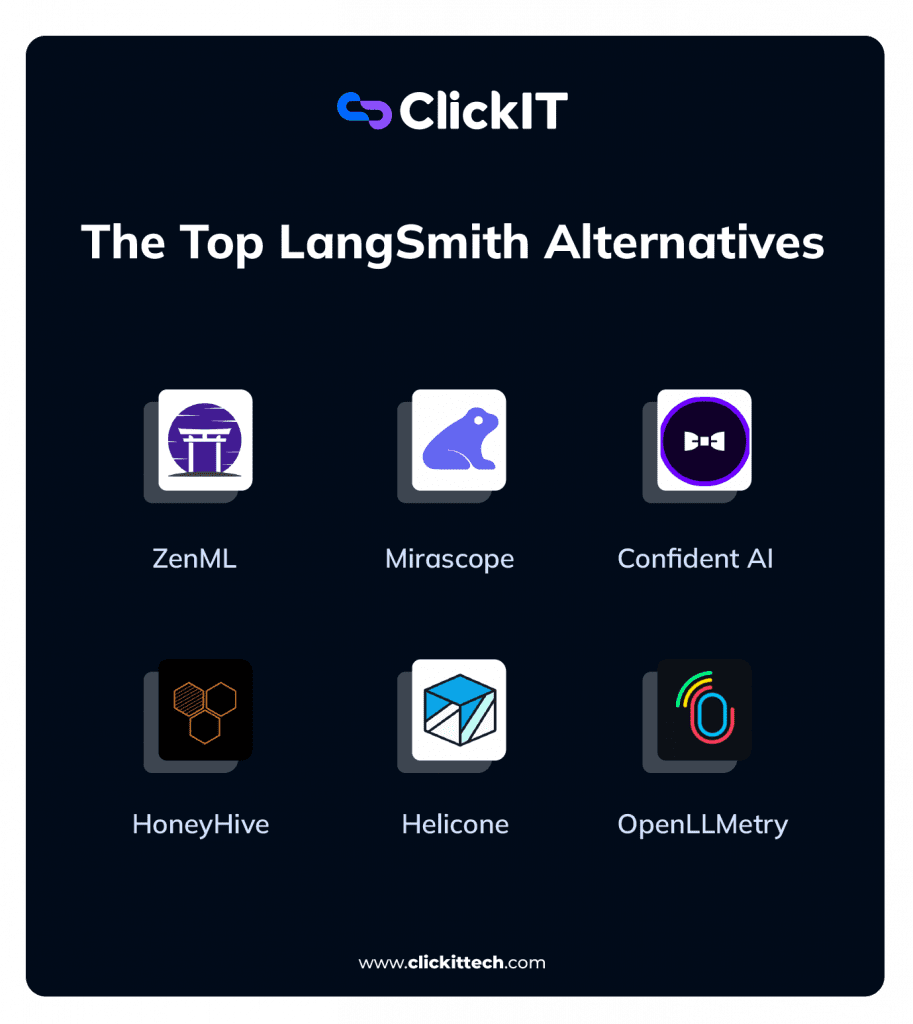
a) ZenML
ZenML is an open-source MLOps and LLMOps framework that enables teams to build, run, and manage reproducible ML and LLM workflows. Right from data ingestion and prompt engineering to model training, agent deployment, and production monitoring, ZenML orchestrates, observes, and governs the entire machine learning and large language model pipeline.
It lets you write workflows as Python pipelines, then containerizes and version-controls everything, tracks metadata, and supports flexible deployment across infrastructure backends.
Unlike siloed observability tools, ZenML treats LLM workflows as reproducible pipelines. It means we get a unified dashboard for visualizing directed acyclic graphs (DAGs), runtime metrics, artifact lineage, and evaluation results. The Apache 2.0 license allows full self-hosting and integrates seamlessly with notebooks and CI/CD systems for end-to-end traceability. ZenML is not a monolithic SaaS, but it acts as a unifying layer that wraps your entire AI stack to provide a standard, infrastructure-agnostic workflow orchestration.
Why is ZenML a good LangSmith alternative for 2026?
- Open-source & Vendor-agnostic: Unlike some commercial observability or LLM platforms, ZenML gives you full control. You avoid vendor lock-in and can host entirely on-premises or in your preferred cloud/VPC.
- Unified ML, LLM, and Agent Support: ZenML is explicitly built to support traditional ML workflows and modern LLM/agent workflows under a single framework.
- Reproducibility & Observability: It automatically tracks metadata, artifacts, logs, and even pipeline runs. This audit trail helps with debugging, evaluation, compliance, and long-term tracking.
- Flexibility and Extensibility: ZenML lets teams integrate their existing tools or swap components as needed. It supports orchestration engines of your choice, deployment to whichever infrastructure, etc.
- Scalable from prototype to production: Whether you’re building a quick proof-of-concept or deploying multi-agent LLM systems at enterprise scale, ZenML supports both, with the ability to transition pipelines from local dev to full production.
This video walks through how ZenML functions as a control layer for AI in production:
ZenML Strengths for 2026
As LLM applications evolve into complex agentic systems, regulations like expanded EU AI Act requirements for auditable AI are getting stricter. ZenML’s strengths in self-hosted governance and metadata-only tracking would be helpful for organizations to comply with these strict regulations.
Its open-source foundation enables custom retention policies, PII redaction, and integration with any cloud or on-prem infrastructure. This is where it has an edge over cloud-only tools like LangSmith, which are constrained by scale restrictions.
Going into 2026, the support for emerging agent frameworks like CrewAI and LangGraph positions ZenML as the best choice for the multi-agent era, wherein end-to-end lineage is a key requirement for safe and traceable handoffs between models.
Pro features like model control planes for version comparisons and parallel experiment analysis will scale to petabyte datasets without latency spikes. Moreover, its programmatic API enables observability to be embedded into Kubernetes-orchestrated deployments.
According to Forrester’s 2025 forecasts, 70% of enterprises would prioritize open-source AI tools for cost control. And ZenML’s zero-lock-in model and rich artifact visualizations, such as HTML previews in Jupyter, make it a future-proof bet for sustainable, compliant scaling.
ZenML Use Cases
- Compliance-Heavy Enterprises or privacy-sensitive deployments: Financial or healthcare teams building auditable LLM pipelines for regulatory reporting can use ZenML’s lineage to trace data provenance from ingestion to inference. Organizations can host data and compute in specific locations like on-premises, private cloud, and VPC for data residency or regulatory compliance.
- R&D Teams Iterating on Agents: Startups developing multi-step AI agents that require prompt versioning and regression testing to catch drifts early. (e.g. for e-commerce personalization).
- Hybrid ML/LLM Workflows: Data science groups transitioning traditional ML models to LLM-augmented systems can leverage ZenML’s unified dashboard for cross-paradigm monitoring without tool sprawl.
- Cost-Optimized Startups: Bootstrapped ventures self-hosting on AWS or GCP can avoid LangSmith’s usage fees while maintaining full observability for investor demos.
- Compliance-conscious: Compliance-conscious organizations can self-host ZenML without compromising on features.
b) Mirascope
Mirascope is an open-source Python library/framework that provides a unified, high-level interface for interacting with large language models (LLMs) across multiple providers. It supports tasks like text generation, structured output extraction, and building LLM-driven agent systems.
With a vision to make working with LLMs simple and developer-friendly, Mirascope eliminates repetitive and boring setup code while hiding complex API details behind clean abstractions. At the same time, it offers the flexibility to integrate with diverse backends and model providers, including OpenAI, Google/Vertex, Mistral, Anthropic, and Cohere.
Why is Mirascope a good LangSmith alternative?
- Unified LLM abstraction across multiple providers: Instead of writing provider-specific code, Mirascope offers a common interface that works across multiple LLM vendors. This reduces coupling to a single API and gives teams flexibility to switch or mix models without rewriting large portions of code.
- Structured-data-friendly and built-in output parsing: Mirascope supports output mapping via Pydantic models, so you can request structured data like objects or records instead of raw strings. This is especially useful for tasks requiring deterministic or predictable output like forms, data extraction, database entries, etc.
- Simplicity and developer experience (DevX): By abstracting away lower-level API calls and offering a clean Pythonic interface, Mirascope makes it easy to integrate LLM functionality.
- Flexibility, interoperability, and composability: Mirascope doesn’t enforce a monolithic SaaS or rigid workflow. As such, we can combine it with other tools like observability or logging frameworks. It doesn’t force a specific orchestration paradigm or vendor ecosystem.
Simply put, Mirascope offers a lighter-weight, flexible, provider-agnostic foundation for developing LLM applications.
Mirascope Strengths for 2026
As LLM development shifts toward agentic, multi-provider ecosystems in 2026, and as regulations demand full auditability, Mirascope’s strengths in holistic versioning and lightweight scalability make it a frontrunner in this space.
Mirascope Lilypad’s trace-first evaluation that turns every run into a reusable dataset, the support for pass/fail labeling, and upcoming LLM-as-judge automations for bias and hallucination checks give it an edge over LangSmith. Its OpenTelemetry integration future-proofs traces for export to enterprise tools like Grafana or Datadog, handling petabyte-scale logs without quotas.
With minimal overhead, it scales to edge deployments and CI/CD pipelines, while the no-code playground fosters cross-functional collaboration. This is especially helpful for non-technical stakeholders. Gartner 2025 data shows 55% of AI projects involve non-technical stakeholders.
Most importantly, pricing remains developer-friendly. The free tier supports 30k spans/month for up to 2 users. The Pro/Team plans (TBD but expected at $20-50/user/mo) unlock unlimited storage and advanced analytics, making it ideal for bootstrapped teams eyeing sustainable growth amid rising AI compute costs.
Mirascope Use Cases:
- Structured data extraction from unstructured text: Converting free-form user inputs, documents, or logs into structured data objects like JSON or typed records. This is useful for internal tools, CRM/email parsing, report generation, data ingestion pipelines, knowledge-base population, etc.
- Building backend services or APIs that leverage LLMs: Quickly build robust LLM-powered REST or RPC services, content-generation endpoints, automation agents, etc.
- Agentic systems or LLM-driven workflows: Mirascope offers a clean, composable foundation when you need to combine LLM calls, function/tool invocation, structured output, and chain multiple steps. For e.g for bots, workflow automation, or agent orchestration.
- Prototyping and iterating LLM-based features without heavy infrastructure lock-in: For teams experimenting with LLMs and building proofs of concept, Mirascope helps avoid overcommitting to a heavyweight platform too soon.
- Hybrid and multi-provider LLM strategies: Organizations that want to mix and match LLM providers for cost, performance, data-residency, or redundancy reasons can use Mirascope to write provider-agnostic LLM-calling code and make migrations or provider-switches easier.
c) Confident AI
Confident AI is a platform designed for automated evaluation, red-teaming, and validation of LLM systems. It helps teams test their AI applications for safety, reliability, performance, and compliance using customizable evaluation frameworks.
Confident AI provides synthetic test generation, scenario creation, automated scoring, and dashboards that enable teams to systematically measure how well their LLM applications behave under real-world and adversarial conditions.
Simply put, Confident AI helps you move from ad-hoc testing to continuous, automated evaluation for production-grade LLM systems.

Why Confident AI is a good LangSmith Alternative in 2026?
LangSmith’s chain-focused tracing often falls short on root-cause analysis for hallucinations or drifts. Confident AI addresses these observability gaps in production debugging and non-deterministic behaviors.
Moreover, it eliminates LangSmith’s vendor lock-in and escalating per-trace cost concerns by offering a free tier with unlimited development evaluations. It also enables seamless migration through framework-agnostic integrations like LangChain and LlamaIndex, built on its open-source DeepEval foundation.
Confident AI also addresses another concern with LangSmith which is limited custom metrics or integration silos. The platform’s LLM-as-a-judge evals and human-in-the-loop feedback automate safeguards without custom scripting.
This reduces debugging time by up to 80% in complex RAG pipelines. Moreover, its emphasis on regression testing in CI/CD pipelines counters LangSmith’s scale restrictions, ensuring reproducible experiments even as apps evolve into multi-agent systems. All this at a fraction of the cost for high-volume tracing.
Confident AI Strengths for 2026
In 2026, new regulations such as the EU AI Act and U.S. executive orders require AI systems to be auditable and capable of real-time drift detection. Confident AI supports these needs with a compliance toolkit that includes HIPAA and SOC 2 readiness, role-based access control, data masking, and U.S. and EU data residency. This makes it well-suited for high-stakes regulated industries.
Scalability with unlimited traces in premium tiers, 99.9% uptime SLAs, and optional on-prem deployments in AWS, Azure, or GCP, gives it an edge over LangSmith’s cloud-only quotas that throttle petabyte-scale logs.
Looking forward, the platform’s native support for A/B testing prompts/models, no-code workflows, and advanced filtering by user feedback or failed metrics aligns perfectly with the agentic AI boom.
Confident AI also facilitates proactive optimization amid evolving models like Anthropic’s Claude 3.5 successors. With recent 2025 enhancements in synthetic data generation and red-teaming metrics, Confident AI future-proofs against infinite query variations and performance regressions.
Gartner projects that 70% of enterprises prioritize sustainable, verifiable AI stacks. Confident AI’s async API that ensures zero-latency overhead in edge deployments becomes a key advantage for the platform.
Confident AI – Use Cases
| Confident AI – Use Cases | Tasks |
| CI/CD Regression Testing | Dev teams automating LLM unit tests to catch breaking changes in chatbot deployments, integrating DeepEval metrics directly into GitHub Actions for confident releases. |
| Production Drift Monitoring | E-commerce platforms tracing RAG pipelines in real-time, using custom faithfulness scores and alerting to flag hallucinations before they impact user trust. |
| Enterprise Compliance Workflows | Healthcare or fintech firms leveraging HIPAA-compliant tracing and human-in-the-loop annotations to audit agent decisions, ensuring alignment with business goals and regulations. |
| Cross-Functional Optimization | Product managers and engineers collaborating on A/B experiments for content generation apps, with shareable dashboards quantifying ROI through cost/latency reductions. |
| Pre-production evaluation of new models or model updates | Validate quality, safety, and reliability at scale before switching from one LLM provider to another or updating a prompt. |
Confident AI excels as a LangSmith alternative for organizations that prioritize automated evaluation, safety, compliance, and rigorous testing.
d) HoneyHive
HoneyHive is an end-to-end evaluation, monitoring, and data management platform for LLM applications. It was originally designed to streamline LLM prompt engineering workflows, but quickly evolved into a full-stack LLMOps platform. Built to help teams develop, test, fine-tune, and deploy AI systems with high reliability, it enables enterprises to scale from prototype to production with consistent quality guardrails.
The good thing about HoneyHive is that it brings synthetic data generation, prompt management, evaluation frameworks, dataset creation tools, and observability dashboards into a unified interface.
Why is it a good LangSmith Alternative in 2026?
HoneyHive addresses the pain points of LangSmith with regard to vendor lock-in and costs for multi-step workflow debugging and production-grade evaluations.
LangSmith ties users to LangChain and charges for high-volume usage that often exceeds $0.50/1,000 traces. HoneyHive’s OTLP-native ingestion works seamlessly with any orchestration framework like CrewAI, LangGraph, or custom pipelines that enable lock-free migration. It also offers cost predictability via its generous free tier of 10,000 events/month.
In addition, HoneyHive addresses observability blind spots such as real-time drift detection and human-in-the-loop grading, with features like session replays. This helps teams replay full agent sessions to pinpoint tool failures or state errors better than LangSmith.
For teams battling integration silos, HoneyHive’s async SDK and CI/CD embedding streamline workflows. This reduces debugging time by up to 70% in agent-heavy apps, per early adopter benchmarks.
Overall, it democratizes advanced evals without custom code, making it a more holistic, agent-optimized tool for lifecycle management of LLM-powered applications.
HoneyHive Strengths for 2026
Gartner predicts that by 2026, task-specific AI agents will be embedded in roughly 40% of enterprise applications, accelerating the shift toward autonomous, AI-driven enterprise automation. HoneyHive’s agent-first architecture, including RAG-specific analytics and AI-assisted root-cause analysis, makes it the right fit for verifiable, low-latency systems.
The compliance toolkit for SOC-2, GDPR, HIPAA with BAAs, and flexible hosting for multi-tenant SaaS to full on-prem helps teams comply with regulatory demands like the EU AI Act’s high-risk audits.
As agent fleets hit millions of inferences daily, HoneyHive’s scalability with unlimited events in Enterprise tiers, 99.9% SLAs, and drift alerts that integrate with Slack/Teams becomes a key advantage.
Post-2025 funding, we can expect enhancements in synthetic dataset generation from production logs and expanded metrics for emerging multi-modal agents that enable proactive optimization amid model non-determinism.
The dev-prod feedback loop that blends user engagement tracking with automated regression tests means continuous improvement to the tool. HoneyHive’s user base grew 3x in H2 2025 which implies the ecosystem is maturing.
HoneyHive Use Cases
| HoneyHive Use Cases | Tasks |
| Agent Debugging at Scale | Tech teams deploying customer support agents to thousands of users, using session replays and timeline views to trace tool invocation failures in RAG pipelines and iterate via Playground experiments. |
| E-commerce Personalization Monitoring | Retail platforms tracking LLM-driven recommendations, leveraging online evaluators for context relevance and user feedback loops to detect drifts in real-time, boosting conversion rates by 15-20%. |
| Cross-Functional Evaluation Workflows | Product and engineering groups in fintech collaborating on prompt versioning and annotation queues to ensure compliant outputs, with Git integration for seamless CI/CD testing. |
| Enterprise Compliance Auditing | Regulated industries like banking auditing agent decisions for PII leakage or bias, utilizing custom dashboards and exportable traces for regulatory reporting without data export fees. |
HoneyHive is one of the best LangSmith alternatives for teams that want deep evaluation tooling, strong synthetic data workflows, collaborative prompt management, and continuous monitoring, all within a single platform.
e) Helicone
Helicone is an open-source observability and analytics platform for LLM applications. It acts as a proxy layer that sits between your application and the LLM provider such as OpenAI, Anthropic, Google, or Mistral to capture detailed logs, metrics, traces, and cost data. Launched in 2023, the tool rapidly matured by 2025 with 4,800+ GitHub stars.
Helicone’s lightweight architecture means you can integrate it with a single API key or proxy endpoint. This is what makes it one of the easiest tools for teams to adopt for better visibility into LLM systems’ behavior.
Why is Heliconea a good LangSmith alternative in 2026?
Helicone offers similar benefits as LangSmith for logging, tracing, cost analysis, and performance monitoring. However, the difference is greater flexibility, lower friction, and an open-source-first approach.
LangSmith users often face high per-trace pricing ($0.50/1,000) and the limited gateway capabilities of LangSmith that leave teams exposed to provider outages or inefficient routing. Helicone combines seamless observability with proactive cost and performance optimization to resolve this concern.
Secondly, LangSmith’s tight integration with LangChain results in lock-in and spotty support across diverse stacks. On the other hand, Helicone’s framework-agnostic proxy works out-of-the-box with any SDK or orchestration tool, including LlamaIndex or raw API calls. It exports traces via OpenTelemetry for easy migration or hybrid setups.
Helicone fills observability gaps with built-in response caching that can reduce API costs by around 20–30% on duplicate requests, while its dashboards provide session-level insights into usage patterns and token spend. LangSmith handles these tasks reactively at extra cost.
For integration-challenged teams, Helicone’s zero-markup unified billing across providers and one-line setup eliminates silos. In addition, the generous free tier (10,000 requests/month) supports scaling without high charges. This empowers migrations that preserve historical data through bulk imports.
Helicone Strengths for 2026
McKinsey’s 2025 AI research highlights a growing shift toward multi-LLM strategies, as enterprises look to balance cost, performance, and reliability across diverse use cases. Helicone’s gateway-first design with Rust-built low-latency routing and up to 95% cost savings via semantic caching is a perfect choice for high-throughput applications demanding reliability without overhead.
Here is the Helicone AI Gateway launch video:
Its OpenTelemetry compliance ensures seamless integration with enterprise APMs like Datadog or Grafana. This addresses scale restrictions by handling millions of inferences daily with distributed rate limiting and health-aware load balancing. It surpasses LangSmith’s quota-bound cloud model.
Post-2025 enhancements that include advanced evals for agent workflows and zero-trust security (SOC-2 in Enterprise) align with regulatory shifts like expanded NIST AI RMF guidelines for auditable traces. The open-source core fosters community-driven extensions for emerging modalities like vision models.
With Pro plans starting at $20/seat/month and Team at $200/month for unlimited seats, Helicone offers predictable economics that scale with usage.
Helicone Use Cases
- Cost-Optimized Production Gateways: SaaS companies proxying traffic to multiple providers for chatbots, using Helicone’s caching and routing to reduce OpenAI bills by 25% while monitoring latency spikes in real-time.
- Failover-Enabled Agent Deployments: AI startups building resilient multi-agent systems, leveraging automatic provider switching during outages to maintain 99.9% uptime without custom failover logic.
- Developer-Led Experimentation: Engineering teams A/B testing prompts across models, with session dashboards quantifying trade-offs in cost, speed, and output quality for rapid iteration.
- Enterprise Billing Consolidation: Finance ops consolidating LLM spend from disparate vendors, tracking per-user costs and generating compliance reports via OpenTelemetry exports.
Helicone is an open-source, cost-focused LangSmith alternative ideal for teams that need transparent observability without heavy vendor lock-in.
f) OpenLLMetry
OpenLLMetry is an open-source observability framework built on OpenTelemetry, the industry standard for distributed tracing. It extends OpenTelemetry to support LLM applications for enabling structured logs, spans, metrics, and traces that integrate directly into existing observability stacks.
It brings LLM-specific instrumentation such as prompt/response events, token usage, model metadata, and evaluation metrics into the same telemetry pipeline that organizations already use for microservices, APIs, and infrastructure.
Why is OpenLLMetry a good LangSmith Alternative in 2026?
OpenLLMetry is a powerful LangSmith alternative for engineering-led teams that want enterprise-grade, vendor-neutral observability built on the OpenTelemetry standard. LangSmith’s proprietary ecosystem comes with lock-in and integration friction that often requires framework-specific wrappers or costly custom work. OpenLLMetry stands out as a LangSmith alternative by leveraging battle-tested OpenTelemetry for vendor-neutral, standards-based observability.
Secondly, LangSmith charges for traces and limits exports. On the other hand, OpenLLMetry comes with the Apache 2.0 license and is fully free. It delivers unlimited instrumentation with zero runtime overhead which means teams can pipe data into existing APM stacks for holistic monitoring. This is especially beneficial for migrations that retain lineage without data silos.
OpenLLMetry eliminates observability gaps in multi-tool setups by auto-capturing RAG-specific metrics like retrieval relevance and hallucination proxies along with full prompt/response logging. LangSmith handles this inconsistently outside LangChain.
For teams operating at scale, OpenLLMetry’s non-intrusive, OpenTelemetry-based design supports high-volume production workloads without artificial quotas, while ensuring seamless interoperability across existing observability stacks.
This approach helps reduce the engineering overhead caused by custom integrations and glue code. This is an issue consistently highlighted in Stack Overflow’s developer surveys as a major drain on developer productivity.
Here is a video that demonstrates OpenLLMetry’s capabilities for LLM observability and tracing with OpenTelemetry integration:
OpenLLMetry Strengths for 2026
CNFC surveys show that the majority of Fortune 500 companies are adopting OpenTelemetry for distributed AI tracing. OpenLLMetry’s semantic conventions for LLM attributes will enable predictive analytics in agentic systems and eventually outpace LangSmith’s siloed evals with federated dashboards across microservices.
In the recent December release of v0.49.7, OpenLLMetry added agent evaluators and RAG tooling to future-proof multi-modal workflows under regulations like the EU AI Act’s transparency mandates, with built-in support for reproducible tests and error correlation.
Its auto-instrumentation scales effortlessly to edge and Kubernetes deployments, exporting to 25+ backends without vendor fees. For optional hosted enhancements like AI-specific dashboards, you can use the Traceloop platform. This hybrid open/commercial model empowers cost-free starts with enterprise extensibility.
OpenLLMetry Use Cases
| OpenLLMetry Use Cases | Purpose |
| APM-Integrated RAG Pipelines | Data teams tracing retrieval-augmented generation flows in search apps, exporting spans to Grafana for correlating embedding latencies with final output quality. |
| Framework-Agnostic Agent Tracing | Developers building cross-framework agents (e.g., LangChain + Haystack), using auto-instrumentation to debug tool handoffs and retries in Jaeger without manual spans. |
| Compliance-Focused Audits | Regulated enterprises logging full prompt histories for bias audits, sampling traces to SigNoz for long-term retention and regulatory queries. |
| DIY Observability Startups | Bootstrapped ventures instrumenting OpenAI SDK calls, batching metrics to ClickHouse for custom cost dashboards at zero marginal cost. |
OpenLLMetry best suits organizations that want LLM tracing integrated directly into their existing DevOps and monitoring stack rather than relying on a proprietary SaaS platform.
g) Langfuse
Langfuse is an open-source LLM observability and evaluation platform focused on tracing, prompt versioning, and feedback-driven improvement for LLM applications. It captures end-to-end traces of prompts, responses, costs, latency, and user feedback, making it especially popular for production LLM apps that require tight feedback loops.
Unlike LangSmith’s LangChain-centric approach, Langfuse is framework-agnostic and integrates cleanly with LangChain, LlamaIndex, custom pipelines, and raw API calls. It supports self-hosting and OpenTelemetry-style exports, which makes it attractive to teams that want control over data residency and retention.
Why Langfuse is a good LangSmith alternative for 2026
Langfuse solves three major pain points teams hit with LangSmith: lock-in, opaque pricing, and limited production feedback loops.
First, Langfuse is open source and self-hostable, allowing teams to keep sensitive prompts, traces, and user data inside their own infrastructure—critical for healthcare, fintech, and regulated environments. Second, its first-class feedback objects (human, heuristic, or LLM-based) make it easier to operationalize continuous improvement instead of treating evals as offline experiments.
LangSmith excels at development-time tracing, but Langfuse bridges the gap between production usage and evaluation, turning real user interactions into training signals.
Langfuse Strengths for 2026
As LLM systems evolve into long-running agent workflows, Langfuse’s session-level tracing and cost attribution become essential. Its ability to correlate user actions → agent decisions → tool calls → outcomes aligns well with upcoming auditability requirements from the EU AI Act and internal governance teams.
By 2026, most serious LLM apps will need to justify cost, quality, and impact in near real time. Langfuse’s native cost tracking, latency breakdowns, and feedback aggregation make it one of the most pragmatic LangSmith alternatives for production-first teams.
Langfuse Use Cases
- Production monitoring for chatbots and AI copilots
- Feedback-driven prompt and agent optimization
- Cost and latency attribution per user, feature, or model
- Self-hosted observability for regulated industries
h) Phoenix
Phoenix is an open-source observability and evaluation framework originally built by Arize AI, designed specifically for debugging, evaluating, and improving LLM applications such as RAG systems and agents.
Phoenix focuses heavily on offline analysis, dataset-driven evaluation, and root-cause debugging rather than live production tracing. It integrates well with Jupyter notebooks and data science workflows, making it popular among ML engineers and research-oriented teams.
Why Phoenix is a good LangSmith alternative for 2026
LangSmith is optimized for developer workflows inside LangChain. Phoenix, on the other hand, excels at deep inspection of failures—especially hallucinations, retrieval errors, and grounding issues in RAG pipelines.
Phoenix shines when teams need to answer questions like:
- Why did this answer hallucinate?
- Was the failure caused by retrieval, ranking, or generation?
- Which documents consistently degrade output quality?
For 2026, as RAG pipelines become more complex and multi-stage, Phoenix’s dataset-centric debugging approach becomes more valuable than raw trace counts.
Phoenix Strengths for 2026
Phoenix’s semantic clustering, embedding-based error analysis, and eval visualizations are particularly useful for LLM quality assurance at scale. As enterprises shift toward pre-deployment validation and continuous regression testing, Phoenix complements LangSmith by covering the “why did it fail?” layer.
Its open-source nature and tight integration with Python, Pandas, and notebooks make it ideal for teams that treat LLMs as evolving models—not just APIs.
Phoenix Use Cases
- RAG quality evaluation and debugging
- Hallucination root-cause analysis
- Dataset-driven LLM evaluation
- Research-heavy or ML-first teams
i) SigNoz (with OpenTelemetry / OpenLLMetry)
SigNoz is an open-source, OpenTelemetry-native observability platform used for logs, metrics, and distributed tracing. While not LLM-specific by default, SigNoz becomes a powerful LangSmith alternative when paired with OpenLLMetry or custom LLM instrumentation.
This combination allows teams to monitor LLM systems using the same observability stack they already use for microservices, APIs, and infrastructure.
Why SigNoz is a good LangSmith alternative for 2026
LangSmith operates as a siloed SaaS observability tool. SigNoz, when fed LLM traces, enables unified observability across the entire system—frontend, backend, vector databases, retrievers, and LLM calls.
For large engineering organizations, this is a decisive advantage. Instead of switching dashboards, teams can correlate:
- API latency spikes
- Vector DB failures
- LLM token usage
- Agent retries
All in one place.
SigNoz Strengths for 2026
As enterprises converge on OpenTelemetry as the standard, SigNoz becomes a natural home for LLM observability. Its ClickHouse-based backend supports high-volume traces at a fraction of the cost of SaaS tools, making it suitable for millions of daily LLM calls.
In regulated or cost-sensitive environments, SigNoz + OpenLLMetry is often more sustainable than LangSmith’s per-trace pricing.
SigNoz Use Cases
- End-to-end observability for AI-powered platforms
- Correlating LLM behavior with infra and API performance
- Long-term retention for compliance and audits
- Teams standardizing on OpenTelemetry
j) Maxim
Maxim is a developer-focused platform for evaluating, testing, and iterating on LLM applications, with a strong emphasis on prompt experiments, comparisons, and regression testing.
Where LangSmith focuses on tracing execution paths, Maxim focuses on decision quality: comparing prompts, models, and configurations to understand which changes actually improve outcomes.
Why Maxim is a good LangSmith alternative for 2026
LangSmith’s evaluation features are tightly coupled to LangChain runs. Maxim decouples evaluation from orchestration, making it easier to test prompts and models independently of runtime architecture.
This makes Maxim especially appealing for:
- Teams running frequent prompt experiments
- Organizations with strict release gates
- CI/CD-driven LLM development
Maxim treats prompts and model configs as versioned artifacts, similar to code.
Maxim Strengths for 2026
As LLM development matures, prompt changes will increasingly require the same rigor as code changes. Maxim’s experiment tracking, side-by-side comparisons, and regression testing align well with this shift.
By 2026, most production LLM teams will need deterministic ways to answer: Did this change actually improve quality? Maxim is built for exactly that question.
Maxim Use Cases
- Prompt and model A/B testing
- Regression testing before production releases
- CI/CD-integrated LLM evaluations
- Teams optimizing quality over raw observability
How these tools fit together (editorial note you may want to add)
By 2026, no single tool fully replaces LangSmith. The market is clearly fragmenting into layers:
- Tracing & observability: Langfuse, Helicone, SigNoz
- Evaluation & testing: Confident AI, HoneyHive, Maxim, Phoenix
- Standards-based telemetry: OpenLLMetry
This modular stack is exactly where the ecosystem is heading—and why LangSmith is no longer the default choice for serious, large-scale LLM systems.
LangSmith Vs LangSmith Alternatives Comparison Table
| Tool | Tracing | Multi-Agent Support | Open-Source | Pricing (2026 Projections) | Best for (Startups vs Enterprises) | Deployment Options | Ecosystem Integrations |
| LangSmith | Excellent chain-level spans; input/output capture | Strong via LangGraph; workflow debugging | No (Proprietary) | Free (5k traces/mo); $39/user/mo + $0.50/1k traces | Startups (prototyping ease); Enterprises (LangChain lock-in) | Cloud-only (AWS-hosted) | LangChain/LangGraph; limited (OpenAI, some vector DBs) |
| ZenML | Pipeline lineage & DAG visualization; artifact tracking | High; supports CrewAI/LangGraph agents | Yes (Apache 2.0) | Free core; Pro $99/mo (unlimited pipelines) | Balanced; Startups (free self-host); Enterprises (governance) | Self-host (Docker/K8s), cloud | MLOps (MLflow, Kubeflow); LLM (LlamaIndex, Evidently); OTEL |
| Mirascope | Full-code snapshots & prompt versioning via Lilypad | Moderate; workflow closures for agents | Yes (MIT) | Free (30k spans/mo); Pro $20-50/user/mo | Startups (dev ergonomics); Early enterprises (reproducibility) | Self-host (Postgres/Docker) | Providers (OpenAI/Anthropic); OTEL; Jupyter/no-code playground |
| Confident AI | RAG-specific & production traces; 30+ metrics | High; regression testing for agent pipelines | Yes (DeepEval core) | Free dev evals; Growth $99/mo (1M traces) + usage | Enterprises (compliance focus); Startups (CI/CD ease) | Cloud (multi-region), on-prem (AWS/Azure/GCP) | LangChain/LlamaIndex; CI/CD (GitHub Actions); HIPAA tools |
| HoneyHive | Session replays & execution graphs; agent timelines | Excellent; RAG/agent integrity checks | No (Proprietary) | Free (10k events/mo); Team $99/mo unlimited | Enterprises (agent reliability); Mid-stage startups (funding-backed) | SaaS (multi-tenant), on-prem | OTLP/OTEL; Git; Slack/Teams; 50+ metrics (hallucination/bias) |
| Helicone | Proxy-based session analytics; latency/cost logs | High; routing for multi-provider agents | Yes (Core MIT) | Free hobby; Pro $20/seat/mo; Team $200/mo | Startups (cost savings); Enterprises (unified billing) | Self-host (Docker), cloud proxy | 00+ providers; OTEL; Slack alerts; caching/routing SDKs |
| OpenLLMetry | OTel semantic spans; auto-instrument RAG/agents | High; error correlation in workflows | Yes (Apache 2.0) | Free (fully open); Optional hosted $50/mo | DevOps teams; Startups (DIY); Enterprises (APM federation) | Self-host (any OTel backend) | Frameworks (LangChain/Haystack); Backends (Jaeger/Grafana/Datadog); 25+ exporters |
| Langfuse | End-to-end session tracing; feedback & cost attribution | High; agent sessions & tool-call visibility | Yes (Open-core) | Free OSS; Cloud Pro ~$29–49/mo (est.) | Startups (prod feedback loops); Enterprises (self-hosting) | Self-host (Docker/K8s), SaaS | LangChain, LlamaIndex, OTEL exports, Slack |
| Phoenix | Dataset-driven traces; embedding & failure clustering | Moderate–High; RAG & agent debugging | Yes (Apache 2.0) | Free (open-source) | ML teams; research-heavy orgs | Local / self-host | Jupyter, Pandas, Arize stack, LangChain |
| SigNoz | Full-stack distributed tracing via OTEL | High (via OpenLLMetry instrumentation | Yes (Apache 2.0) | Free OSS; Cloud ~$49–199/mo | Enterprises standardizing observability | Self-host, managed cloud | OpenTelemetry, ClickHouse, Kubernetes, LLM stacks |
| Maxim | Experiment-level traces; prompt/model comparisons | Moderate; agent output regression testing | No (Proprietary) | Free tier; Pro ~$30–60/user/mo (est.) | Product & platform teams | SaaS | CI/CD, model providers, prompt registries |
What to look for in LangSmith Alternatives in 2026?
As we enter 2026, AI systems will continue to become more complex with multi-step agents, RAG pipelines, customizable evaluation needs, and enterprise governance requirements.
According to Elastic’s 2026 Observability Report, 60% of enterprises will prioritize maturity in tracing and evals to drive business value, up from 2025 baselines. As such, choosing the right LLM observability and evaluation platform in 2026 is not easy. LangSmith alternatives must deliver proactive insights, interoperability via OpenTelemetry, and defenses against hallucinations in RAG pipelines.
Below are the key capabilities and qualities of the best LangSmith alternatives.
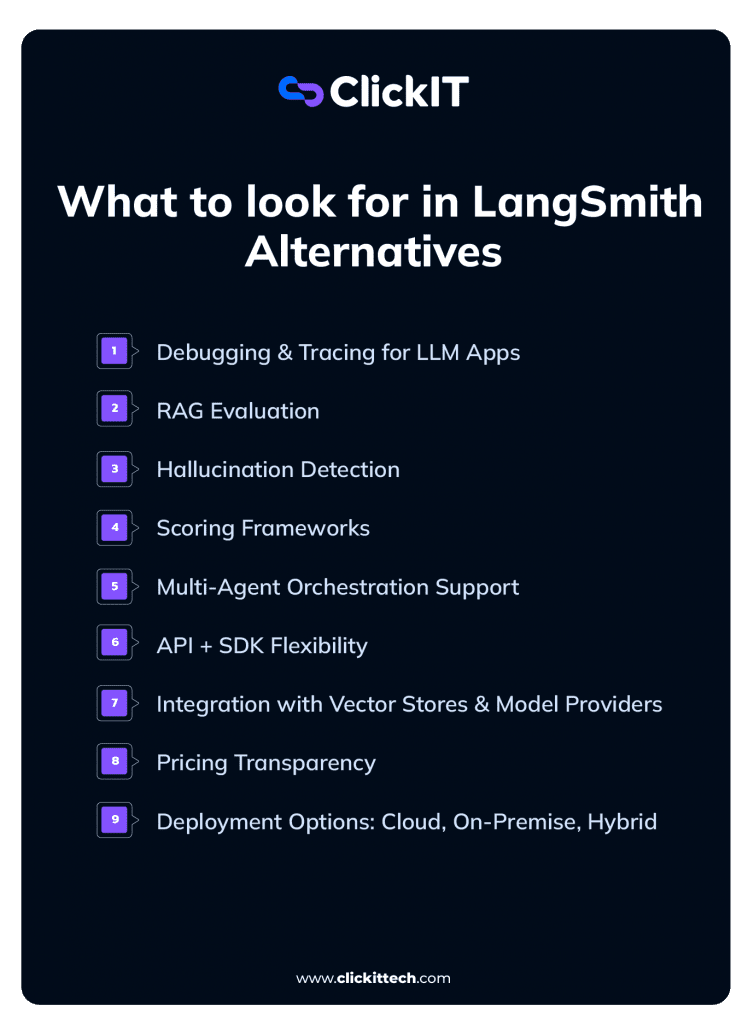
a) Debugging & Tracing for LLM Apps
LLM systems aren’t like traditional APIs. The outputs vary with prompt changes, model versions, and context windows.
When things go wrong, teams need fine-grained visibility into what happened:
- What prompt was sent?
- Which model version ran?
- How many tokens were used?
- What steps did an agent take before producing a result?
So, check out these debugging and tracing features:
- Token-level traces
- Full request/response logging
- Contextual breadcrumbs for multi-step workflows
- Visualization of execution flow
- Correlation with downstream services (e.g., database calls, tool integrations)
The idea is to achieve faster debugging, higher reliability, and clearer accountability across development and production stages.
b) Evaluation Tools (RAG Evaluation, Hallucination Detection, Scoring Frameworks)
In 2026, LLM evaluation goes beyond accuracy. It includes hallucination detection, relevance scoring, context alignment, safety metrics, and fairness checks. Enterprises need automated and human-in-the-loop mechanisms to assess quality reliably.
What to look for:
- Relevance and coverage metrics for RAG systems
- Hallucination detection and alerts
- Customizable scoring frameworks (BLEU, ROUGE, embedding similarity, human scoring integration)
- Red-teaming and adversarial test support
- Dataset versioning and evaluation dashboards
Improved trust and quality control across production AI systems is the key.
c) Multi-Agent Orchestration Support
Many modern AI workflows are multi-agent by design and invoke planners, tool-using agents, RAG retrievers, and chain LLM calls. Observability and instrumentation must reflect this complexity.
So check out for:
- Instrumentation that captures each agent’s step
- Support for agent workflows (e.g., task planners, tool execution)
- Logging of intermediate outputs
- Correlated traces across agents
The goal is better insight into complex logic flows, easier error diagnosis, and more predictable system behavior.
d) API + SDK Flexibility (Python, JS, TypeScript)
Teams today build LLM-powered products across multiple languages and runtimes. Normally, developers use Python for backend services, TypeScript for frontend orchestration, and JavaScript to build dashboards.
So look for:
- First-class SDK support in Python
- Official JS/TS SDKs for web and serverless apps
- Flexible REST or gRPC APIs
- Client-side observability where needed
Faster adoption, fewer integration bottlenecks, and consistent developer experience across stacks are the key here.
e) Integration with Vector Stores & Model Providers
LLM apps rarely exist in isolation. They depend on vector databases, retrievers, caching layers, fine-tuning pipelines, and multiple model providers. Tooling that doesn’t integrate here becomes a bottleneck.
What to look for:
- Plug-and-play integration with major vector stores (e.g., Pinecone, Milvus, Weaviate)
- Support for multiple model vendors (OpenAI, Anthropic, Mistral, GPT-style open models)
- Retriever evaluation and traceability
- Data lineage and dataset management
The idea here is to reduce engineering overhead and build a more cohesive development ecosystem.
f) Pricing Transparency
Unpredictable billing can eat up your revenues in a quick time. Transparent pricing is essential for budgeting and cost control, especially for high-volume workloads or frequent evaluation/testing pipelines.
So look for:
- Clear, predictable pricing tiers
- Token-based and usage-based breakdowns
- Avoidance of opaque per-trace or per-dashboard fees
- Predictive cost estimates
The key here is better financial planning and ROI measurement for AI investments.
g) Deployment Options: Cloud, On-Premise, Hybrid
Not all organizations are comfortable sending sensitive or regulated data to third-party clouds. Flexibility in deployment models is critical for compliance, performance, and corporate governance.
So look for:
- Fully managed cloud SaaS
- On-premise or private VPC deployment
- Hybrid options with secure gateways
- Data residency guarantees
The goal is broader enterprise adoption and alignment with security policies.
FAQs
LangSmith is still a solid option in 2026, especially for teams deeply embedded in the LangChain ecosystem. However, in 2026, many organizations are looking to supplement or replace LangSmith with more flexible, open, or enterprise-aligned tools. The concerns are its constraints around pricing, deployment flexibility, and vendor lock-in.
Startups should prioritize speed, simplicity, and cost efficiency. LangSmith alternatives like Mirascope or Helicone fit into this space. On the other hand, enterprises need to consider governance, compliance, deployment flexibility, and integration with existing infrastructure. ZenML, HoneyHive, Confident AI, or OpenLLMetry are more suitable for this purpose.
For bootstrapped startups expecting 1M+ inferences per month, OpenLLMetry is a good choice. Its OTel foundation handles petabyte logs at zero cost by federating to free backends like SigNoz or self-hosted ClickHouse.