Building an AI strategy without auditing your data is like dropping a Ferrari engine into a chassis with no wheels. You have immense processing power under the hood, but you aren’t going anywhere.
For Chief Technology Officers (CTOs), engineering leaders, and data architects, the success of any enterprise AI deployment, whether it’s a fine-tuned LLM, an autonomous agent, or a Retrieval-Augmented Generation (RAG) system, hinges entirely on one factor: data quality for AI.
If your data is fragmented, dirty, or locked away in inaccessible formats, your AI will be slow, inaccurate, and prone to hallucinations.
To determine if your current tech stack can actually handle the demands of production-ready AI or if you are standing on a mountain of technical debt, you need a rigorous infrastructure diagnosis.
This comprehensive technical blueprint outlines the specific data-quality questions, architecture checklists, and performance benchmarks you must run to establish the overall sanity of the infrastructure.
Phase 1: The Core Data & Infrastructure Diagnosis
The objective of this phase is straightforward: determine whether your current technological foundation can support modern AI workloads or if critical engineering debt will stall your initiatives before they launch.
1.1 Context Questions for Stakeholders
Before writing a single line of model code, sit down with your Software Architects, Security Officers, and Data Leads to answer these eight foundational data quality questions.
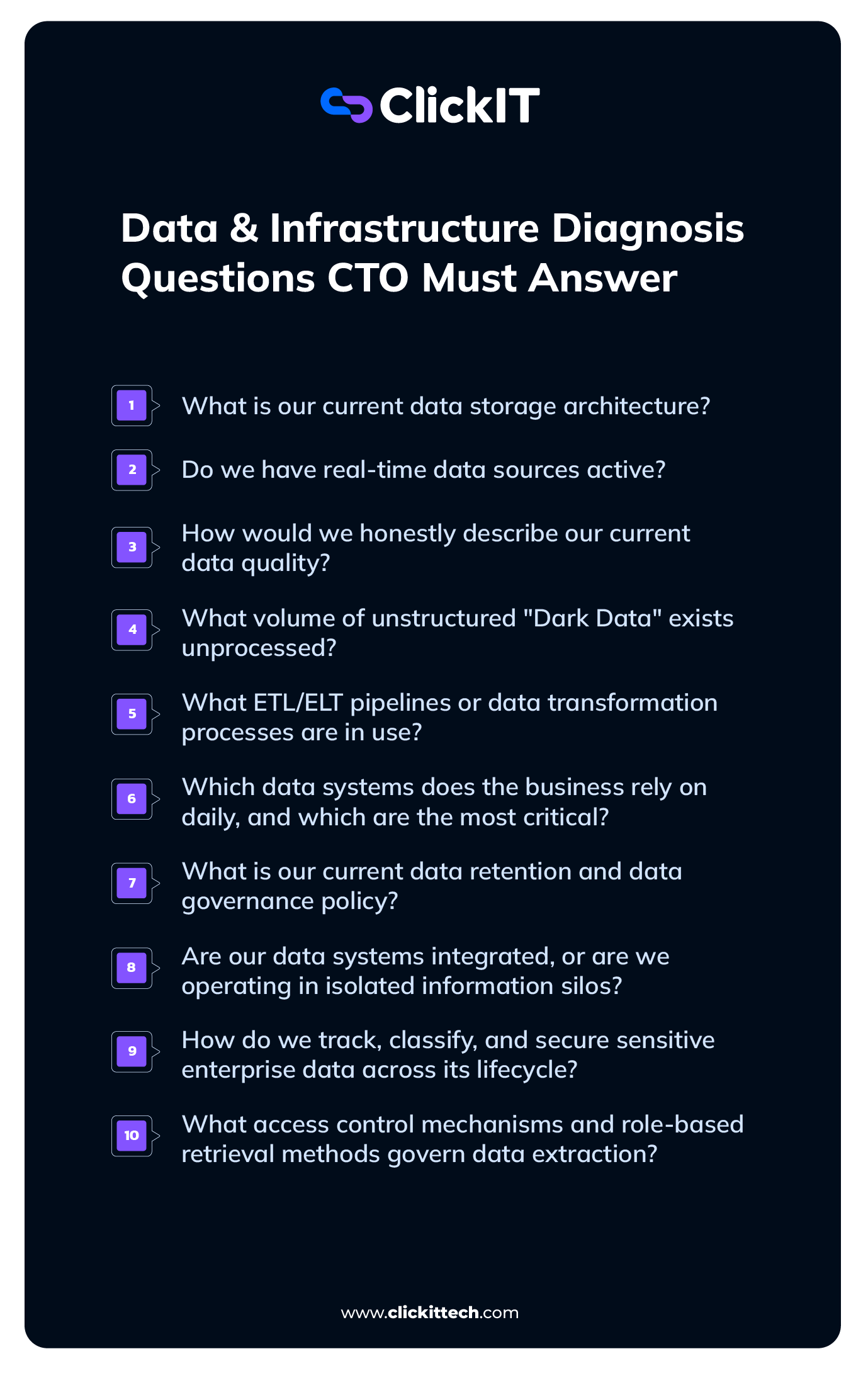
1. What is our current data storage architecture?
Are you relying on legacy relational databases (SQL), document stores (NoSQL), distributed data lakes (such as AWS S3 or Azure ADLS), or modern hybrid data lakehouses (such as Snowflake or Databricks)? Modern AI workloads, especially semantic search, will ultimately require a strategy for vector databases (such as Pinecone, Milvus, or pgvector) to store and query high-dimensional embeddings efficiently.
2. Do we have real-time data sources active?
Does your business generate event-driven data streams? Look for message brokers like Apache Kafka, AWS Kinesis, or Google Cloud Pub/Sub. If your AI applications require live, up-to-the-minute context (such as fraud detection or real-time inventory tracking), your ingestion pipelines must support stream processing rather than simple overnight batch updates.
3. How would we honestly describe our current data quality?
Be brutally honest here. Is your data well-structured, thoroughly documented, and strictly typed? Or is it inconsistent, plagued by duplicate records, missing schemas, and completely unstandardized? AI data quality requires strict data contracts. If human developers struggle to parse your data, an AI model will find it impossible.
4. What volume of unstructured “Dark Data” exists unprocessed?
Dark Data refers to massive pools of operational data that are collected but left unused. Think of legal PDFs, customer support emails, server logs, employee Slack/Teams chats, and markdown documentation. Unstructured data is an absolute goldmine for training specialized LLMs or powering corporate RAG systems, but only if you have a strategy to extract, chunk, and embed it.
5. What ETL/ELT pipelines or data transformation processes are in use?
Map out your current Extract, Transform, Load (ETL) architecture. Are your transformations handling data clean-up efficiently? Are you using modern tools like dbt (Data Build Tool) or Airflow? To feed an AI pipeline, your transformations must be deterministic, highly observable, and scalable under high compute loads.
6. Which data systems does the business rely on daily, and which are the most critical?
Identify your true sources of truth (e.g., Salesforce for CRM, SAP for ERP, custom internal databases). Your AI should interface directly with your highest-value systems, meaning those core applications must expose reliable APIs or data-sharing endpoints without compromising operational performance.
7. What is our current data retention and data governance policy?
AI models must comply with frameworks such as GDPR, CCPA, and HIPAA. Do you have automated systems to purge data when a user exercises their “right to be forgotten”? If your data retention policies are non-existent, you risk leaking sensitive, outdated, or legally protected information straight into your AI model’s generation context.
8. Are our data systems integrated, or are we operating in isolated information silos?
If your marketing data cannot talk to your product usage data because they live in isolated systems with no shared identifiers, your AI will have a fragmented, incomplete view of your business. AI thrives on cross-functional context; bridging these data silos is a mandatory prerequisite.
9. How do we track, classify, and secure sensitive enterprise data across its lifecycle?
Identify where PII, PHI, proprietary IP, and confidential metrics live, how they are classified, and how their data lineage (traceability) is audited. AI agents and LLMs inherit the security boundaries of the data they ingest.
If sensitive information lacks granular security tags and lineage tracking, AI models risk leaking protected context during prompt generation or retrieval.
10. What access control mechanisms and role-based retrieval methods govern data extraction?
In enterprise environments, data retrieval is rarely a simple database query; it is tied to complex authorization flows. Audit whether your data sources enforce Role-Based Access Control (RBAC) or Attribute-Based Access Control (ABAC). When building AI applications (like RAG systems), the retrieval mechanism must respect these user-level permissions.
Discover ClickIT’s Data Engineering Solutions
Phase 2: The Practical AI Data Audit Checklist
Once you have gathered the architectural context, use this operational audit framework to grade your technical readiness.
| Data Component | Status | Readiness Evaluation | Strategic Action Item |
| Cold Storage Type (e.g., S3, Azure Blob, SQL DBs) | ☐ Present ☐ Absent | ☐ RAG Ready ☐ Not Ready | Ensure historical data is clean and accessible via secure IAM roles for batch embedding generation. |
| Hot Data Streams (e.g., Live Event Streams) | ☐ Present ☐ Absent | ☐ RAG Ready ☐ Not Ready | Mandatory if your AI needs to act on live data. Requires real-time stream ingestion tooling. |
| Dark Data Identified (e.g., PDFs, Email, Chats, Logs) | ☐ Yes ☐ No | ☐ ETL Pipeline ☐ Missing Pipeline | Implement OCR and specialized document parsing pipelines (e.g., Unstructured.io) to extract text. |
| Data Standardization (Schemas, Validation) | ☐ High ☐ Medium ☐ Low | ☐ Production Ready ☐ Requires Cleanup | Eliminate duplicate entries and null values. Build strict data validation checks into your pipeline. |
| System Integrations (Internal & External Connections) | ☐ REST / GraphQL ☐ Direct DB Access ☐ No Integration | ☐ Ready ☐ Technical Debt | Avoid exposing raw, direct DB connections to AI apps. Wrap data access layers behind secure, rate-limited APIs. |
Phase 3: The Latency Audit: Why Speed Dictates Quality
When dealing with data pipelines for AI, latency is a core component of quality. Clean data is completely useless if it arrives too late to be actionable.
If your data engineering pipelines cannot fetch, process, and deliver context to your AI models within millisecond windows, your user experience will collapse. Track these three critical performance benchmarks:
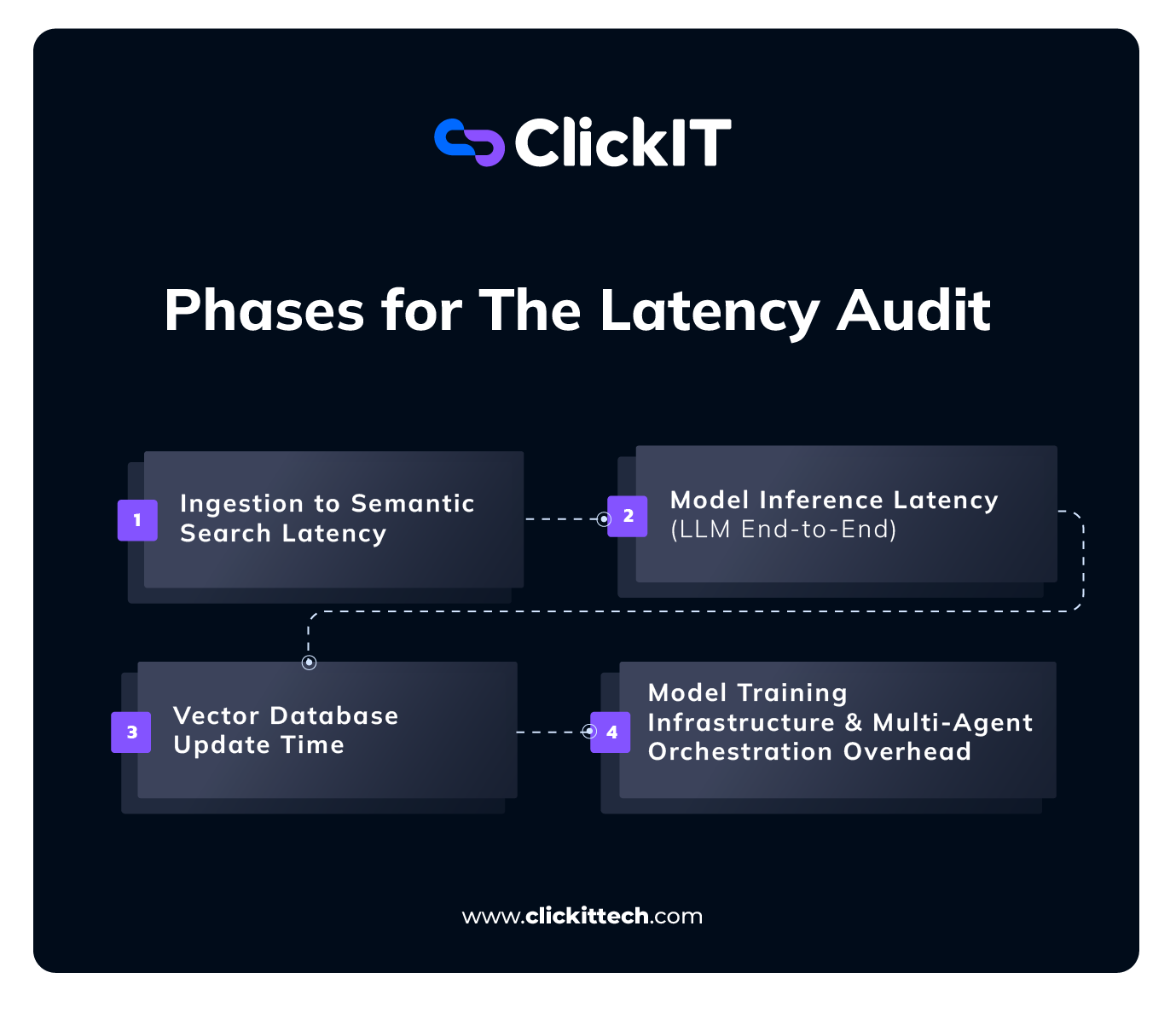
1. Ingestion to Semantic Search Latency
- Recommended Threshold: Less than 200ms for real-time applications.
- The Technical Reality: This measures the exact time it takes for a new data point to enter your system, get converted into a vector embedding by an embedding model, and become indexable/searchable within your vector database. If this process takes hours, your AI will consistently answer prompts with outdated information.
2. Model Inference Latency (LLM End-to-End)
- Recommended Threshold: Less than 3 seconds for interactive, fluid user conversations.
- The Technical Reality: This is the time spanning from the user pressing “Submit” to the first token appearing on screen. If your data fetching layer (the time spent running semantic searches and pulling context) takes 2.5 seconds, you leave your LLM virtually no time to generate its response without causing massive user frustration.
3. Vector Database Update Time
- Recommended Threshold: Batch schedules (e.g., hourly/nightly) are acceptable only if your specific business case does not explicitly require live updates.
- The Technical Reality: If your AI assists support agents with shifting product inventories or volatile pricing, batch updates will cause your AI to confidently hallucinate incorrect data. Match your index refresh rate directly to the velocity of your underlying data.
4. Model Training Infrastructure & Multi-Agent Orchestration Overhead
- Recommended Threshold: Low-latency GPU/TPU interconnects (e.g., NVLink) and sub-second orchestration response times for multi-step agent execution loops.
- The Technical Reality: Audit whether your organization trains custom base models, runs fine-tuning pipelines, or deploys autonomous “deep agents.” Fine-tuning and custom training require dedicated compute clusters and high-throughput data pipelines to avoid training bottlenecks. Furthermore, if you are building complex agentic systems where an agent plans, executes tool calls, and reflects iteratively, each internal loop adds compounding network and processing latency. Without high-performance compute infrastructure and optimized multi-agent frameworks, your agent’s time-to-resolution will degrade rapidly.
Read the blog: How does a CTO justify an AI investment
Phase 4: Summarizing Infrastructure Sanity
Before allocating budget to expensive model training or prompt engineering, use this scorecard panel to rate your technical debt.
The Red Line Rule: If more than two components below are marked as Critical or Improvable, freeze your scaling plans immediately. Divert your engineering resources to stabilizing data pipelines before touching an AI framework.
Data Pipeline Stability
- Status: ☐ Solid | ☐ Improvable | ☐ Critical
- Identified Technical Debt: ___________________________________________
Storage & Vector Readlines
- Status: ☐ Solid | ☐ Improvable | ☐ Critical
- Identified Technical Debt: ___________________________________________
Integration & API Security
- Status: ☐ Solid | ☐ Improvable | ☐ Critical
- Identified Technical Debt: ___________________________________________
Baseline Data Quality & Schema Hygiene
- Status: ☐ Solid | ☐ Improvable | ☐ Critical
- Identified Technical Debt: ___________________________________________
Real-Time RAG Capacity
- Status: ☐ Solid | ☐ Improvable | ☐ Critical
- Identified Technical Debt: ___________________________________________
Data Quality Audit Final Verdict
Fixing data pipelines retroactively is easily ten times more expensive than addressing them upfront. If you build AI tools on top of an unverified data swamp, your developers will waste hundreds of hours chasing down model bugs that are actually just data errors in disguise.
By systemically answering these architectural questions, mapping your latencies, and aggressively tackling your technical debt today, you ensure that your organization’s AI initiatives are built on rock-solid, production-grade infrastructure. Clean up your data first; your models will thank you.
FAQs about Data Quality Audit
A data quality audit is a structured review of your data for accuracy, completeness, consistency, freshness, and relevance. It matters because AI systems only perform well when they’re trained and fed with reliable data.
Your data is AI-ready when it is clean, well-governed, consistently formatted, and representative of the real-world problem you want AI to solve. If key fields are missing, duplicated, outdated, or inconsistent, you likely need an audit first.
A CTO should ask whether the data is accurate, where it comes from, who owns it, how often it changes, and whether it reflects the business use case. These questions help prevent building AI on weak or biased data foundations.
Poor data quality can cause inaccurate predictions, biased outputs, unstable models, and higher maintenance costs. Even the best AI architecture will fail if the underlying data is noisy, incomplete, or inconsistent.