Planning your engineering team’s training and travel budget is tough today. Half the tech calendar has rebranded around generic generative AI hype. Consequently, VPs of Data and Data Architects must filter out high-level marketing expos. Instead, they need data engineering conferences that prioritize distributed systems, data pipelines, open table formats, and governance.
Artificial intelligence is undeniably reshaping modern data stacks. However, the core engineering challenges remain rooted in scalability, reliability, and cost control. Below is a curated guide to the best data engineering conferences and big data conferences for 2027. We also break down the industry shifts and technical themes dominating these agendas.
Data Engineering Trends in 2027: AI Readiness, Open Formats, and FinOps
The role of the data engineering team has fundamentally expanded. Previously, data platforms existed primarily to feed historical business intelligence dashboards. Today, they serve as the real-time operational backbone for enterprise AI agents and Retrieval-Augmented Generation (RAG) systems. As a result, data engineers must build governed ingestion pipelines for unstructured data like PDFs, logs, and audio. Meanwhile, they still maintain traditional structured SQL workloads.
At the same time, enterprise architecture is pushing hard toward storage interoperability. Organizations are actively moving away from closed, proprietary data formats. Instead, they are adopting open standards that prevent vendor lock-in. Furthermore, these standards allow multiple compute engines to query the exact same data layer.
Finally, financial and operational scrutiny is at an all-time high. After years of rapid cloud expansion, 2027 L&D and infrastructure budgets prioritize FinOps and pipeline reliability. Therefore, data engineering conferences in 2027 focus heavily on upstream governance rather than experimental tooling.
Best Data Engineering Conferences for 2027
Here are the best data engineering conferences to put on your 2027 roadmap. We ordered them by ecosystem impact, architectural depth, and technical relevance.
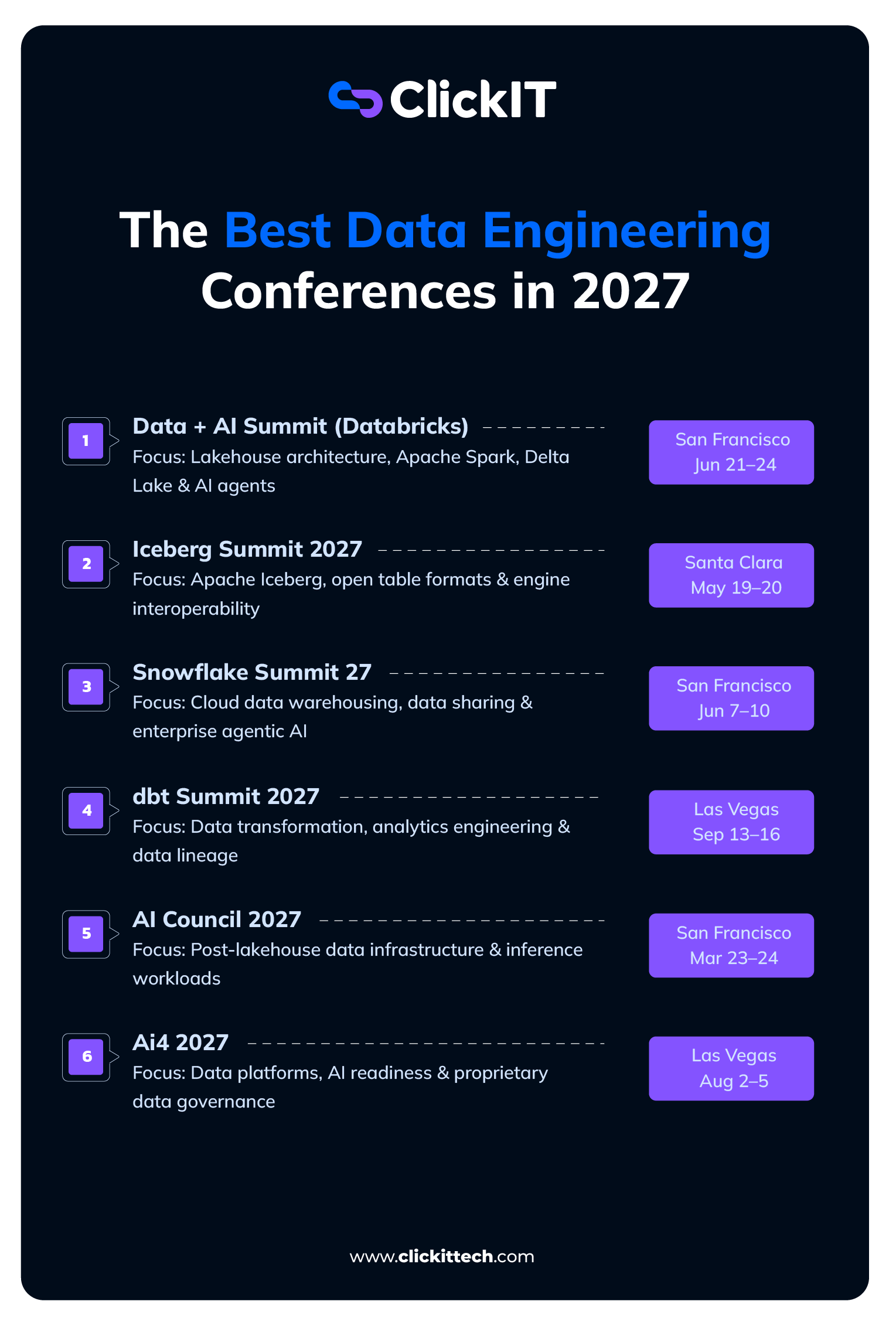
1. Data + AI Summit (Databricks)
- Dates: June 21–24, 2027
- Location: Moscone North, West, and South (San Francisco, CA) + Virtual
- Best for: Data engineers, AI/ML engineers, data scientists, app developers, database administrators, and IT decision-makers.
- Core focus: This event covers the full spectrum of data intelligence, from data engineering and governance to analytics and AI agents. Specifically, technical tracks explore Delta Lake, Apache Iceberg, Apache Spark, MLflow, Unity Catalog, Lakeflow, and Databricks SQL. You will also find sessions on Databricks Apps, Lakebase, DSPy, LangChain, PyTorch, dbt, and Trino.
- Why attend: Even with “AI” in its title, Databricks’ flagship data engineering conference remains the epicenter for Lakehouse architecture. Attendees get access to over 800 technical sessions, hands-on labs, and onsite certifications. Additionally, you can network with practitioners from 160+ countries alongside speakers from OpenAI, Anthropic, Microsoft, and NVIDIA.
2. Iceberg Summit 2027
- Dates: May 19–20, 2027
- Location: Santa Clara, CA
- Best for: Data engineering professionals, data architects, and platform leaders evaluating storage engines.
- Core focus: Sessions center on Apache Iceberg and open table formats. Key topics include REST catalog capabilities, compaction, engine interoperability, migration strategies, and performance tuning. Furthermore, tracks cover multi-engine deployments, schema evolution, and cross-cloud architectures.
- Why attend: Endorsed by the Apache Software Foundation, this focused two-day data engineering conference serves teams decoupling storage from compute. It features 75+ deep technical sessions, core maintainer roadmaps, and real-world scalability case studies. Consequently, it delivers high engineering value without enterprise sales fluff.
3. Snowflake Summit 27
- Dates: June 7–10, 2027
- Location: Moscone Center (San Francisco, CA)
- Best for: Enterprise data architects, analytics leaders, and engineering teams scaling cloud data platforms.
- Core focus: The agenda highlights enterprise data warehousing, cross-cloud data sharing, and open table format interoperability. Moreover, it explores how to operationalize enterprise agentic AI (“Making AI Real for Business”).
- Why attend: Across four days, this flagship among big data conferences offers 500+ sessions, hands-on labs, and certification tracks. It is essential for teams running Snowflake in production. Specifically, it clarifies how modern cloud warehouses support open storage standards and heavy AI workloads.
4. dbt Summit 2027
- Dates: September 13–16, 2027 (tentative; early event headers also list September 15–18)
- Location: Las Vegas, NV (waitlist details list Resorts World; initial headers list The Cosmopolitan)
- Best for: Analytics engineers, data modelers, data platform leads, and BI teams.
- Core focus: The official 2027 agenda and role tracks are not published yet. However, dbt’s flagship data engineering conference historically anchors the industry conversation around data transformation. Expect deep dives into modular SQL/Python modeling, automated testing, and data lineage.
- Why attend: Joining the 2027 waitlist locks in a $495 registration rate before public early-bird pricing opens. Therefore, it stands out as one of the most cost-effective data engineering conferences for transformation-focused teams.
5. AI Council 2027
- Dates: March 23–24, 2027
- Location: Palace Hotel (San Francisco, CA)
- Best for: Senior engineers, data infrastructure architects, technical founders, and researchers building production systems.
- Core focus: The event explores deep technical architectures and post-lakehouse data infrastructure for the AI era. Additionally, sessions cover modern inference workloads and reinforcement learning (RL) post-training environments.
- Why attend: Designed as an intimate gathering of 1,200+ builders, AI Council enforces a strict “no vendor pitches” policy. Instead, engineers share unfiltered architectural tradeoffs, post-mortems, and production failures. As a result, it is an ideal early-year checkpoint for teams redesigning their data infrastructure.
6. Ai4 2027
- Dates: August 2–5, 2027
- Location: The Venetian (Las Vegas, NV)
- Best for: Data leaders, CDOs, technology executives, and practitioners. Notably, it features dedicated tracks for Data Engineering, Data Analytics & BI, and CDO & Data Leadership.
- Core focus: The agenda covers enterprise AI applications alongside dedicated infrastructure tracks. Specifically, these tracks examine Data Platforms & AI Readiness, AI Customization & Proprietary Data, and Synthetic Data Generation.
- Why attend: Positioned as North America’s largest AI gathering (20,000+ attendees), Ai4 bridges executive strategy and data execution. Unlike broader big data conferences, its dedicated engineering tracks focus directly on governing proprietary datasets for enterprise AI.
4 Core Themes to Watch at 2027 Events (and in Your Stack)
Your team may not attend every event on this list. Nevertheless, your 2027 architectural roadmap should account for the four core themes dominating these data engineering conferences:
- Open Table Formats & Storage Interoperability: Apache Iceberg and Delta Lake are standardizing the enterprise storage layer. Accordingly, expect heavy focus on REST catalogs, automated compaction, and zero-copy architectures. These capabilities let different query engines access the same underlying tables without duplicating data.
- Data Readiness for Unstructured AI Pipelines: Enterprise AI initiatives routinely stall due to messy, ungoverned source data. Therefore, modern data engineering requires automated ingestion, chunking, and metadata pipelines for unstructured documents. You can explore this foundational discipline in our guide on Data Readiness for AI.
- Shift-Left Governance & Data Contracts: Fixing broken dashboards or corrupted vector indexes downstream is costly. Consequently, teams are enforcing schema validation and data contracts upstream where software engineers generate the data.
- Data FinOps & Compute Optimization: Cloud warehousing and cluster compute bills can spiral quickly as real-time streaming and AI workloads scale. Thus, expect practical sessions on query optimization, tiered storage, and workload isolation.
Going beyond data pipelines to build production AI? Once your data architecture is ready, the next challenge is scaling the AI platform layer. Download ClickIT’s AI Engineering Book: A CTO’s Guide to Building Enterprise AI Systems for practical blueprints on RAG architectures, agentic orchestration, and LLMOps.
Quick Guide: Which Data Engineering Conference Should Your Team Pick?
To maximize your 2027 L&D budget, align your specific engineering bottlenecks with the right data engineering conference:
Send your CDOs & Data Leadership to: Ai4 2027. This venue helps leaders align data platform readiness with broader enterprise AI adoption strategies.
Send your Data Platform & Storage Architects to: Iceberg Summit 2027 or AI Council 2027. Both offer deep, vendor-neutral technical architecture and open table format roadmaps.
Send your Enterprise Data & Lakehouse Teams to: Data + AI Summit or Snowflake Summit 27. These big data conferences excel at hands-on certifications, ecosystem updates, and large-scale governance workflows.
Send your Analytics Engineers & Data Modelers to: dbt Summit 2027. Locking in the early waitlist rate is a smart move to sharpen transformation, testing, and lineage workflows.
Conclusion
Attending the best data engineering conferences in 2027 helps engineering leaders validate architectural bets and benchmark their stack against peers. Furthermore, these events provide practical strategies to avoid costly vendor lock-in.
However, turning conference takeaways into production-ready pipelines requires dedicated engineering bandwidth.
Modernizing your data infrastructure or preparing your pipelines for 2027 AI workloads? ClickIT’s Data Engineering experts help technology leaders design, migrate, and scale resilient cloud data platforms. Contact our data engineering team today to discuss your data roadmap.
Frequently Asked Questions About Data Engineering Conferences
Choose Data + AI Summit (June 21–24, 2027, in San Francisco) if your team builds on Apache Spark, Delta Lake, Lakehouse architectures, and end-to-end ML/AI pipelines. Choose Snowflake Summit 27 (June 7–10, 2027, in San Francisco) if your organization prioritizes cloud data warehousing, cross-cloud data sharing, SQL governance, and enterprise agentic AI workflows.
Data + AI Summit is the primary flagship event offering dedicated virtual attendance alongside its in-person San Francisco tracks, making it ideal for distributed teams with limited travel budgets. For other major events like Iceberg Summit or dbt Summit, technical keynotes and session recordings are typically published on-demand after the event.
Iceberg Summit 2027 (May 19–20, 2027, in Santa Clara, CA) is the top dedicated conference for open table formats. Sanctioned by the Apache Software Foundation, it features 75+ deep technical sessions on REST catalogs, compaction, schema evolution, and multi-engine interoperability, with Data + AI Summit serving as a strong secondary option for Delta Lake and Iceberg cross-compatibility.
Conference pass prices vary significantly depending on the event scale and registration tier. Community-focused events like dbt Summit 2027 offer early waitlist registration starting at $495, whereas large-scale enterprise summits such as Snowflake Summit 27, Data + AI Summit, and Ai4 2027 typically range from $1,500 to $2,500+ USD per full-conference pass (excluding travel and lodging).