In today’s rapidly evolving AI space, the real challenge for engineering leaders isn’t coding; it’s safely orchestrating multiple AI agents inside a real software delivery environment. This is what makes the Lovable vs Claude Code discussion interesting.
Lovable is an AI-powered development platform that enables teams to rapidly build, refine, and iterate on applications through natural-language instructions. Claude Code is an agentic coding assistant that works directly with a codebase and development environment, helping teams implement, modify, and validate software. Although Lovable or Claude Code can generate and modify code, they serve different roles in the software development lifecycle.
Understanding Lovable vs Claude Code starts with recognizing their complementary strengths. Lovable accelerates application development and product iteration. On the other hand, Claude Code helps engineers inspect repositories, implement complex business logic, strengthen security, and validate changes. Together, they can support a development workflow that moves from product requirements to production software quickly and securely.
From Prototype to Production
Consider an example wherein a team is building a SaaS application with an AI-powered development platform. Within a short period, it can produce a working prototype with a login screen, dashboard, charts, and API integrations. Product managers and designers can test ideas against an interactive application without waiting for several development cycles.
The challenge begins when that prototype becomes a product. The application may need to support multiple organizations, role-based access control, reliable database operations, automated testing, monitoring, and controlled deployment.
They require architectural decisions, validation, and an engineering process that can support the application as it grows.
This is where combining specialized AI agents becomes useful.
The Two-Agent Stack
Instead of using one AI tool to handle every stage of development, engineering teams can divide responsibilities between Lovable and Claude Code based on each tool’s strengths.
- Lovable can act as the autonomous Frontend Engine within this architecture, translating business requirements and user feedback into working interfaces while supporting broader application development.
- Claude Code can then inspect the resulting codebase, implement backend logic, strengthen authorization, add tests, and help prepare the application for deployment.
- GitHub provides the shared repository through which changes can be versioned, reviewed, and validated.
- Automated testing and CI/CD establish repeatable checks
- Human engineers retain responsibility for architectural decisions, security controls, and production approvals.
This combination forms the Two-Agent Stack. Instead of Lovable vs Claude Code, this approach connects both AI agents through a controlled engineering workflow rather than treating them as competing alternatives.
It integrates visual builders and terminal-based coding agents into a continuous delivery process with explicit handoffs, measurable acceptance criteria, and appropriate governance. The objective is to accelerate development while preserving security, maintainability, and operational reliability.
Blog Overview
This guide explores how Lovable and Claude Code can work together in a two-agent development workflow, and how it helps teams accelerate application development while maintaining architectural control, security, and production readiness.
In this guide, you will learn:
- How Lovable and Claude Code approach application development and the distinct roles they can play in a coordinated AI development workflow.
- When to use Lovable, Claude Code, or both, based on project requirements, existing codebases, and engineering complexity.
- How to design a practical two-agent reference architecture using GitHub, API contracts, automated testing, CI/CD, and engineering review to coordinate changes.
- How to define acceptance criteria, establish validation workflows, and apply harness engineering practices to make AI-generated code more reliable and maintainable.
- What CTOs and engineering leaders should consider around backend authorization, application reliability, platform dependencies, and long-term portability.
- How to coordinate work between AI agents without confusing repository synchronization with agent orchestration or replacing engineering oversight.
- How to evaluate the approach through clear ownership, integration quality, testing, risk-based approvals, and production-readiness checks.
Whether you are a CTO, VP of Engineering, software architect, or engineering team lead, this guide will help you understand how to combine AI development tools within a structured engineering workflow while preserving the validation, governance, and human oversight required for production applications.
Lovable: Autonomous Frontend Engine
Lovable is an AI-powered full-stack web application builder that helps teams move from product ideas to working applications through natural-language instructions. It supports rapid development and iteration, allowing teams to create interfaces, connect application services, and refine functionality without following a traditional development cycle for every change.
In the Lovable vs Claude Code workflow, Lovable can serve as an Autonomous Frontend Engine, shortening the feedback loop between business requirements, working interfaces, and user feedback.
From Prototype to Continuous UI Development
Consider an instance wherein you want to build a B2B SaaS application with a customer dashboard. The initial requirement is to display active users, monthly usage, recent activity, and account status, with navigation for Users, Billing, Reports, and Settings.
In a traditional workflow, translating these requirements into an interactive interface involves coordination between product managers, designers, and developers. Lovable can shorten this cycle by generating an initial application from a natural-language description and refining it through follow-up instructions.
For instance, a product manager might request a dashboard with usage charts, a customer table, account-status indicators, and filters for different reporting periods.
After reviewing the result, the team might ask Lovable to reorganize the layout, add a date-range selector, improve the mobile experience, or introduce a detail panel for individual accounts.
The workflow becomes iterative:
Business requirement -> Interface generation -> User feedback -> Refinement -> Validation
This does not eliminate frontend engineering. It reduces the effort involved in routine interface changes while giving product teams a faster way to validate ideas before committing to extensive implementation work.
Designing Systems as Architectural Guardrails
Rapid interface generation introduces a challenge: visual consistency. If every prompt produces a different interpretation of buttons, forms, spacing, typography, and navigation, the application can become difficult to maintain as its number of screens grows.
To limit this variability, implement a defined design system. Tailwind CSS provides utility-based styling conventions while shadcn/ui offers reusable interface components that teams can adapt to their applications.
For example, when a product manager requests an approval workflow for new customer accounts, the implementation should reuse the application’s existing tables, badges, dialogs, buttons, and notification patterns rather than inventing new ones.
A maintainable frontend typically separates three levels:
- Shared UI primitives: Buttons, inputs, dialogs, badges, and other reusable elements.
- Application components: Customer tables, account summaries, approval forms, and reporting panels.
- Page-level compositions: Complete screens assembled from shared and application-specific components.
This structure ensures AI-generated changes follow established conventions. It also allows frontend engineers to maintain reusable components and enforce consistent styling, accessibility, and implementation standards.
For enterprise teams, the design system becomes a shared contract between product iteration and frontend engineering. Product managers can explore changes quickly while engineers retain control over the underlying component architecture.
A Polished Interface Is Not Production Readiness
Lovable can generate a convincing interface and help connect it to application services. However, visual completeness should not be treated as evidence that every underlying requirement has been satisfied.
Consider a customer list that displays records belonging to an organization during a demonstration. The dashboard may display customer records correctly while still relying on incomplete authorization checks, insufficient server-side validation, or untested business rules.
For example, a user interface can hide an action from unauthorized users without preventing a direct API request from reaching the underlying service. These concerns require engineering validation
This distinction becomes particularly important when an application moves beyond a prototype. Product teams need to know whether a workflow looks correct and also ensure that its behavior remains correct under different user roles, unexpected inputs, failures, and changing requirements.
Where Lovable Fits in the Two-Agent Stack
Lovable accelerates the path from product intent to a working application, especially when teams need to explore ideas, collect feedback, and refine the user experience quickly. In addition to producing interface code, it can also contribute application logic and integrations.
As the application becomes more complex, the team may need deeper repository analysis, custom backend logic, more extensive automated testing, architectural changes, or additional security validation. These tasks can be handed to Claude Code as part of a structured engineering workflow.
Claude Code: Agentic Infrastructure Architect
While Lovable accelerates interface development, Claude Code helps engineering teams address the challenges that emerge as an application grows. It is an agentic coding tool that works directly with a codebase and development environment, allowing engineers to inspect repositories, modify files, execute commands, and run tests.
It is available through the command line, supported IDEs, desktop applications, and the web, with workflows that can also extend into CI/CD environments.
Within the Two-Agent Stack, Claude Code serves as the Agentic Infrastructure Architect. Its role is to take the application beyond rapid iteration by helping engineers understand the existing implementation, develop custom backend logic, strengthen data access controls, and validate architectural changes.
This does not mean Claude Code automatically becomes the application’s architect or operates independently of engineering oversight. Its value depends on the context it receives, the repository and tools available to it, and the validation process surrounding its changes.
Start by Understanding the Repository
Consider the SaaS dashboard mentioned earlier in this blog. When Lovable-generated code, the next step should be repository inspection rather than immediate modification.
An application may already contain authentication flows, database schemas, API routes, environment configuration, and reusable components. Introducing new logic without understanding these elements can create duplicated functionality or inconsistencies with the existing architecture.
A focused repository inspection prompt can establish the necessary context:
Inspect this repository before making changes.
Identify the framework, authentication flow, database schema,
authorization checks, and relevant tests. Report the files
and risks associated with the requested change. Do not edit yet.
Claude Code can use the findings to propose an implementation plan before modifying the codebase. Engineers can then review that plan, clarify assumptions, and decide which changes should proceed.
This approach is particularly useful when a generated application must evolve into a maintainable product. Instead of treating the existing code as disposable, the agent works within the repository’s current structure and identifies where additional engineering is required.
Implementing Backend Logic and Tenant Isolation
Consider a multi-tenant SaaS application built with Lovable and Supabase. The application supports multiple customer organizations, each with its own users, customer records, and usage reports. As the product evolves, a critical requirement emerges: tenant isolation.
Tenant isolation means ensuring that users belonging to one organization cannot access another organization’s data unless explicitly authorized. In a multi-tenant application, the backend or database must enforce this boundary, not merely the user interface.
For example, filtering a customer table in the frontend may hide records belonging to other organizations, but it does not prevent a user from accessing those records through a direct API request. The underlying data-access layer must independently enforce the authorization rules.
With Supabase, PostgreSQL Row-Level Security (RLS) can enforce these rules at the database layer. For example, a customers table contains an organization_id column and an organization_members table maps authenticated users to the organizations they belong to.
A simplified read policy could be:
ALTER TABLE public.customers
ENABLE ROW LEVEL SECURITY;

CREATE POLICY "Organization members can read customers"
ON public.customers
FOR SELECT
TO authenticated
USING (
  EXISTS (
    SELECT 1
    FROM public.organization_members AS m
    WHERE m.organization_id = customers.organization_id
      AND m.user_id = (SELECT auth.uid())
  )
);
In the above example, the policy allows authenticated users to read customer records only when they belong to the organization associated with those records. The actual implementation must account for the application’s membership model, database grants, and policies for other operations, including inserts, updates, and deletes.
Claude Code can help trace similar queries throughout the repository, implement tenant-scoped data access, and create tests for cross-tenant access attempts. Engineers must verify that the changes match the application’s authentication model and data relationships.
The same approach applies to database migrations, API validation, background jobs, and error handling. The expected behavior must be defined before the agent modifies the code.
MCP: Connecting Claude Code to Engineering Systems
Application code is only one source of engineering context. Investigating a deployment failure may also require CI output, application logs, database schemas, or cloud configuration.
The Model Context Protocol (MCP) provides a standardized way for compatible AI applications to connect to external tools and data sources through MCP servers. With suitable configuration, Claude Code can use supported integrations to retrieve additional context and perform permitted operations.
Consider a deployment pipeline that fails after a change to the dashboard API. With an appropriately configured integration, Claude Code could inspect CI output, examine changed files, retrieve relevant application logs, and propose a correction. It could then modify the code and run relevant tests within the capabilities of its environment.
MCP can reduce the manual effort involved in collecting information across engineering systems. However, connecting Claude Code to an MCP server does not automatically grant access to AWS, Azure, production databases, or deployment systems. Each integration requires configuration, authentication, and appropriate permissions.
Project-level MCP configuration can be maintained in a .mcp.json file, while the specific credentials, available tools, permissions, and confirmation requirements depend on the integration and environment.
For an initial implementation, an agent can be allowed to inspect cloud configuration and read logs without the right to modify production resources. Deployment can remain restricted to a separately controlled CI/CD workflow.
Actions that modify resources or trigger deployments may require explicit user confirmation or a separately controlled release process, depending on the configured workflow. The distinction between what an agent can do and what it is authorized to do is fundamental to production engineering.
MCP integrations also introduce another input boundary. Logs, issue descriptions, repository files, and retrieved content may contain misleading instructions or prompt-injection attempts.
Such content should be treated as information to evaluate, not automatically trusted instructions. Teams should consider these risks when deciding which tools to expose and which actions require additional validation.
When to Use Lovable, Claude Code, or Both?
The decision to use Lovable, Claude Code, or both depends on the development workflow, the existing codebase, and the engineering requirements of the project. A key consideration is whether a task requires one tool’s capabilities or benefits from a coordinated handoff between them.
For example, a team creating an internal reporting dashboard may be able to complete most of the work within Lovable if the required functionality fits the application’s existing structure and services. There may be little benefit in introducing a separate engineering workflow for a straightforward change.
However, the requirement changes when the feature must integrate with an established codebase, introduce custom backend behavior, or modify several related components. In that case, the team may benefit from using Lovable for application iteration and Claude Code for repository-level implementation and validation.
Here, the tools contribute to different stages of the same delivery process. The handoff is valuable because it allows interface iteration and repository-level engineering to proceed with clearer responsibilities.
However, please note that using two agents can introduce additional coordination, repository synchronization, review, and integration work. Similarly, connecting Lovable to GitHub automatically does not coordinate its work with Claude Code.
So, implement Two-Agent Stack when a feature has distinct application-development and engineering requirements that can be handled separately but must ultimately work together.
The Two-Agent Stack: Reference Architecture
Combining Lovable and Claude Code does not automatically create a coordinated software delivery system. When it comes to Lovable vs Claude Code, each tool operates within its own working context. So, changes must pass through a defined handoff. A shared repository, automated validation, and engineering review connect their work.
Consider the SaaS dashboard’s usage-reporting feature. Lovable can develop the reporting interface, while Claude Code helps implement the corresponding API endpoint, database queries, validation, and tests.
The Four Layers
The architecture consists of four functional layers: application development, repository and delivery infrastructure, repository-level engineering, and governance.
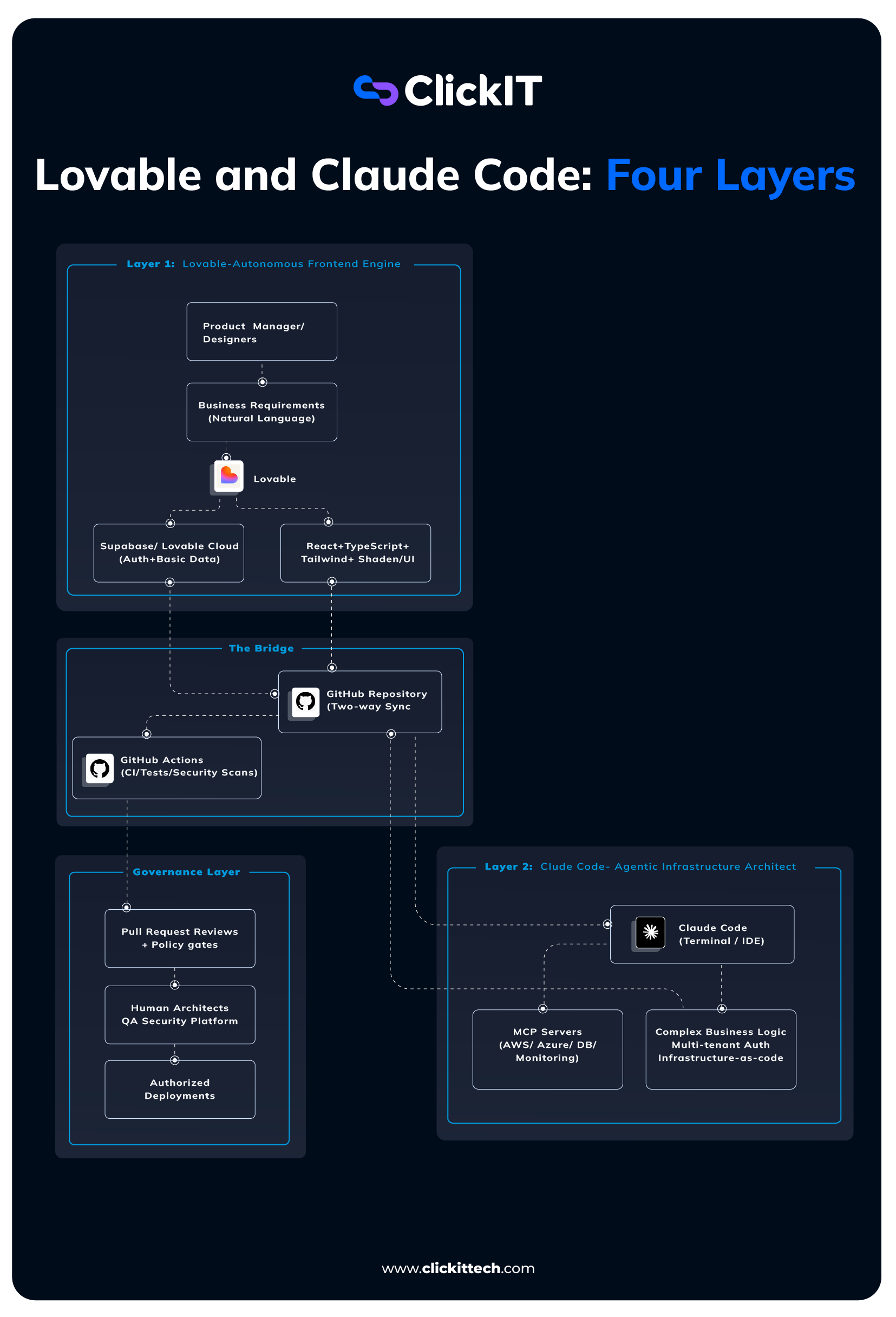
Layer 1: Lovable – Application Development
Lovable translates product requirements and user feedback into working interface components, such as usage charts, date filters, account summaries, and report-generation controls. It can also connect the interface to supported application services.
As a best practice, distinguish actual integrations from simulated behavior. A chart populated with sample data does not demonstrate that the application can securely retrieve production usage statistics.
The output is an interface implementation ready for review and integration with the actual backend.
The Bridge: GitHub and CI/CD
GitHub provides version history and a shared repository through which changes can be inspected and coordinated. Branches and pull requests make modifications reviewable before merging.
GitHub Actions or another CI/CD platform can run linting, type checks, unit and integration tests, dependency checks, and production builds.
Lovable’s GitHub integration supports two-way synchronization. However, it synchronizes one active branch at a time. Connecting a project creates a new repository rather than importing an existing repository directly.
When a push is rejected because of branch protection or a conflict, changes may be pushed to a lovable-sync branch for review and merging.
Repository synchronization is not the same as automatic agent orchestration. Connecting Lovable to GitHub does not guarantee that Claude Code will detect every change, understand its intent, or begin the next task. An engineer or configured automation must initiate the handoff and establish the expected repository state.
Layer 2: Claude Code — Repository-Level Engineering
Once interface changes are available in the repository, Claude Code can inspect the implementation and address backend requirements. For the reporting feature, this may involve implementing a usage endpoint, validating date filters, retrieving tenant-scoped data, handling empty results, and adding tests.
Claude Code should work against a known repository version and intended branch. Its modifications must remain traceable and reviewable.
Governance: Engineering Review and Release Control
Engineering governance defines acceptance criteria, review responsibilities, and release permissions. Engineers, QA specialists, and security reviewers determine whether the implementation meets functional, architectural, and operational requirements.
UI layout modifications such as chart-spacing adjustments may require routine checks. Changes to authentication, tenant isolation, database migrations, or infrastructure permissions warrant stronger testing and explicit engineering approval.
Reference Architecture
The flow below illustrates how the agents, repository, automated validation, and human reviewers connect.
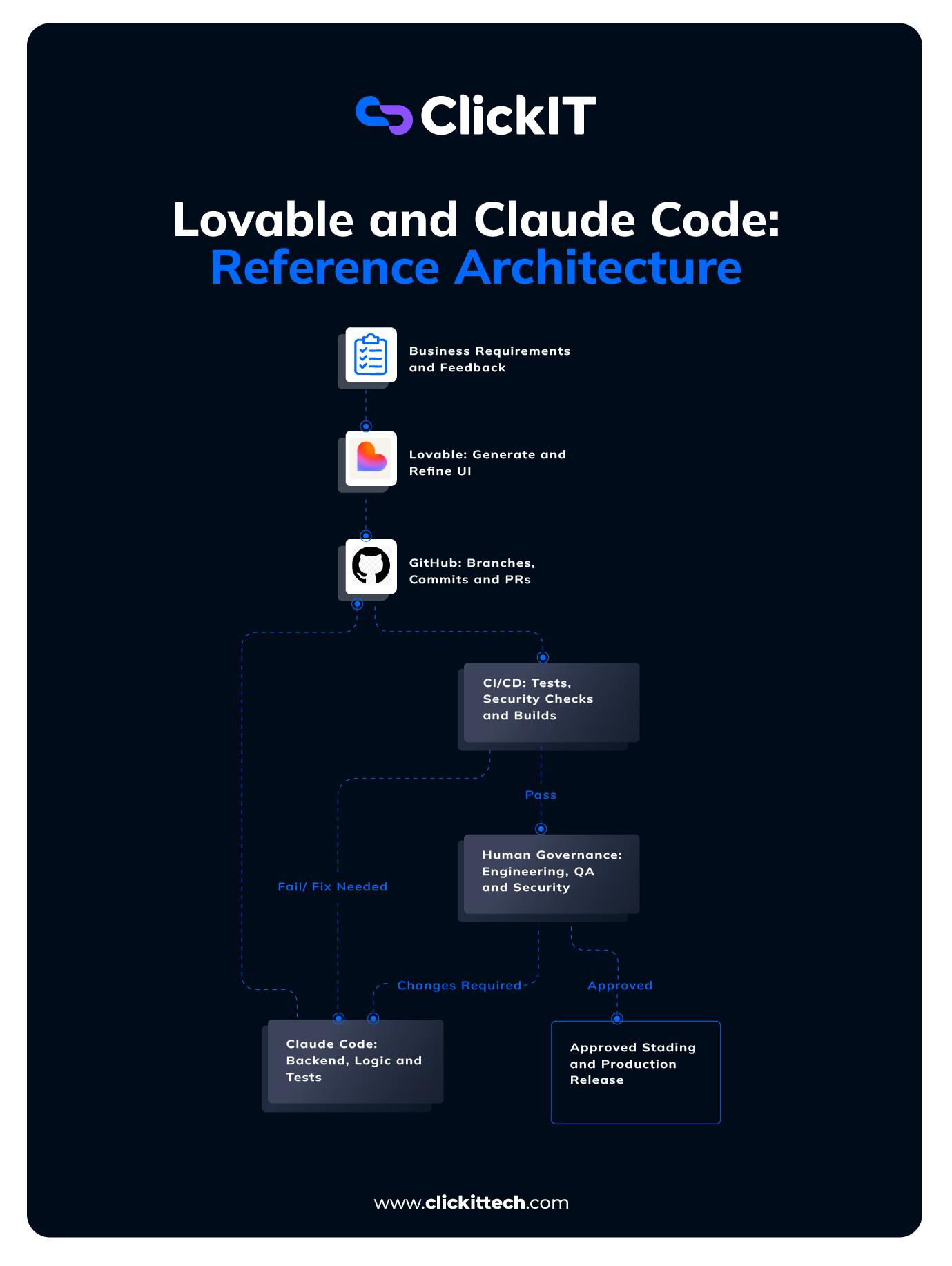
The repository records the code, CI/CD validates changes, and engineering review determines whether they are ready to proceed.
The API Contract as the Formal Handoff
An explicit API contract reduces ambiguity between interface development and backend implementation. It defines the endpoint, request parameters, response structure, and expected error behavior so both agents work against the same interface.
For example:
- Endpoint: GET /api/v1/usage/reports
- Authentication: Bearer access token
- Query: startDate, endDate, page, limit
- Response: data array + pagination metadata
The contract must also define how the endpoint handles invalid requests, missing authentication, and requests that the user is not authorized to make.
JSON

{
  "endpoint": "GET /api/v1/usage/reports",
  "authentication": "Bearer access token",
  "query": ["startDate", "endDate", "page", "limit"],
  "response": {
    "data": "array",
    "pagination": "metadata"
  }
}
The API contract acts as the formal handoff between agents. Lovable can build the interface around the agreed request and response structure, while Claude Code implements the endpoint, validation, data access, and tests.
CI verifies the implementation, and an engineering reviewer confirms that the contract is satisfied.
The End-to-End Handoff
A practical workflow for the reporting feature follows eight steps.
- Define the requirement. Specify what the report displays, who may access it, the supported date range, and expected behavior when no data exists.
- Build the interface in Lovable. Generate the reporting screen, refine it with product feedback, and identify the API contract the interface expects.
- Synchronize and inspect changes. Commit or synchronize the implementation through GitHub. Confirm the branch, review the diff, and establish a known starting point.
- Assign the backend task to Claude Code. Provide the API contract and acceptance criteria. Ask the agent to inspect authentication, data-access patterns, and existing tests before modifying files.
- Validate the implementation. Test valid requests, invalid date ranges, empty results, and attempts to access another tenant’s data.
- Review the pull request. Examine code changes, test evidence, authorization logic, and frontend compatibility. Request revisions where necessary.
- Validate in staging. Test the integrated application with representative data and verify that frontend and backend behavior agree.
- Release through the approved pipeline. Merge and deploy according to repository protections and release policies, retaining required approvals for sensitive changes.
This workflow does not require a human to direct every line of generated code. It requires clear ownership of handoffs and explicit conditions for moving changes between stages.
Branch Discipline and Change Ownership
Integration problems often arise when multiple contributors modify the same repository without a clear understanding of which changes are authoritative.
One approach is to let Lovable refine interface changes on a controlled feature branch, and Claude Code can work from an up-to-date version of that branch or from a separate engineering branch. The appropriate arrangement depends on the repository workflow and tool configuration.
Separate branches make differences visible when both tools may modify the same files, though they don’t eliminate merge conflicts. Before each handoff, the receiving agent should know which branch to use, what has changed, which task it owns, and which acceptance criteria it must satisfy.
Engineers should review the resulting diff rather than assuming successful synchronization means the application is correct. The architecture’s benefit is specialization within a controlled process.
Why AI Stacks Require Harness Engineering?
A defined workflow does not guarantee reliable results. AI agents can misunderstand requirements, modify code outside the intended scope, overlook repository conventions, or produce implementations that pass basic checks while violating business rules.
Harness engineering addresses this problem by establishing the instructions, tools, permissions, execution environments, validation mechanisms, and approval policies surrounding an agent. Its purpose is to make mistakes easier to detect and prevent unsafe changes from progressing unchecked.
The real advantage of Lovable vs Claude Code as a combined development strategy depends on harness engineering,
Define Acceptance Criteria Before Assigning Work
When you request Claude Code to “build the reporting API”, it introduces significant execution risks. The AI agent might create the API but fail to include crucial details, such as:
- Security: Forgetting to require proper user login or authorization.
- Data Validation: Allowing users to enter broken or invalid date ranges.
- Consistency: Formatting the final data output unpredictably.
A better task defines the expected outcome before implementation begins. For the reporting endpoint, acceptance criteria should require that:
- Tenant identity comes from trusted server-side authentication context.
- Every relevant database query is scoped to the authenticated tenant.
- Invalid date ranges are rejected.
- The response follows the agreed API contract, including the expected fields and pagination metadata.
- Tests cover authorized requests, unauthorized access, invalid input, empty results, and cross-tenant access attempts.
- Linting, type checks, tests, and the production build pass.
These criteria give the agent a concrete target and reviewers a basis for evaluating the result. They distinguish code that merely runs from code that satisfies engineering requirements.
The same principle applies to Lovable. A UI task should specify required components, supported interactions, loading and error states, accessibility expectations, and the API contract the interface must follow.
Provide Repository Instructions and Bounded Permissions
Agents need relevant context about the codebase they modify. Repository-level instructions can document the framework, coding conventions, directory structure, testing commands, architectural boundaries, and security requirements.
For example, a repository instruction file might identify standard commands for running tests, explain how API routes are organized, and specify where database migrations should go.
These instructions help an agent work consistently with the existing project rather than inventing a new structure for each task.
However, instructions alone don’t build a security boundary. The execution environment must also limit what the agent can access and change.
A development agent may need to read application code, modify files in a working branch, and run tests. It generally does not need unrestricted access to production databases, live customer records, deployment credentials, or cloud administration privileges. Development and test environments should use restricted or synthetic data wherever possible.
The governing principle is least privilege. Provide the access required for the assigned task, not unrestricted access just because the agent is capable of using it.
Make Automated Validation Part of the Workflow
An agent’s explanation of its changes is not evidence that those changes are correct. Validation must evaluate the implementation independently.
A CI pipeline can run several layers of checks:
- Code quality: Linting, formatting, and type checking.
- Functional correctness: Unit and integration tests for API behavior and business rules.
- Security: Dependency analysis, secret scanning, and suitable static security checks.
- Integration: Frontend builds, API compatibility checks, and tests against the expected data model.
- Release readiness: Production build verification and staging checks.
For the reporting API, automated tests should verify that one tenant cannot retrieve another tenant’s data by changing a request parameter or record identifier. They should also cover malformed dates, missing authentication, empty datasets, and pagination boundaries.
Passing these checks does not prove that the application is entirely secure. Tests cover only the scenarios and properties they evaluate. Still, independent validation provides a repeatable quality gate that is more reliable than accepting an agent’s self-assessment.
Match Approval Requirements to Risk
Not every AI-generated change requires the same level of scrutiny. Requiring identical manual approvals for minor interface adjustments and database authorization changes can slow delivery without proportionately improving risk management.
A visual adjustment may qualify for standard automated checks and ordinary review. Changes to authentication, tenant isolation, payment processing, data deletion, database migrations, or infrastructure permissions should trigger stronger testing and explicit engineering approval.
Production deployment should follow the organization’s protected release process. An agent that can edit application code or execute tests should not automatically receive permission to deploy that code to production.
The approval process should be defined before work begins. Reviewers need to know which changes require additional checks, what evidence must accompany a pull request, and who is responsible for authorizing a release.
Measure Engineering Outcomes, Not Code Volume
Harness engineering should optimize delivery outcomes rather than simply increasing the repository size. Multi-agent stacks can generate thousands of lines of code in seconds.
To evaluate the true ROI of your agent stack, leadership must measure operational velocity and systemic stability:
- Cycle Time (Intent-to-Production): The velocity from an approved requirement to a live, stable production release.
- Agent First-Time Merge Rate: The percentage of agent-generated changes accepted without requiring manual engineering interventions or heavy rework.
- The “Shadow” Maintenance Burden: The exact time human engineers spend debugging, refactoring, or correcting agent-generated output.
- Systemic Defect Leakage: The frequency of escaped bugs, regression defects, and security vulnerabilities introduced specifically by automated cycles.
- Release Reliability: The rate of failed deployments, rollbacks, or release-blocking issues.
These measures reveal whether the workflow is genuinely improving productivity. A system that generates interfaces quickly but repeatedly produces integration defects may simply move effort from implementation into debugging.
Running a Two-Agent Stack also requires specialized expertise in LLMOps, cloud architecture, and corporate security. Engineers must understand how to configure agent environments, evaluate model-assisted workflows, design reliable systems, and enforce organizational security policies.
The objective is not to remove engineering judgment but to apply it where it has the greatest impact. Harness engineering makes agent specialization dependable by establishing the context, constraints, validation, and approval mechanisms under which both tools operate.
Three Architectural Questions CTOs Must Ask in 2027
Combining Lovable and Claude Code can shorten the path from a product requirement to working software. However, development speed is only one dimension of production readiness. When evaluating Lovable vs Claude Code for enterprise applications, engineering leaders must evaluate how the resulting system handles workloads, protects sensitive context, and remains maintainable as platforms evolve.
Here are three important questions CTOs must ask in 2027:
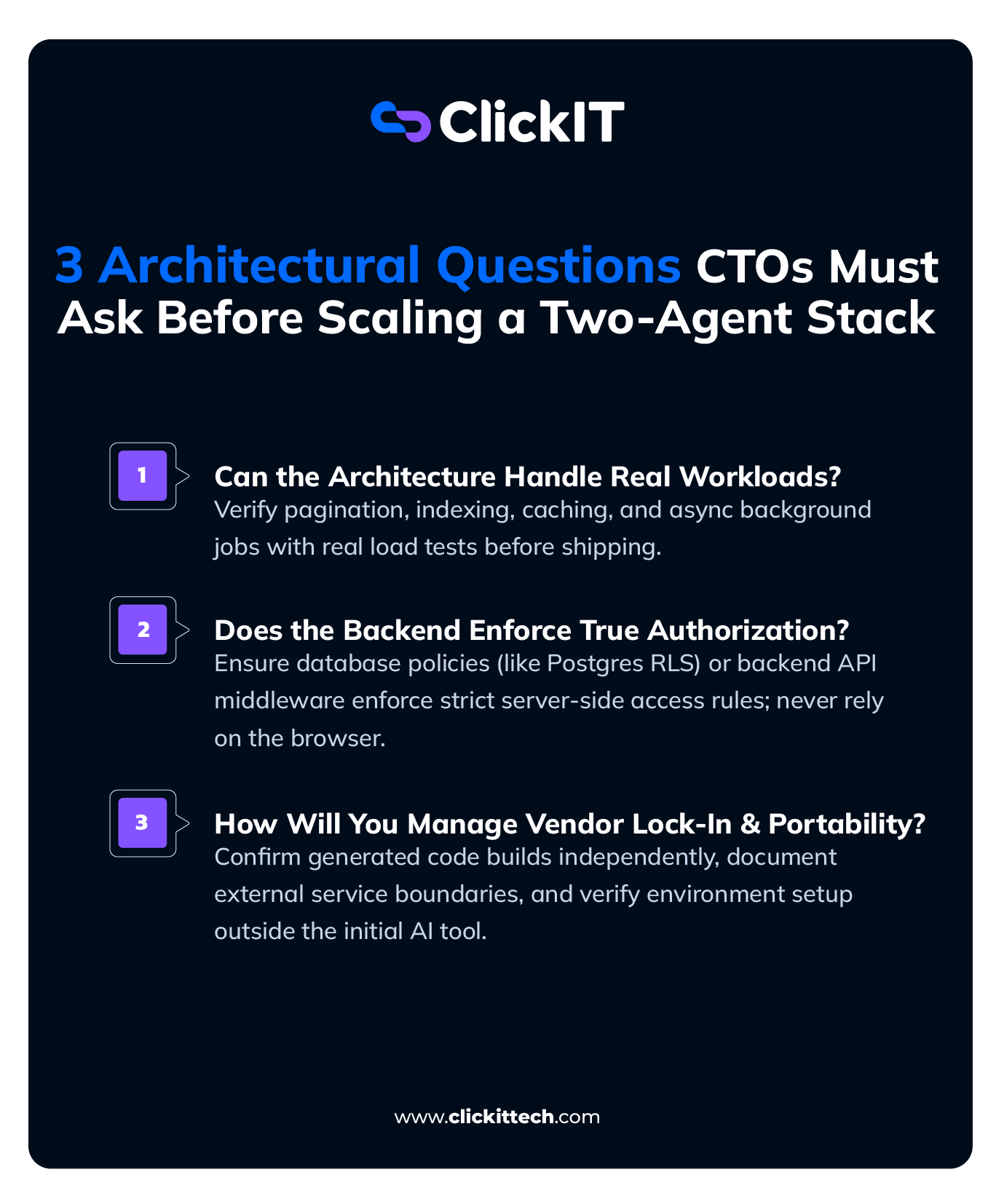
a) Can the Architecture Handle Real Workloads Reliably?
A dashboard can perform well during a demonstration and still fail when several customers use it at the same time. Prototype data is often small and predictable. Production workloads introduce concurrent requests, growing datasets, uneven usage patterns, and queries that become more expensive as the application scales.
For a usage-reporting application, returning every record in one response may work with a small dataset but create excessive database load and large network payloads as usage grows.
Pagination, date-range limits, appropriate indexes, and server-side aggregation can make reporting more predictable. Frequently requested summaries may benefit from caching, while expensive reports may need background jobs and asynchronous status tracking.
Engineering teams should define expected request volumes, data growth, latency targets, concurrency, and recovery expectations. Load tests and production observability must then establish whether the design meets those targets.
AI agents can help implement optimizations and generate tests, but they need measurable performance requirements.
The question for the CTO is whether the architecture has been evaluated against expected operating conditions, rather than whether the initial version appears responsive.
b) Does the Backend Enforce the Intended State and Authorization Rules?
As an application evolves, its backend must remain consistent with the business rules represented in the interface. This requires clear decisions about where data is stored, how requests are validated, and which layer enforces authorization.
For applications built with Supabase, database policies and the authentication model should be reviewed together. RLS policies need to reflect the actual data relationships, while database grants and policies for relevant operations must be configured appropriately.
The engineering team should verify these controls through tests rather than assuming that successful authentication alone establishes correct access.
For applications using a custom backend, the corresponding responsibilities may be implemented in API middleware, service-layer authorization, and database-access logic. The implementation should follow the established architecture, with clear ownership of validation and access decisions.
Claude Code can assist with reviewing these components, implementing changes, and generating tests. The engineering team remains responsible for confirming that the resulting behavior matches the application’s requirements.
c) How Will the Application Manage Platform Dependencies and Portability?
A Two-Agent Stack can create value but introduces dependencies on development platforms, hosted services, model providers, and proprietary integrations. These dependencies are not inherently bad.
Managed services can reduce operational overhead and accelerate delivery. However, the architectural risk appears when a team cannot reasonably change a component without rebuilding a substantial part of the application.
Engineering leaders should understand which parts of the application depend on platform-specific services, what can be maintained independently, and what a future migration would involve.
Lovable’s GitHub integration provides a practical starting point for repository access and local development, but it has specific synchronization behavior. It creates a new repository when connecting a project, synchronizes one active branch at a time, and may use a lovable-sync branch when a push is rejected because of branch protection or conflicts.
These details affect how teams organize development and review changes.
Repository access is useful, but it does not by itself establish that every application dependency is portable. Teams should document the services the application uses, how authentication and data storage are configured, which environment variables are required, and how builds and deployments can be reproduced outside the original development environment.
Before committing to a managed application platform, teams should determine whether the generated source code can be built independently, whether the application relies on proprietary services, how to export customer data, and what migration would require.
The same questions apply to the development workflow. Can engineers maintain the codebase without access to the original AI conversation? Are business rules expressed in application code and documented interfaces, or are critical assumptions embedded in platform-specific configuration? Can the application be tested and deployed through a separate, documented pipeline?
Where regional availability, compliance, or data residency matters, teams should confirm the current service documentation and contractual terms for their intended deployment rather than assume all regions and configurations are supported.
Here are a few best practices that help preserve flexibility:
- Keep business logic explicit. Authorization, billing, and reporting rules should remain understandable and testable independently of the interface-generation tool.
- Document service boundaries. Define API contracts and data ownership so components can be replaced without rewriting the entire application.
- Maintain reproducible builds. Keep dependencies, environment configuration, migration procedures, and deployment requirements documented in version control, excluding secrets.
- Test portability where it matters. Periodically verify that the application can be built and tested outside the original development platform.
- Evaluate exit costs. Understand data-export capabilities, proprietary dependencies, migration complexity, operational requirements, and contractual restrictions.
Claude Code can help inspect dependencies, identify platform-specific code, and assist with migration work. It cannot eliminate contractual restrictions or make an unavailable service portable simply by rewriting application code. Moving code between repositories does not automatically migrate databases, identity systems, secrets, or operational processes.
The objective is not to eliminate every vendor dependency. It is to make dependencies deliberate, document their value, and understand the cost of changing them.
The Architectural Decision
These three questions address different but connected dimensions of production readiness.
- Backend design determines whether application state and authorization rules are implemented correctly.
- Workload testing and observability establish whether the application can operate reliably as usage grows.
- Portability planning helps the organization understand platform dependencies and future migration requirements.
Lovable and Claude Code can accelerate implementation across these dimensions, but neither substitutes for architectural decisions, production evidence, or engineering accountability.
The strategic opportunity is to combine faster development with explicit architectural boundaries and systems that remain secure, testable, operable, and maintainable after the initial prototype.
Frequently Asked Questions (FAQs)
Lovable or Claude Code both address overlapping but different needs. Lovable accelerates application development and product iteration, while Claude Code works across repositories, code, tests, and development tools. Combining them can create a more complete workflow, as long as you manage the handoff through version control, automated validation, and engineering review.
Connect the Lovable project to GitHub, clone the repository locally, and open it in Claude Code. Use branches and pull requests to manage changes, and ensure both environments work from a known repository state. Avoid simultaneous edits to the same files without a clear conflict-resolution process.
A practical starting point is Lovable for rapid application development, GitHub for source control, Claude Code for repository-level engineering, and GitHub Actions for automated validation. The backend must implement explicit authentication, tenant isolation, and authorization controls. Select the database, hosting platform, and monitoring tools based on workload, compliance, and operational requirements.
MCP allows compatible clients to connect to external tools and data sources through MCP servers. Depending on configuration, Claude Code can use approved integrations for repository workflows, observability, databases, or cloud operations. Access is not automatic: integrations require appropriate configuration, credentials, and least-privilege permissions. Teams should also consider prompt-injection risks when an agent consumes external content or invokes connected tools.