Marketsandmarkets reports that the global AI in supply chain market earned a revenue of $13.93 billion in 2025. This value is expected to reach $50 billion by 2032, with a CAGR growth of 20.2% during this period.
Companies that successfully integrated AI into their distribution networks are reducing operational costs, improving inventory accuracy, increasing delivery reliability, and strengthening customer satisfaction. Gaining the agility needed to navigate through complex global supply chains is a big advantage as well.
AI has evolved beyond simple automation. Modern AI systems can analyze massive volumes of real-time data and detect patterns invisible to human planners. It can also predict disruptions before they occur and recommend the best course of action across procurement, inventory, warehousing, transportation, and last-mile delivery.
Instead of reacting to problems after they happen, businesses can now anticipate demand fluctuations, optimize warehouse workflows, and dynamically reroute shipments using AI-powered insights. This is what makes AI a strategic necessity rather than an experimental technology.
Blog Overview
Artificial intelligence is transforming how organizations plan, manage, and optimize supply chain distribution. This blog explores the latest AI trends in supply chain distribution and provides practical insights into how businesses can leverage AI in supply chain optimization to improve efficiency, resilience, and decision-making.
In this blog, you’ll learn:
- How AI-powered demand forecasting improves forecast accuracy and reduces inventory costs.
- Why AI-enabled control towers are evolving from monitoring dashboards into intelligent decision engines.
- How Agentic AI is automating routine supply chain operations while supporting human decision-making.
- Why distribution teams are shifting from manual planning to exception-based management.
- How real-time supply chain visibility helps organizations identify and respond to disruptions faster.
- The role of digital twins in testing distribution scenarios and optimizing supply chain planning.
- How AI copilots are improving productivity for supply chain, logistics, and operations teams.
- Why measuring AI ROI is becoming more important than simply adopting AI technologies.
- Which AI trends are mature, which are emerging, and where organizations should prioritize their investments.
- The leading AI tools and enterprise platforms that support modern supply chain distribution.
Whether you’re a supply chain executive, logistics manager, operations leader, or technology decision-maker, this blog will help you understand where AI delivers the greatest business value and how to build a smarter, more resilient distribution strategy.
What are the AI Trends in Supply Chain Distribution?
The following trends highlight how AI in supply chain optimization is evolving in 2026 and where businesses are seeing the greatest operational and financial impact.
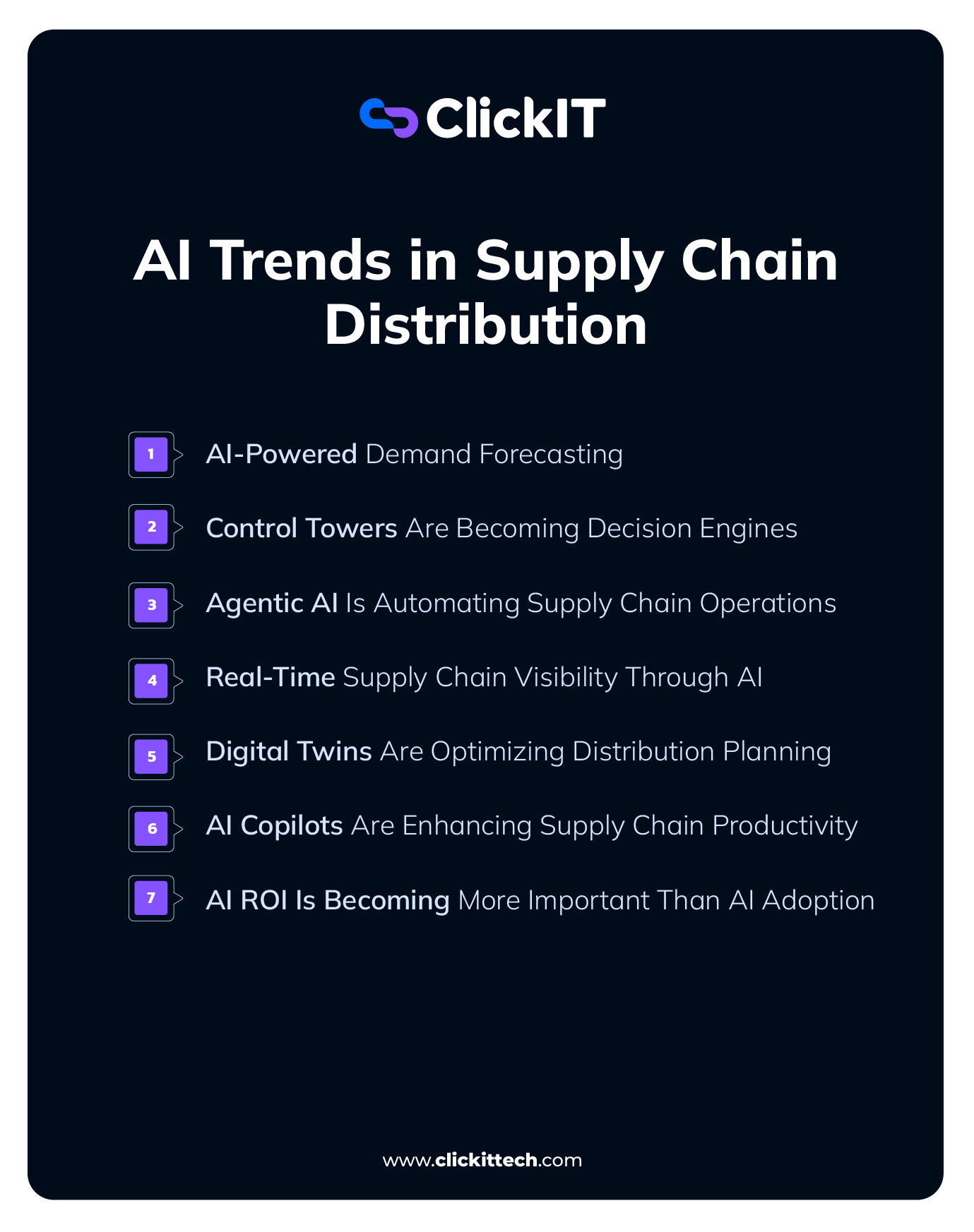
a) AI-Powered Demand Forecasting Is Becoming More Accurate
One of the biggest challenges in supply chain distribution is accurate demand forecasting. Traditional forecasting methods rely heavily on historical sales data and periodic market analysis. However, this approach is less effective when customer behavior, economic conditions, or supply chain disruptions change rapidly.
In 2026, one of the most significant AI trends in supply chain distribution is the widespread adoption of AI-powered demand forecasting. This enables businesses to anticipate demand with greater speed and precision.
The global market for AI-powered demand forecasting was valued at USD 7.4 billion in 2025. This value is projected to grow to USD 28.6 billion by 2034, expanding at a compound annual growth rate (CAGR) of 16.2% over the forecast period as per Data Intelo.
Modern AI models analyze vast amounts of structured and unstructured data that includes:
- Historical sales,
- Seasonal trends
- Weather patterns
- Promotional campaigns
- Supplier performance
- Economic indicators
- Social media sentiment
By continuously learning from new information, machine learning algorithms can identify demand patterns that traditional forecasting tools often overlook.
Consider an example wherein a retailer is launching a new product. The retailer can use AI to predict regional demand to optimize inventory allocation across distribution centers and minimize both stockouts and excess inventory.
Similarly, manufacturers can adjust production schedules based on real-time forecasts, thereby reducing waste and improving service levels.
Multinational retail corporation Walmart uses AI and machine learning to improve demand forecasting by analyzing historical sales, weather, and local demand signals. This is helping the company reduce stockouts, optimize inventory levels, and improve product availability for customers.
This shift is driving significant improvements in AI in supply chain optimization. As forecasting becomes increasingly dynamic and data-driven, businesses can respond quickly to market fluctuations while ensuring products are available where and when customers need them.
Popular AI Tools for Demand Forecasting in Supply Chain Distribution:
| Top Recommendations by Use Case | Popular AI Tools | Ideal For |
| Enterprise Supply Chains | Kinaxis Maestro, Blue Yonder, o9 Solutions | Global manufacturers and distributors managing complex, multi-tier supply chains. |
| Retail & Ecommerce | Blue Yonder, ToolsGroup, Oracle Fusion Cloud SCM | Handling seasonal demand, promotions, and omnichannel inventory planning |
| Companies already Using SAP or Microsoft | SAP Integrated Business Planning (IBP), Microsoft Dynamics 365 Supply Chain Management | Seamless integration with existing ERP environments and reduction of implementation complexity |
| Cloud-First Organizations | AWS Supply Chain, Anaplan | Businesses looking to leverage scalable AI and cloud-based analytics. |
b) Control Towers Are Becoming Decision Engines
In 2026, one of the most transformative AI Trends in Supply Chain Distribution is the evolution of control towers into AI-powered decision engines.
Modern control towers combine:
- artificial intelligence
- predictive analytics
- real-time data from enterprise systems
- IoT devicestransportation networks
- weather forecasts
- traffic conditions.
Rather than simply identifying disruptions, AI can evaluate multiple scenarios, predict their potential impact, and recommend the most effective response within minutes.
For example, if a shipment is delayed due to severe weather or port congestion, an AI-enabled control tower can automatically identify alternative transportation routes, recommend inventory reallocation across nearby distribution centers, or prioritize high-value customer orders based on service-level agreements.
This enables supply chain teams to act proactively rather than react after disruptions affect customers.
Multinational Logistics company DHL uses AI-enabled control towers and real-time analytics to monitor shipments, detect disruptions early, and coordinate responses across its logistics network. This helped improve visibility, reduced delays, and faster operational decision-making.
This shift from visibility to intelligent decision-making is significantly advancing AI in supply chain optimization. As AI capabilities continue to mature, control towers are becoming the operational nerve center of modern distribution networks, enabling organizations to make smarter, data-driven decisions at scale.
Popular AI-powered Control Towers in Supply Chain Distribution:
| Top Recommendations by Use Case | Popular AI Tools | Ideal For |
| End-to-End Supply Chain Visibility | Project44, FourKites | Real-time shipment tracking, predictive ETAs, and logistics visibility across carriers and suppliers. |
| Enterprise Supply Chain Orchestration | Kinaxis Maestro, Blue Yonder | Large enterprises seeking AI-driven decision support, inventory visibility, and end-to-end supply chain orchestration. |
| Oracle Ecosystem | Oracle Fusion Cloud SCM | Organizations already using Oracle ERP and supply chain applications. |
c) Agentic AI Is Automating Supply Chain Operations
While predictive analytics helps businesses anticipate disruptions, AI-powered control towers recommend the best course of action. Agentic AI takes automation a step further by executing tasks with minimal human intervention.
Traditional AI systems respond to predefined rules or user prompts. However, agentic AI comprises intelligent software agents capable of planning, reasoning, and taking action to achieve specific business objectives.
As organizations seek greater speed and efficiency, this is emerging as one of the most impactful AI Trends in Supply Chain Distribution.
When it comes to supply chain operations, AI agents can continuously monitor inventory levels, shipment status, supplier performance, warehouse capacity, and customer demand across multiple systems.
In case of an issue such as a delayed shipment, an unexpected demand spike, or low inventory, an AI agent analyzes the situation, evaluates multiple response options, and initiates appropriate actions.
For instance, the agent can create purchase orders, reallocate inventory between distribution centers, reschedule deliveries, or notify suppliers and logistics partners. The good thing about agentic AI is that it does all of this while keeping human teams informed.
Consider another example wherein a critical component is delayed by a supplier. An AI agent can identify alternative suppliers, assess delivery timelines and costs, recommend the most suitable option, and prepare the necessary procurement workflows for approval.
Instead of spending hours coordinating across departments, supply chain teams can focus on strategic decisions while AI handles repetitive operational tasks.
As organizations invest in AI for supply chain optimization, Agentic AI helps reduce manual workload, accelerate decision-making, and improve responsiveness across complex distribution networks.
Microsoft has transformed its own global supply chain from Excel-based planning into an AI-driven operation.
The company says it has already deployed more than 25 AI agents across its logistics and supply chain operations and aims to have over 100 AI agents running by the end of 2026. These agents support planning, simulations, warehouse operations, and logistics, saving teams hundreds of hours every month
Popular Agentic AI Tools for Supply Chain Distribution:
| Top Recommendations by Use Case | Popular AI Tools | Ideal For |
| Enterprise AI Agents | Salesforce Agentforce, Microsoft Copilot Studio | Building autonomous AI agents that automate workflows across procurement, customer service, and logistics. |
| Business Process Automation | UiPath Platform, IBM watsonx Orchestrate | Organizations looking to combine AI with robotic process automation (RPA) for end-to-end workflow automation. |
| SAP Customers | SAP Joule | Enterprises using SAP to automate supply chain and procurement processes with AI assistance. |
d) Distribution Teams Are Shifting From Planning to Exception Management
With modern AI platforms, routine decisions such as replenishing stock, balancing inventory across distribution centers, or selecting optimal shipping routes can be automated based on predefined business rules and machine learning models.
Instead of reviewing every transaction, planners are alerted only when AI detects an exception, such as an unexpected demand surge, supplier disruption, delayed shipment, or inventory shortage that requires human judgment. This is one of the most significant AI trends in supply chain distribution.
This change allows supply chain professionals to spend more time solving high-impact business challenges rather than managing routine operations. Teams can focus on evaluating risks, strengthening supplier relationships, improving customer service, and making strategic decisions that AI cannot address independently.
This evolution represents a major step forward in AI in supply chain optimization. Organizations that successfully combine AI automation with human expertise are improving operational agility, reducing response times, and building more resilient distribution networks.
Amazon recently unveiled an upgraded version of its autonomous warehouse robot, Proteus, that can understand natural language instructions from workers.
Instead of relying on pre-programmed commands, employees can now communicate with the robot conversationally. This allows Proteus to prioritize tasks, plan routes, and collaborate more naturally with warehouse teams.
This marks a significant step toward human-AI collaboration in distribution centers.
Popular AI Tools for Supply Chain Planning and Monitoring:
| Top Recommendations by Use Case | Popular AI Tools | Ideal For |
| AI-Driven Supply Chain Planning | Kinaxis Maestro, o9 Solutions | Organizations transitioning from manual planning to AI-assisted exception management. |
| Risk & Exception Monitoring | E2open, Blue Yonder | Monitoring disruptions, supplier performance, and inventory exceptions in real time. |
| Oracle Users | Oracle Fusion Cloud SCM | Built-in exception management within Oracle’s enterprise planning ecosystem. |
e) Real-Time Supply Chain Visibility Through AI
Supply chain visibility is a key factor for operational efficiency and customer satisfaction. However, traditional tracking systems often provide only fragmented information. As such, organizations find it difficult to identify disruptions before they impact distribution.
In 2026, one of the most influential AI Trends in Supply Chain Distribution is achieving real-time, end-to-end visibility across the entire supply chain.
AI integrates data from various sources into a unified operational view.
Data Sources include:
- Enterprise resource planning (ERP) systems
- Warehouse management systems (WMS)
- Transportation management systems (TMS)
- IoT sensors
- GPS devices
- Supplier portals
- Other external data sources
By continuously analyzing this information, AI can detect delays, inventory imbalances, equipment failures, and transportation bottlenecks as they occur, enabling organizations to respond before minor issues escalate into costly disruptions.
For example, if a shipment is delayed due to severe weather or traffic congestion, AI can instantly assess the potential impact on warehouse operations, customer deliveries, and inventory availability.
It can then recommend alternative transportation routes, prioritize critical orders, or rebalance inventory across nearby distribution centers to minimize service disruptions. This proactive approach helps businesses maintain continuity even in highly dynamic operating environments.
Real-time visibility is also a critical component of AI in supply chain optimization. By providing accurate, continuously updated insights, AI enables organizations to improve forecasting, optimize inventory levels, streamline warehouse operations, and enhance collaboration with suppliers and logistics partners.
NVIDIA’s weather forecasting service Earth-2 platform uses AI to create high-resolution weather forecasts that can predict extreme weather events much faster than traditional models. This is especially useful for industries affected by hurricanes, floods, or heat waves.
Here is some more interesting news!
GNC has deployed AI-powered autonomous drones inside its distribution centers to perform inventory checks. These drones scan more than 2,000 pallet locations in a 250,000-square-foot warehouse, allowing inventory audits to be performed monthly instead of quarterly.
This increased visibility has significantly reduced daily backorders while freeing warehouse employees from repetitive counting tasks.
As supply chains become increasingly interconnected, real-time visibility serves as the foundation for faster decision-making, greater operational resilience, and more responsive distribution networks.
Popular AI Tools for Supply Chain Visibility:
| Top Recommendations by Use Case | Popular AI Tools | Ideal For |
| Shipment Visibility | Project44, FourKites | Tracking shipments, predicting delivery times, and identifying transportation delays. |
| Supply Chain Risk Monitoring | Overhaul | Organizations that need AI-powered monitoring of cargo risks, theft, delays, and disruptions. |
| Global Logistics Networks | Descartes Systems Group, Oracle Fusion Cloud SCM | Enterprises managing complex international transportation and distribution operations. |
f) Digital Twins Are Optimizing Distribution Planning
When supply chains become more complex, real-time visibility is not enough. You need the ability to predict the impact of decisions before implementing them. This is where digital twins comes to the rescue.
Listed among the emerging AI trends in supply chain distribution, digital twins enable organizations to simulate real-world operations and evaluate scenarios to make better-informed decisions with reduced risk.
What is a digital twin? A digital twin is a virtual representation of a physical supply chain that is continuously updated using real-time data from warehouses, transportation networks, inventory systems, suppliers, and customer demand. Powered by AI and predictive analytics, digital twins allow businesses to test multiple “what-if” scenarios without disrupting actual operations.
For example, planners can simulate the effects of opening a new distribution center, changing transportation routes, adjusting inventory levels, or responding to supplier delays before making costly operational changes.
This capability is particularly valuable in industries with complex distribution networks, wherein even small disruptions can have significant downstream effects.
Global consumer goods company Unilever uses AI-enabled digital twins to simulate manufacturing and supply chain operations before implementing changes. These virtual models help improve production efficiency, optimize resource utilization, and support more informed operational decisions across its global network.
As AI capabilities continue to advance, digital twins are expected to play a central role in creating smarter, more adaptive, and highly efficient supply chain ecosystems.
Popular AI tools for Digital Twins:
| Top Recommendations by Use Case | Popular AI Tools | Ideal For |
| Supply Chain Simulation | AnyLogic, o9 Solutions | Testing “what-if” scenarios and optimizing inventory, transportation, and distribution strategies. |
| Manufacturing & Industrial Operations | Siemens Digital Twin, Dassault Systèmes DELMIA | Manufacturers who require integrated production, warehouse, and logistics simulations. |
| Microsoft Azure Customers | Azure Digital Twins | Organizations already invested in the Microsoft Azure ecosystem. |
g) AI Copilots Are Enhancing Supply Chain Productivity
As artificial intelligence becomes embedded in enterprise software, AI copilots are emerging as indispensable assistants for supply chain professionals.
Unlike Agentic AI that autonomously executes workflows based on predefined goals, AI copilots are designed to collaborate with users. They provide recommendations, summarize information, answer questions, support faster decision-making, etc.
This human-AI partnership is becoming one of the most practical AI trends in supply chain distribution, helping organizations improve productivity without disrupting existing workflows.
Integrated into supply chain management platforms, AI copilots can analyze operational data, generate inventory reports, explain demand fluctuations, identify potential supply chain risks, and recommend actions based on real-time insights. Instead of manually searching through multiple dashboards or spreadsheets, planners and logistics managers can interact with AI using natural language.
For instance, a user might ask:
- Which distribution centers are at risk of stockouts next week?
- Why have transportation costs increased this month?
The copilot can quickly retrieve relevant data, summarize key findings, and present actionable recommendations.
Not just analytics! AI copilots can automate routine administrative tasks such as drafting supplier communications, generating procurement summaries, preparing shipment status updates, and creating performance reports.
This reduces the time employees spend on repetitive work, allowing them to focus on strategic planning, supplier collaboration, and customer service.
A good thing about AI copilots is that they are not replacing experienced professionals. Instead, they enhance human expertise by delivering faster insights, reducing manual effort, and enabling teams to make more informed decisions with greater confidence.
Popular AI Copilot Tools:
| Top Recommendations by Use Case | Popular AI Tools | Ideal For |
| Enterprise Productivity | Microsoft 365 Copilot | Organizations using Microsoft 365 to improve reporting, planning, and collaboration. |
| ERP-Integrated AI Assistants | SAP Joule, Oracle AI Assistant | Businesses seeking AI assistance directly within ERP and supply chain applications. |
| Knowledge Management & Collaboration | Google Gemini for Workspace, IBM watsonx Assistant | Document summarization, knowledge retrieval, and enterprise-wide collaboration. |
As adoption grows, AI copilots are expected to become a standard feature of modern supply chain platforms, empowering organizations to operate more efficiently in an increasingly complex logistics environment.
h) AI ROI Is Becoming More Important Than AI Adoption
Over the past few years, many organizations have launched AI initiatives to modernize their supply chain operations. Initially, the focus was on experimenting with new technologies,
Today, business leaders are less concerned with how many AI solutions have been implemented and more focused on whether those investments deliver measurable results. This shift in priorities is one of the defining AI Trends in Supply Chain Distribution.
Rather than measuring success by the number of AI-powered tools deployed, organizations are evaluating how AI contributes to key business outcomes.
These include:
- Improved demand forecast accuracy
- Reduced inventory carrying costs
- Faster order fulfillment
- Optimized transportation routes
- Lower logistics expenses
- Higher warehouse productivity
- Increased customer satisfaction
AI projects that generate clear operational improvements are far more likely to receive continued investment and organizational support.
This outcome-driven approach is encouraging businesses to establish clear performance metrics before implementing AI solutions. By aligning AI projects with strategic business objectives, organizations can prioritize investments that create long-term value.
Ultimately, the future of AI in supply chain optimization will be defined by business impact rather than adoption rates. Organizations that combine intelligent technologies with clear performance goals, skilled teams, and continuous improvement strategies will be ahead of the competition.
Popular AI-Powered BI Tools:
| Top Recommendations by Use Case | Popular AI Tools | Ideal For |
| Business Intelligence & KPI Dashboards | Microsoft Power BI, Tableau | Visualizing AI performance metrics, supply chain KPIs, and executive dashboards. |
| AI-Driven Analytics | Qlik Sense | Organizations seeking augmented analytics and AI-assisted business intelligence. |
| Strategic Planning & Scenario Modeling | Anaplan, IBM Planning Analytics | Measuring ROI, forecasting business outcomes, and supporting strategic decision-making. |
Which AI Trends Are Mature vs. Emerging?
Gartner predicts that by 2030, 50% of newly built warehouses in developed markets will be designed around robots rather than people.
Not every AI technology is at the same stage of adoption. While capabilities such as demand forecasting and route optimization have become mainstream across many industries, Agentic AI and autonomous supply chains are still evolving.
Understanding the maturity of each trend helps organizations prioritize investments, allocate resources effectively, and build an AI roadmap that balances immediate business value with long-term innovation.
The following table summarizes the current maturity of the key AI Trends in Supply Chain Distribution and provides guidance on where organizations should focus their efforts.
| AI Trend in Supply Chain | Maturity Level | AI Adoption Priority | Why It Matters |
| AI-Powered Demand Forecasting | High | Start Now | Improves forecast accuracy, reduces inventory costs, and minimizes stockouts. |
| AI-Based Inventory Optimization | High | Start Now | Optimizes inventory levels while improving product availability and warehouse efficiency. |
| AI-Powered Route Optimization | High | Start Now | Reduces transportation costs, improves delivery performance, and supports sustainability goals. |
| AI Control Towers | High | Start Now | Provides real-time visibility and enables faster, data-driven operational decisions. |
| AI Copilots | Medium | Evaluate | Enhances workforce productivity by assisting planners, analysts, and logistics teams with insights and recommendations. |
| Agentic AI | Medium | Pilot | Automates complex workflows and operational decision-making with human oversight. |
| Digital Twins | Medium | Selective | Simulates distribution scenarios to improve planning and reduce operational risk. |
| Autonomous Supply Chains | Low | Monitor | Represents the long-term vision of self-optimizing supply chains with minimal human intervention. |
Frequently Asked Questions (FAQs)
Large enterprises often use digital twins to model complex global supply chains. At the same time, mid-sized organizations can also benefit from digital twins in warehouse planning, transportation optimization, and distribution network analysis.
AI-powered demand forecasting, inventory optimization, route optimization, and warehouse automation are a few examples of AI applications that deliver faster ROI in supply chain optimization.
These AI solutions reduce operational costs, improve forecast accuracy, minimize stockouts, and increase on-time deliveries. This is what makes them ideal starting points for AI in supply chain optimization initiatives.
AI copilots assist supply chain professionals by providing insights, answering questions, and recommending actions. On the other hand, agentic AI autonomously executes predefined tasks such as reallocating inventory, initiating procurement workflows, or responding to supply chain disruptions with minimal human intervention.