Modern software systems are becoming increasingly difficult to operate. Cloud-native applications, microservices, Kubernetes, distributed dependencies, and frequent deployments give organizations greater flexibility, but they also increase operational complexity.
Site Reliability Engineering (SRE) applies software engineering practices to building and operating reliable, scalable systems. It focuses on areas such as availability, performance, monitoring, automation, and incident response.
For SRE teams, the challenge is often not a lack of data. Most organizations already collect enormous volumes of metrics, logs, traces, alerts, and infrastructure events.
The real challenge is connecting that information quickly enough to understand what is happening and decide what to do next.
When a production incident occurs, an engineer may need to move between dashboards, log platforms, tracing tools, deployment systems, runbooks, and incident-management platforms before getting a clear picture of the problem. This process can consume valuable time, particularly during high-severity incidents.
Traditional automation helps with predictable problems. If a known condition occurs and the appropriate response is well-defined, an automated workflow can often handle it quickly.
But many incidents are not that simple. They require engineers to connect signals across multiple systems, understand recent changes, and determine which of several possible explanations is most likely.
This is where an SRE Agent comes to the rescue.
An SRE Agent uses AI to gather context, reason across operational data, and assist with tasks such as incident investigation, root cause analysis, troubleshooting, and remediation.
It is important to note that an SRE agent doesn’t replace SRE teams or existing automation. It acts as an intelligent layer within the operational workflow.
When Does an SRE Agent Make Sense?
An SRE Agent is highly useful when an operational problem involves ambiguity, investigation, or fragmented information.
Teams may benefit from an agent when the challenge isn’t simply executing a predefined action, but understanding the situation first.
For example:
- Alert overload, where teams struggle to determine which signals are related.
- Slow incident investigation caused by switching between multiple tools.
- Repetitive operational work, such as gathering incident information and searching for runbooks.
- Operational knowledge spread across documentation, tickets, and experienced engineers.
- Difficulty connecting incidents with recent application and infrastructure changes.
According to the Grafana Labs 2025 survey, alert fatigue is the No. 1 obstacle to faster incident response. And 28% of respondents identified faster root cause analysis as a desired AI/ML capability.
However, not every SRE workflow needs AI. Well-understood, repeatable tasks should continue to use conventional automation where it is simpler and more predictable.
An SRE Agent makes sense when teams need to bridge the gap between detection and action to determine the right response.
Blog Overview
This guide explores how an AI SRE Agent can become part of an existing SRE workflow without replacing the tools, automation, or human expertise teams already rely on.
In this guide, you will learn:
- What an AI SRE Agent is and how it differs from monitoring, traditional automation, and AI assistants.
- How SRE Agents support context gathering, evidence normalization, incident investigation, root cause analysis, and remediation.
- How a practical SRE Agent reference architecture connects alerts, operational data, investigation, recommendations, controlled actions, verification, and audit.
- How to implement an SRE Agent using a service context layer, evidence and tool contracts, existing operational tools, human oversight, and controlled automation.
- How to evaluate an SRE Agent using measures such as correctness, evidence quality, uncertainty, latency, operator trust, safety, and operational cost.
- How an SRE Agent can handle a real-world incident workflow, from an initial alert through competing hypotheses, recommendation, approval, remediation, verification, and audit
- What organizations should consider around cost, security, compliance, and sensitive information.
Whether you are an SRE, DevOps engineer, platform engineer, or cloud architect, this guide will help you understand how SRE Agents can support modern reliability workflows while maintaining the context, security controls, governance, and human oversight required for production environments.
What Is an AI SRE Agent?
An AI SRE Agent is an AI-powered system that can access operational context and connected tools to investigate system conditions, reason about potential problems, and recommend or initiate approved actions.
The key difference between an agent and a traditional AI assistant is its ability to participate in a workflow. Instead of simply answering a question, an agent can gather information from multiple sources, analyze that information in context, and determine what should happen next.
For instance, when a monitoring tool reports that latency has exceeded a threshold, an SRE agent can investigate that signal by gathering additional evidence. It may check when the latency increase began, identify affected services, examine related logs and traces, review recent deployments, and retrieve the relevant runbook.
Here is how different technologies work:
- Monitoring detects known conditions.
- Automation executes predefined actions.
- An SRE Agent gathers context and helps determine what the situation means and what should happen next.
An SRE Agent does not necessarily have to be autonomous. It can operate at different levels of autonomy depending on the organization’s requirements and risk tolerance.
A practical way to think about SRE Agent adoption is as a progression from investigation to controlled action.
Investigate
At the first level, the agent focuses on understanding what is happening. It gathers relevant context, retrieves operational data, examines recent changes, and helps engineers investigate potential causes.
The agent may produce an incident summary, identify relevant evidence, and surface competing hypotheses, while engineers are responsible for evaluating the findings.
Recommend
Once the investigation workflow is reliable, the agent can move from explaining the situation to recommending what should happen next.
For instance, if the evidence indicates that a recent deployment is likely related to an increase in errors, the agent can recommend an approved rollback procedure and explain the evidence supporting that recommendation.
The engineer can then review the recommendation before any production change is made.
Act
At the highest level, the agent can trigger approved actions for specific, well-understood scenarios.
This should not mean giving the AI model unrestricted access to production systems. Instead, the agent should operate through controlled tools and predefined workflows with appropriate permissions, approval requirements, and safeguards.
This progression provides a practical adoption model:
Investigate → Recommend → Act
For example, an organization may initially use an agent to summarize incidents and assist with investigations, while more mature implementations may allow it to trigger predefined remediation workflows for specific, low-risk scenarios.
Common Use Cases
Here are common use cases of an SRE agent:
a) Incident Investigation and Triage
When an alert is triggered, the agent can automatically gather relevant information before an engineer begins the investigation.
Instead of manually opening several dashboards and searching multiple systems, the engineer can receive an initial summary of the affected service, relevant operational signals, recent changes, and possible areas to investigate.
This way, engineers can save time spent on routine information gathering and focus on validating and resolving the issue.
Catchpoint’s 2025 SRE Report found that the median share of SRE work spent on toil rose to 30%, up from 25% in 2024. AI agents can reduce this repetitive investigation and operational work.
b) Operational Knowledge and Root Cause Analysis
An AI SRE Agent can also help connect operational data with organizational knowledge. It can retrieve relevant runbooks, architecture documentation, or information about similar incidents and use that context to support an investigation.
For example, if a service begins failing after a deployment, the agent may identify the timing of the change, examine related errors, and surface a previous incident involving a similar failure pattern.
The agent may not have to determine the root cause on its own. Instead, it brings together the relevant evidence so engineers can investigate and validate the most likely explanations.
c) Remediation and Post-Incident Work
Once the agent understands the likely cause of an issue, it can recommend the next step or guide an engineer through an approved remediation process. In more mature implementations, it may trigger predefined workflows for low-risk situations.
The same capabilities can be useful after an incident. An agent can help organize event timelines, summarize the investigation, and prepare an initial post-incident analysis. This will reduce some of the manual work associated with incident follow-up.
Related Technologies
An AI SRE Agent is not a single technology. It brings together several capabilities that already exist within an organization’s technology stack.
- Large language models provide the ability to interpret information and reason across different sources of context.
- Observability platforms provide operational signals such as metrics, logs, and traces.
- Knowledge retrieval systems give the agent access to runbooks and internal documentation.
- Tool integrations allow it to query operational systems, while workflow and automation platforms provide controlled ways to take action.
The implementation may vary, but the underlying model is consistent: The agent needs context to understand the problem, tools to investigate it, and controlled workflows to act on it.
Building custom AI agents for your infrastructure? → Explore our AI Agent Development Services.
AI SRE vs. Traditional SRE
AI-assisted SRE should not be viewed as a replacement for traditional SRE, but as an augmentation.
Traditional SRE remains responsible for designing reliable systems, defining reliability objectives, building automation, and making important engineering decisions. An AI SRE Agent can augment this work by reducing the effort required to collect and interpret operational information.
Also, traditional automation remains essential. As a best practice, combine all three approaches:
- Monitoring detects the problem.
- The SRE Agent investigates and provides context.
- Engineers make decisions when necessary.
- Approved automation executes the response.
This combination allows organizations to benefit from AI-assisted investigation while retaining the predictability and control of existing SRE practices.
Core Capabilities of an SRE Agent
An SRE Agent brings several capabilities together to help move an incident from detection toward resolution.
Gather Context → Normalize Evidence → Investigate → Remediate
The agent does not need to perform every step autonomously. Its role can range from providing investigation support to recommending actions. Additionally, in carefully controlled scenarios, it can trigger approved remediation workflows.
a) Context Gathering
Context gathering is the foundation of an effective SRE Agent.
An agent cannot perform useful analysis if it only receives an isolated alert without understanding the surrounding environment. A single production issue may involve information spread across observability tools, cloud platforms, CI/CD systems, service documentation, and incident records.
When an alert occurs, the agent may need to understand the affected service, its dependencies, current system behavior, recent changes, and the operational procedures associated with it.
For example, instead of simply reporting that the payment service latency is high, the agent could establish that the latency increase began shortly after a deployment, affected several dependent services, and coincided with increased database query latency.
It could then retrieve the relevant runbook and identify whether a similar pattern has occurred before.
This ability to connect information is often one of the most immediate sources of value from an AI SRE Agent. The goal is to retrieve the right context for the situation being investigated, instead of sending every available log or metric to the model.
b) Evidence Normalization
Once the relevant information has been gathered, the agent needs to turn data from different systems into a form that can be analyzed consistently.
Operational systems produce information in different formats and with different levels of freshness.
- Metrics may contain time-series values
- Logs may contain individual events,
- Tracing systems may describe request paths
- Deployment systems may record changes using completely different identifiers and timestamps.
Evidence normalization helps bring these signals together.
For instance, an agent investigating an increase in application errors may need to align:
- The time the errors increased
- The time of a recent deployment
- Changes in database latency
- Relevant trace failures
- Infrastructure events occurring during the same period
The purpose is not to convert all operational data into one format. Instead, the agent should preserve the source and meaning of each signal while creating a consistent evidence set for investigation.
This also allows the agent to distinguish between what a system directly reported and what the agent inferred from multiple signals.
A normalized evidence set might therefore identify:
- Observed: Error rates increased at 14:07 UTC.
- Observed: A deployment completed at 14:03 UTC.
- Observed: Database latency increased at 14:06 UTC.
- Hypothesis: The deployment may be contributing to the increase in errors.
This distinction becomes important when the agent begins reasoning about possible causes.
c) Root Cause Analysis
Once the relevant context has been gathered, an SRE Agent can help investigate the likely cause of an incident.
The agent might perform the following actions:
- Correlate evidence across different systems.
- Examine when an issue began.
- Identify related anomalies.
- Review recent deployments and configuration changes.
- Investigate dependencies shared by affected services.
For example, an agent might determine that application errors increased shortly after a new release and that no major infrastructure anomalies occurred during the same period. That creates a strong hypothesis that the deployment may be related to the incident.
However, an AI SRE Agent should not treat every correlation as a confirmed root cause.
Complex systems often produce multiple changes and anomalies simultaneously. A reliable SRE agent should therefore distinguish between facts, correlations, hypotheses, and conclusions.
Rather than stating that the deployment caused the outage, the agent should be able to explain:
- The error rate increased within minutes of the deployment.
- The affected services share the newly updated dependency.
- No corresponding infrastructure anomaly was detected.
- The deployment is therefore the leading hypothesis and should be validated.
The idea is not to make the agent sound certain. It is to make its reasoning evidence-based, transparent, and useful to the engineer investigating the incident.
PagerDuty has also applied this approach to its own SRE Agent, wherein it can investigate incidents by analyzing logs, metrics, deployments, and other operational context while allowing engineers to observe the investigation and provide input.
d) Remediation: Guided and Autonomous
Once the agent has gathered evidence and identified a likely course of action, it can support remediation in two main ways:
- Guided Remediation
In guided remediation, the agent recommends an action, but an engineer reviews and approves it.
For example, the agent may identify a recent deployment as the likely source of increased errors and recommend following the approved rollback procedure. It can retrieve the relevant runbook, explain why it applies, and guide the engineer through the required steps.
This approach balances AI-assisted investigation with human judgment, making it a practical starting point for organizations adopting SRE agents.
- Autonomous Remediation
In a more advanced implementation, the agent can trigger predefined actions automatically.
This should generally be limited to well-understood and low-risk situations with clearly defined conditions and recovery procedures.
For example, the agent might detect a known failure pattern, validate that predefined conditions are met, trigger an approved recovery workflow, and verify whether system health improves.
Autonomous remediation should not mean giving the AI model unrestricted authority over production systems. Instead, the agent should operate through controlled tools and approved automation workflows that enforce the organization’s permissions and safeguards.
Together, these capabilities create a practical SRE workflow:
Detect → Gather Context → Normalize Evidence → Investigate → Recommend → Approve / Act → Verify
Reference Architecture for an SRE Agent
A best practice is to introduce an SRE agent as an intelligent layer within the existing operational environment instead of replacing the organization’s monitoring, observability, deployment, or automation system with it.
A practical SRE Agent workflow can be represented as:
Alert Intake → Context Gathering → Evidence Normalization → Investigation Loop → Recommendation → Approval / Action → Verification → Audit
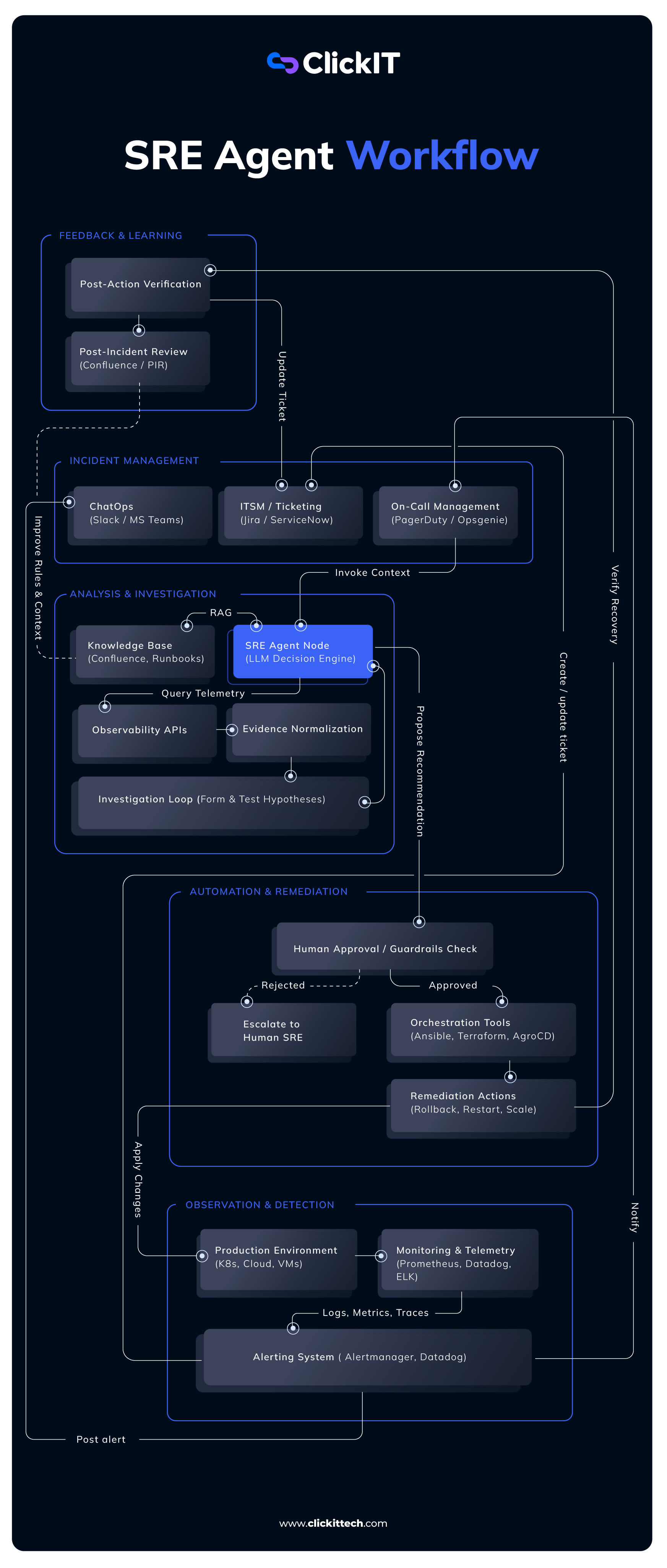
How the Workflow Works
Step 1: Alert Intake
The workflow begins when an operational signal triggers an investigation.
This could be a monitoring alert, an SLO violation, an anomaly detected by an observability platform, a deployment event, or another operational event that requires investigation.
The alert establishes the initial scope of the investigation but does not necessarily identify the cause.
Step 2: Context Gathering
The agent retrieves relevant information about the affected service, including ownership, dependencies, recent changes, dashboards, runbooks, and related incidents. The purpose is to establish the environment surrounding the alert.
This context helps the agent decide which evidence is relevant and which systems it needs to investigate next.
Step 3: Evidence Normalization
The agent brings information from different systems together into a consistent evidence set. The agent should preserve the source and freshness of each observation and distinguish observed facts from its own inferences.
Step 4: Investigation Loop
The agent evaluates possible explanations, retrieves additional evidence, and updates its assessment.
Gather Evidence → Form Hypothesis → Test → Update Confidence
The agent should distinguish between facts, correlations, hypotheses, and conclusions rather than treating every correlation as a confirmed root cause.
Step 5: Recommendation
Once the agent has gathered sufficient evidence, it can recommend an appropriate response and explain the evidence supporting it.
The recommendation should also communicate meaningful uncertainty when the evidence is incomplete or competing explanations remain plausible.
Step 6: Approval / Action
For higher-impact actions, an engineer should review and approve the recommendation before execution. For predefined, low-risk scenarios, the agent may be allowed to trigger an approved workflow automatically.
These workflows should enforce appropriate permissions, blast-radius limits, timeouts, rollback procedures, and other operational safeguards.
Step 7: Verification
After taking action, the agent checks whether the system has recovered by examining relevant metrics, service health, dependencies, and SLOs.
If recovery does not occur, the workflow can return to investigation or escalate to an engineer.
Step 8: Audit
The system records the alert, evidence retrieved, investigation, recommendation, approval, action, and verification results. This provides traceability and creates data to improve the agent over time.
The result is a controlled operational loop:
Detect → Understand → Decide → Act → Verify → Learn
How to Implement SRE Agents in Your Workflow?
A practical implementation of SRE agents in your workflow can be built around four areas:
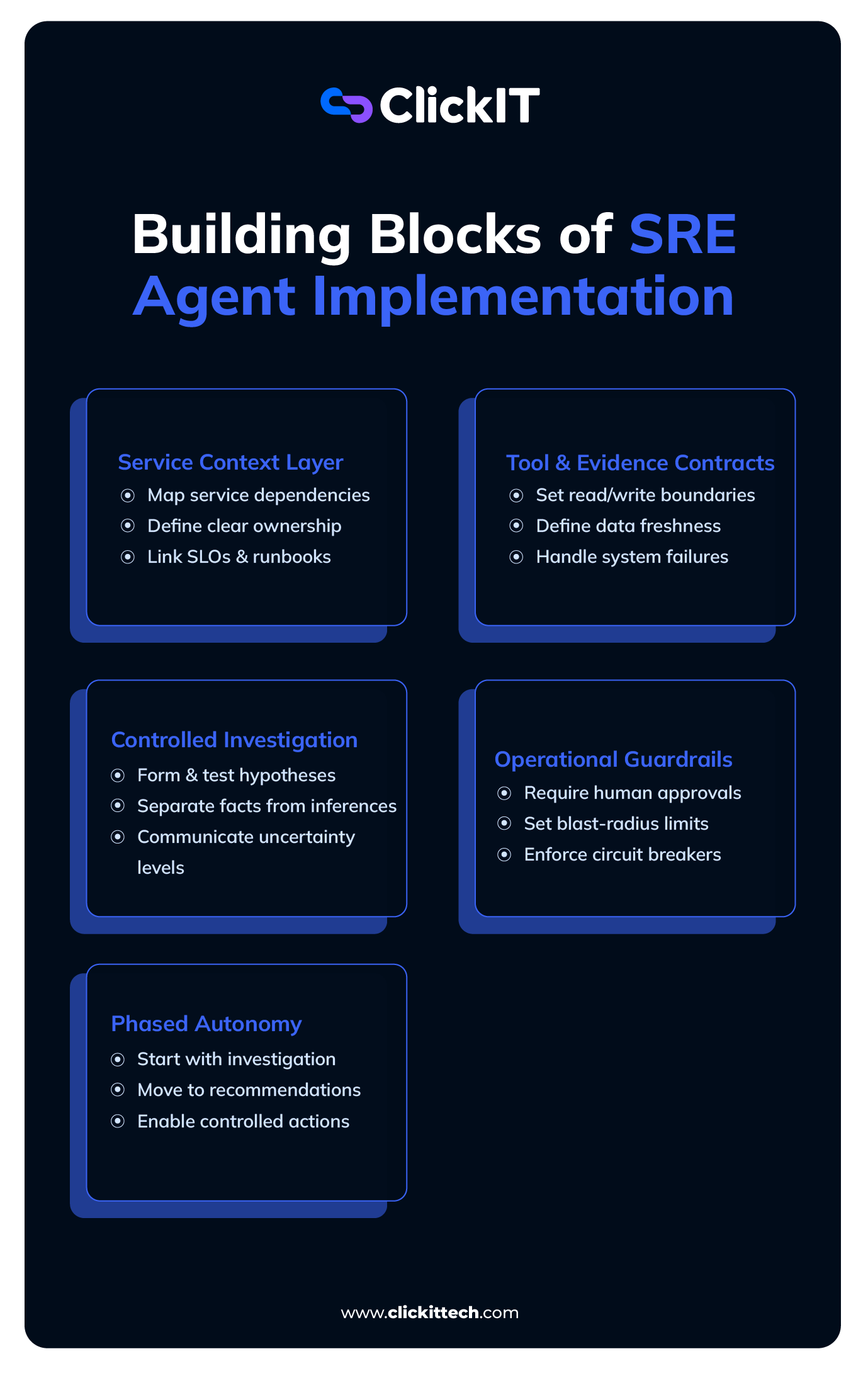
- Build a reliable service context layer.
- Define evidence and tool contracts
- Integrate existing operational tools
- Introduce controlled automation gradually
a) Build a Service Context Layer
An SRE Agent is only as useful as the context available to it.
Most organizations already have plenty of operational data. The problem is that information is often fragmented. Service ownership may exist in one system, dependencies in architecture documentation, dashboards in an observability platform, and runbooks in a knowledge base.
Grafana Labs’ 2026 Observability Survey reinforces AI’s growing role in observability. The survey found that 92% of respondents see value in using AI to surface anomalies and other issues before they cause downtime, while 91% see value in AI for forecasting and assisting with root cause analysis.
At the same time, complexity and overhead remain the biggest observability concern, cited by 38% of respondents.
Before introducing an agent, organizations should establish a reliable way to connect this information.
A useful starting point is a service context catalog. Instead of creating another repository containing every metric and log, the catalog provides a structured view of the environment. For each important service, it should capture information such as its owner, upstream and downstream dependencies, service criticality and SLOs, deployment environment, relevant dashboards, repositories and CI/CD pipelines, and associated runbooks.
This gives the agent something that raw observability data alone cannot provide: context and meaning.
For instance, an alert identifies a problem with Service A. The agent should be able to determine who owns the service, what it depends on, which other services depend on it, and where to retrieve the most relevant operational information.
The purpose is to give the agent a clear model of how the environment fits together.
Don’t simply give an SRE Agent access to more data. Give it context about the systems that data represents.
A well-maintained service catalog also provides benefits beyond AI implementation by reducing dependency on tacit knowledge (Institutional memory) and making system ownership clearer.
b) Define Evidence and Tool Contracts
Connecting an agent to a system is not enough. Each integration should have a clearly defined contract that describes what the agent can expect from that system and what it is allowed to do.
An evidence and tool contract should define at least five things:
- Purpose: What is the system used for during an investigation?
- Permissions: What can the agent read, recommend, or execute?
- Data freshness: How current is the information expected to be?
- Failure behavior: What should happen if the system is unavailable, returns incomplete data, or provides stale information?
- Output shape: What structure should the agent expect when information is returned?
Here is an example of a deployment-system contract:
- Purpose: Identify recent production deployments affecting a service.
- Permissions: Read-only.
- Data freshness: Deployment status should reflect the current production state.
- Failure behavior: If deployment information cannot be retrieved, the agent should mark it as unavailable rather than assume that no deployment occurred.
- Output: Service, version, deployment ID, timestamp, environment, and deployment status.
This makes the concept of context more concrete. The agent doesn’t simply have access to a collection of tools; it understands what each tool is intended to provide, how trustworthy the output is, and what it is permitted to do with that system.
The same principle should apply to observability, incident management, cloud infrastructure, Kubernetes, knowledge bases, and remediation workflows.
Clear contracts also make failures safer. If an evidence source is unavailable, the agent should be able to recognize that it has incomplete information. Then it should adjust the investigation rather than silently treating missing evidence as negative evidence.
c) Integrate Existing Operational Tools
Once the context layer is established, the next step is connecting the agent to the tools already used in the SRE workflow.
Depending on the environment, these may include:
- Monitoring and observability platforms
- Log and tracing systems
- Cloud and Kubernetes environments
- CI/CD pipelines
- Incident-management platforms
- Ticketing systems
- Knowledge bases
- Configuration management systems
The most important implementation principle is to start with read access.
Initially, the agent should focus on retrieving information rather than changing systems. It may query metrics, search logs, review traces, examine deployment history, and retrieve relevant documentation.
This alone can provide significant value.
For example, an existing monitoring platform detects an anomaly and sends the relevant event to the SRE Agent. The agent identifies the affected service, retrieves the appropriate context, investigates recent changes and operational signals, and produces an initial incident summary.
The monitoring platform still performs monitoring. The observability platform still stores and presents telemetry. Deployment systems track changes. Knowledge systems provide operational guidance. The SRE Agent connects this information to support investigation.
When the organization is ready to introduce remediation, it should expose actions through controlled tools or workflows rather than unrestricted credentials.
For example, the agent may be allowed to request an approved rollback workflow or restart a predefined workload. The existing automation system remains responsible for executing the action and enforcing permissions.
This creates a useful separation: The agent provides reasoning and decision support. Controlled automation performs execution.
d) Build a Controlled Investigation Loop
An SRE Agent should not be designed to gather information once and immediately produce a conclusion. A more reliable approach is to allow the agent to work through an investigation loop:
Gather Evidence → Form Hypothesis → Test Against Evidence → Update Confidence → Gather More Evidence
The agent can start with the information available from the alert and service context. It can then identify gaps, retrieve additional evidence, compare competing explanations, and update its assessment as new information becomes available.
For example, if application errors increase shortly after a deployment, the agent might initially consider the deployment, database performance, and a downstream dependency as possible causes.
It can then retrieve evidence relevant to each hypothesis and determine which explanation is best supported. Importantly, the agent should communicate uncertainty rather than presenting every conclusion as fact.
It should distinguish between:
- Observed facts
- Correlations
- Hypotheses
- Supported conclusions
- Unknown or unavailable information
This makes the investigation easier for engineers to evaluate and reduces the risk of false confidence.
e) Keep Humans in the Loop
Design human oversight into the workflow rather than adding it as an afterthought.
AI agents can generate useful recommendations, but operational environments are complex, and their conclusions should be evaluated according to the risk involved. The level of human involvement should therefore reflect the risk associated with the decision.
For example, collecting diagnostic information or creating an incident ticket may require little or no intervention. A production rollback or infrastructure change may require explicit approval.
For higher-impact actions, a practical workflow is:
Evidence → Hypothesis → Recommendation → Human approval → Controlled execution
The agent should explain why it is making a recommendation rather than simply issuing instructions.
For example, a recommendation to roll back a deployment should include the evidence that supports the decision, such as the timing of the deployment, the increase in error rates, and the absence of alternative explanations.
This makes the agent easier to evaluate and helps engineers identify incorrect assumptions.
f) Attach Guardrails to Every Action
Security and governance should be part of the execution workflow, not a separate checklist applied after the system is built.
Each action should have clearly defined boundaries based on its potential impact.
These controls can include:
- Permission tiers separating investigation, recommendation, and execution.
- Approval requirements for actions above a defined risk threshold.
- Blast-radius limits restricting which services or resources an action can affect.
- Dry runs that let you evaluate an action before execution.
- Canary execution for changes that can be introduced gradually.
- Rollback protocols providing a defined recovery path.
- Timeouts preventing workflows from running indefinitely.
- Circuit breakers stopping execution when predefined safety conditions are violated.
- Human escalation when the evidence is insufficient or the situation falls outside approved scenarios.
For example, instead of allowing an agent to execute an unrestricted infrastructure command, an organization could expose a specific rollback workflow that accepts only an approved service and deployment version.
The workflow can then enforce the required permissions, validate the parameters, execute the rollback, and return the result to the agent.
This approach keeps the agent’s reasoning capability separate from the authority to make production changes.
g) Introduce Automation Gradually
A common mistake is attempting to build a fully autonomous AI SRE Agent from the beginning.
A more practical approach is to expand automation as the organization develops confidence in the agent and the workflows surrounding it.
Stage 1: Investigate
Begin with a read-only agent that gathers context, summarizes incidents, retrieves relevant knowledge, and assists with root cause analysis.
At this stage, engineers can evaluate whether the agent retrieves useful information and produces reliable hypotheses without introducing production risk.
Stage 2: Recommend
Once the investigation capability is working effectively, the agent can begin recommending remediation steps.
It may identify the appropriate runbook, prepare a workflow, or suggest a specific action based on the available evidence. Engineers remain responsible for approval and execution.
Stage 3: Act
Allow the agent to trigger autonomous remediation only after you have established reliable workflows.
Even then, limit autonomy to known scenarios with well-defined and low-risk responses.
The agent should operate through approved workflows with appropriate permission boundaries, blast-radius limits, rollback mechanisms, and verification steps.
The organization should continuously evaluate whether the agent is retrieving the correct context, generating useful recommendations, and improving incident response. Increased autonomy should be earned through demonstrated reliability rather than assumed from the beginning.
Real-world example: Microsoft reported that more than 1,300 SRE Agents had been deployed internally by the March 2026 general availability launch, helping mitigate more than 35,000 incidents and saving over 20,000 engineering hours. This illustrates how SRE agents can move beyond experimentation and become part of large-scale operational workflows.
Here is another example: Google’s SRE team is already putting agentic AI into its incident-management workflow. It is not to replace engineers, but to collect context, improve handoffs, and automate parts of the incident lifecycle.
How to Evaluate an SRE Agent?
Before increasing an SRE agent’s autonomy, organizations should define how they will measure whether it is improving the reliability workflow.
Evaluation should consider both model quality and overall workflow quality. While model quality focuses on how well the agent performs individual tasks, Workflow quality looks at the broader operational outcome.
Key Evaluation Criteria:
- Correctness: Does the agent reach conclusions and recommendations that are supported by the available evidence?
- Evidence quality: Does it retrieve the right information, use sufficiently recent data, identify missing evidence, and distinguish observed facts from inferred conclusions?
- Useful uncertainty: Does the agent clearly distinguish between facts, hypotheses, and conclusions when the evidence is incomplete or conflicting?
- Latency: How quickly can the agent gather context, produce a useful investigation, recommend an action, and verify the result? The appropriate target will depend on the severity and type of incident.
- Operator trust: Do engineers understand the agent’s reasoning and find its recommendations useful enough to incorporate into real incident workflows?
- Safety: Does the agent remain within its permissions and behave predictably when tools fail, evidence is incomplete, or an action falls outside its approved boundaries?
- Operational cost: Do the benefits such as reduced investigation time and operational toil justify the costs of model usage, data retrieval, integrations, infrastructure, and maintenance?
Model Quality vs. Workflow Quality
Consider these measurements at two levels.
- Model quality evaluates how well the agent reasons, retrieves information, uses tools, and produces recommendations.
- Workflow quality evaluates the overall operational outcome: whether the agent reduces investigation effort, improves response, operates safely, and delivers measurable value to the SRE team.
A model can perform well while the overall workflow performs poorly. For example, an agent may generate technically accurate summaries but take too long to investigate an incident or lack access to critical operational data.
Evaluation should therefore continue after deployment:
Measure → Review → Improve → Re-evaluate
If an agent repeatedly produces weak recommendations, the solution may not be a better model. The problem could instead be incomplete context, poor tool integration, stale evidence, or inadequate workflow controls.
Organizations should consider expanding their authority from Investigate to Recommend and eventually Act only after an agent demonstrates reliable performance.
End-to-End Incident Walkthrough
For an end-to-end incident walkthrough, consider a common production scenario wherein an application begins experiencing an elevated error rate shortly after a new deployment.
Here is an example showing how an SRE Agent could move from the initial alert to investigation, recommendation, controlled action, and verification.
1. Alert Intake
The monitoring system detects that the payment service’s HTTP 5xx error rate has exceeded its defined threshold.
- Observed: Error rates increased at 14:07 UTC.
The alert identifies the affected service, environment, severity, and time of the event. The agent does not assume that the alert itself identifies the cause.
2. Context Gathering
The agent retrieves the service’s operational context from the service catalog and connected systems.
It identifies the service owner, dependencies, relevant dashboards and runbooks, and recent production changes.
The deployment system shows that a new version of the payment service was deployed shortly before the alert.
- Observed: Deployment completed at 14:03 UTC.
The agent then retrieves relevant metrics, logs, traces, and database information.
3. Evidence Normalization
The agent brings the relevant signals together and aligns them around the incident timeline.
- Observed: Error rates increased at 14:07 UTC.
- Observed: Deployment completed at 14:03 UTC.
- Observed: Database latency increased at 14:06 UTC.
- Observed: Three dependent services also show elevated latency.
At this point, the agent should distinguish observations from assumptions. The deployment is a possible explanation, not yet a confirmed root cause.
4. Competing Hypotheses
The agent considers several possible explanations:
- Hypothesis 1: The recent deployment introduced an application regression.
- Hypothesis 2: Database performance degradation caused the application errors.
- Hypothesis 3: A downstream dependency is responsible for the increased failures.
The agent retrieves additional evidence to test these possibilities.
It finds that the deployment introduced a change affecting database connection behavior. The affected services share the updated dependency, while no corresponding infrastructure anomaly is detected.
The deployment therefore becomes the leading hypothesis, but the agent should communicate the conclusion with appropriate uncertainty rather than treating correlation as proof.
5. Recommendation
Based on the available evidence, the agent recommends rolling back the deployment using the organization’s approved rollback procedure.
It explains the reasoning:
- Recommendation: Roll back the latest payment-service deployment.
- Reason: Error rates increased shortly after the deployment, the affected services share the updated dependency, and no corresponding infrastructure anomaly was detected.
The recommendation is then presented to the responsible engineer for review.
6. Approval and Action
As a production rollback has operational consequences, the engineer reviews the evidence and approves the action.
The agent does not execute an unrestricted production command. Instead, it invokes the organization’s controlled rollback workflow, which enforces the required permissions and execution safeguards.
If the organization had previously defined this scenario as a sufficiently low-risk autonomous action, the same controlled workflow could potentially be triggered automatically.
7. Verification
After the rollback completes, the agent verifies whether the system has recovered.
It checks the error rate, service latency, database performance, and health of the dependent services. If these signals return to their expected levels, the remediation can be considered successful.
If the expected recovery does not occur, the agent should not simply continue executing additional actions. It can return to the investigation loop, escalate to an engineer, or follow a predefined recovery procedure.
8. Audit
The complete investigation is recorded for later review.
The audit trail can include the original alert, retrieved evidence, hypotheses considered, recommendations, approvals, actions taken, and verification results.
This creates a traceable operational workflow:
Alert → Context → Evidence → Investigation → Recommendation → Approval / Action → Verification → Audit
Key Considerations When Implementing an SRE Agent
Implementing an SRE Agent is not only a technical challenge. Organizations also need to consider the cost of operating the agent, the security and compliance implications of giving it access to operational systems, and the sensitive information that may appear in the data it processes.
Because many of these controls should already be built into the architecture and execution workflows, the key consideration is maintaining them as the agent scales.
a) Costs
When it comes to cost, it is not limited to the underlying AI model.
Agent workflows may generate costs through model usage, data retrieval, integrations, storage, and the infrastructure required to operate and evaluate the system.
For this reason, organizations should avoid invoking an AI agent for every operational event.
For instance, traditional automation handles known and predictable problems efficiently. AI reasoning is most valuable when an incident requires investigation across multiple information sources.
A cost-effective approach is to filter events and invoke the SRE Agent when additional reasoning is likely to provide value. For example, use AI agents for high-severity incidents, unusual failure patterns, or situations that existing automation cannot resolve.
Context management also affects cost. Sending large volumes of raw operational data to a model can increase costs and noise. The agent should retrieve information relevant to the incident rather than attempting to process everything available.
Use AI where reasoning adds value, not simply because AI is available.
b) Security and Compliance
An SRE Agent may have access to sensitive operational systems, making security architecture essential.
The principle of least privilege should apply throughout the implementation. An agent investigating incidents may need permission to read metrics, logs, deployment information, and approved documentation. Those requirements do not automatically justify permission to modify infrastructure.
Controlled tools provide an additional security layer. Instead of allowing an agent to execute arbitrary commands, organizations can expose specific approved actions that enforce authentication, authorization, and operational safeguards.
Organizations should also maintain an audit trail of the agent’s activity. Teams should be able to understand what triggered the agent, what information it accessed, which tools it used, and what actions were ultimately taken.
These controls become particularly important in environments with requirements around access management, data residency, retention, or regulatory compliance.
c) Controlling Sensitive Information
Operational data can contain more than technical signals.
- Logs may include personally identifiable information, session identifiers, or authentication data.
- Configuration systems may contain secrets.
- Internal documentation can expose sensitive infrastructure details.
Organizations should therefore control both what information the agent receives and what information it can reveal.
To achieve this, redact secrets, credentials, tokens, and sensitive personal information wherever possible before sending the information to the model. Additionally, the agent should retrieve information based on the task at hand rather than automatically accessing unrelated systems.
A particularly important principle is:
Treat retrieved content as data to analyze, not as instructions to follow.
Logs, tickets, and documentation may contain useful information, but they should not automatically be treated as trusted instructions or authorization to perform an action.
The same controls should apply to the agent’s outputs. An incident summary shared broadly should not expose credentials, customer information, or sensitive infrastructure details simply because the agent had access to that information during its investigation.
The goal is to give the AI SRE Agent enough context to be effective without giving it unnecessary visibility into sensitive systems or information.
Need help architecting secure AI SRE agents for your stack? → Talk to our AI engineering experts.
Frequently Asked Questions (FAQs)
The timeline depends on the complexity of the existing SRE environment, the number of systems to integrate, and the level of automation required. A focused implementation for a specific workflow, such as incident triage, can be started much sooner than an agent designed to support multiple services and autonomous remediation.
An incorrect recommendation should be treated as a possibility, not an exceptional failure. It is important for engineers to review, reject, or correct the agent’s recommendations before high-impact actions are taken. You should also evaluate incorrect recommendations over time to identify recurring weaknesses in the agent’s context, tools, or reasoning.
Yes. An SRE Agent can support multiple services and teams when the underlying service ownership, dependencies, permissions, and operational knowledge are clearly defined. However, make sure that a shared agent does not automatically have unrestricted access to every team’s infrastructure or data.