Launching an AI MVP often brings pressure. You need to validate fast, cut costs, and show value. Do this before spending too much time on infrastructure.
However, when an AI solution processes internal documents, customer data, sensitive prompts, or model responses, security is essential.
Many companies start by connecting their application directly to external AI services, storing documents without clear segmentation, or exposing APIs without sufficient controls.
This might work for a demo, but not necessarily for a product that needs to operate with real data.
The main risk is losing control of information. This includes what data is sent. It also includes who can access it and how the data is stored. It includes how the data is audited and how easily the solution can scale.
A secure architecture on AWS for an AI MVP aims to solve this problem from the outset. The goal is not to build an overly complex platform. Instead, we will create a solid technical foundation. In it, the application, data, models, and access are separated. They are also protected and monitored.
Blog Overview: AWS Architecture for AI MVP
- Security must start at the MVP stage because AI applications often process sensitive prompts, internal documents, customer data, and model-generated responses.
- AWS provides a scalable foundation using services like Route 53, CloudFront, S3, AWS WAF, ALB, ECS Fargate, and Amazon Bedrock.
- Private networking reduces exposure by keeping backend services inside private subnets while allowing only controlled API access through the Application Load Balancer.
- Amazon Bedrock and Knowledge Bases enable secure AI features such as RAG, document search, summarization, and enterprise copilots without managing custom AI infrastructure.
- Governance tools like IAM, KMS, Secrets Manager, CloudWatch, and CloudTrail help protect access, encrypt data, manage secrets, monitor performance, and support auditability.
Why is security essential for an AI MVP?
Traditional projects often leave security for later phases. In artificial intelligence, that decision can be especially costly.
An AI MVP doesn’t just run business logic. It can also handle sensitive data. It can generate automated responses. It can search private documents. It can connect to foundation models.
If the initial architecture does not consider security, it is harder to fix issues later.
These issues include exposed services, broad permissions, unencrypted storage, and missing audits.
They also include direct reliance on external APIs without control over data.
Furthermore, security also functions as a product feature. For a startup or company selling an AI-based solution, it helps to prove that data stays in a controlled environment.
Audit logs should exist. Do not expose services directly to the internet. This can be a key differentiator for technical or corporate clients.
Key Components of AWS Architecture for AI MVP
The proposed architecture is divided into four main layers:
- Input and distribution layer.
- Network and computing layer.
- AI layer and data privacy.
- Security, governance, and monitoring layer.
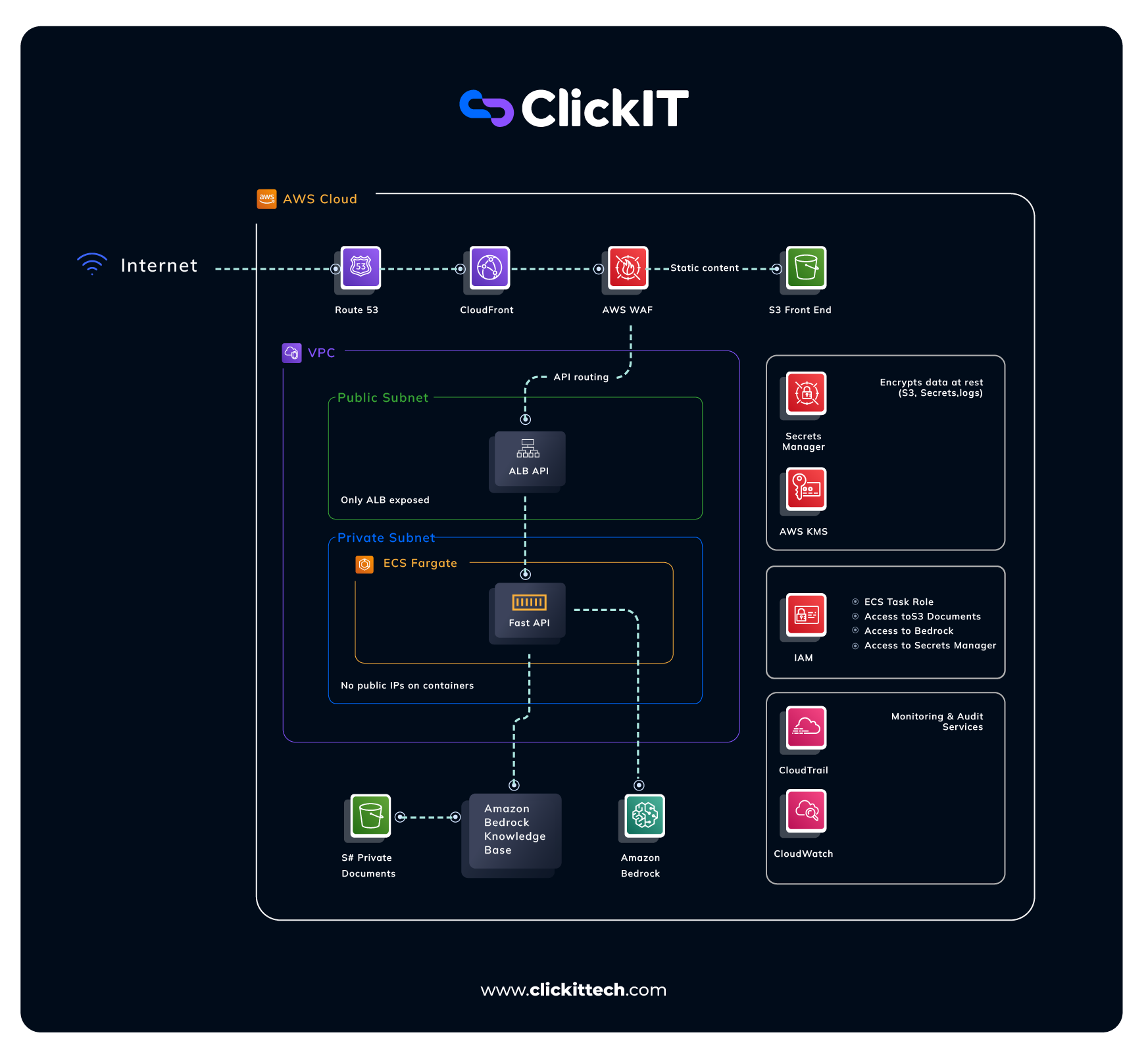
The overall flow begins when a user accesses the application via a Route 53-managed domain. CloudFront and S3 deliver static frontend content, while an Application Load Balancer routes API requests.
From there, traffic enters private services within a VPC, where application logic runs in containers on ECS Fargate.
The application can query private documents in S3. It can generate embeddings or run semantic searches using Knowledge Bases.
It can also connect to foundation models using Amazon Bedrock. IAM, KMS, Secrets Manager, CloudWatch, and CloudTrail secure all of this. It is secured with IAM, KMS, Secrets Manager, CloudWatch, and CloudTrail.
Edge & Entry Layer
Route 53 handles DNS resolution. Simply put, it maps the application’s domain to the appropriate AWS services. It’s the first point of reference for users to access the system using a user-friendly URL.
CloudFront functions as a content delivery network. Its role is to deliver static frontend files, such as HTML, CSS, JavaScript, and images, with low latency. Rather than serving these files from an application server, CloudFront delivers them from locations near the end user.
You can use S3 to host the static frontend. This reduces the need to manage web interface servers. It also simplifies deploying modern apps built with React, Vue, or Angular.
AWS WAF adds a first line of defense. It filters harmful traffic before it reaches the application. It blocks common attacks like SQL injection, cross-site scripting, and endpoint abuse. In an MVP, this helps reduce risk without implementing all the protection logic directly in the backend.
Networking and Compute Layer (VPC)
The VPC is the private network where the architecture resides. It allows you to isolate resources, define IP ranges, control routes, and separate public components from private components.
Within this VPC, we recommend separating services into public and private subnets. The public subnet contains the Application Load Balancer (ALB). It receives internet traffic and routes it to the application. The ALB acts as a controlled entry point for the API.
The core application logic, for example, an API developed in FastAPI, runs on ECS Fargate within a private subnet.
This means that the containers do not need a public IP address and are not directly accessible from the internet. Traffic must first pass through the ALB, which improves control, security, and traceability.
ECS Fargate allows you to run containers without directly managing EC2 servers. For an MVP, this helps because it lowers the operational burden.
The team can focus on the app, endpoints, AI integration, and business logic.
AWS handles the underlying execution infrastructure.
AI and Data Privacy Layer
- Amazon Bedrock lets you use foundation models from AWS and other providers.
You can do this without running your own machine learning infrastructure. For an AI MVP, this speeds up development. The team can add text generation, analysis, summarization, or chat help. They can do this without training a model from scratch. - Knowledge bases help build RAG solutions. In this pattern, the application does not rely only on general model knowledge. Instead, it consults private documents to generate more contextual answers.
This is especially useful for internal assistants, intelligent search engines, enterprise copilots, or documentation-based technical support systems.
- Private documents are stored in S3. This bucket should serve as a controlled silo for sensitive information. It can store manuals, PDFs, internal policies, contracts, knowledge bases, and technical documentation.
The advantage of this separation is that the information can inform the model’s responses. It does so without exposing it or mixing it with public storage.
In this design, the goal is to maintain control over the documents, queries, and generated responses. The application decides what information to query, how to construct the prompt, and what data to send to the model.
Security & Governance Layer
- AWS KMS allows you to manage encryption keys to protect data at rest. You can use it to encrypt S3 buckets, logs, and other sensitive resources. This is important when the solution processes internal documents or customer data.
- Secrets Manager stores secrets such as API keys, database credentials, tokens, or sensitive settings. Instead of storing secrets within code or exposed variables, the application securely retrieves them when needed.
- IAM defines permissions between services. In this architecture, ECS Fargate should use a Task Role with minimal permissions. It should grant access only to required buckets, Bedrock, Secrets Manager, and necessary resources. This approach follows the principle of least privilege and reduces the impact if an attacker compromises a component.
- CloudWatch provides operational monitoring. It allows you to view application logs, metrics, errors, latency, and service behavior. For an MVP, this is crucial because it helps detect failures quickly and understand how the solution performs under real-world use.
- CloudTrail logs API events within AWS. This means it allows you to know who did what, when, and from where. This adds an auditing layer that can be crucial for investigations, internal compliance, or security reviews.

Building an AI MVP doesn’t mean sacrificing security. With a well-designed AWS architecture, you can move fast without losing control of data, access, or operations.
Services like Route 53, CloudFront, S3, AWS WAF, ALB, and ECS Fargate help build a modern base.
They support AI solutions that need security, scale, and traceability from day one.
Amazon Bedrock and Knowledge Bases add AI features and managed context.
KMS and Secrets Manager protect keys and secrets. IAM controls access across services.
CloudWatch and CloudTrail support monitoring and audit tracking.
If your team is building a similar idea, you can get expert DevOps and Cloud Architecture support.
This can help you move a prototype into production faster.
It can also help you improve your AI app.
It can speed up delivery and reduce early technical risks.
FAQs: AWS Architecture for AI MVP
An AWS architecture for AI MVP is a cloud infrastructure setup designed to help teams build, test, and validate an AI product while keeping data, APIs, and model interactions secure.
Security is important because AI MVPs may process sensitive prompts, internal documents, customer information, and generated responses. Without proper controls, the product can expose data or require major rework later.
A secure AI MVP architecture can use services like Route 53, CloudFront, S3, AWS WAF, Application Load Balancer, ECS Fargate, Amazon Bedrock, IAM, KMS, Secrets Manager, CloudWatch, and CloudTrail.
Amazon Bedrock allows teams to integrate foundation models without managing their own AI infrastructure. It can support use cases like chatbots, document analysis, summarization, intelligent search, and AI assistants.
Yes. A well-designed AWS architecture for AI MVP can scale into production by using private networking, managed containers, secure storage, monitoring, audit logs, and controlled access from the beginning.