How does a Large Language Model answer questions about your company’s documents, find the right information from millions of records, and avoid exposing sensitive data all within a matter of seconds?
This is where NLP Pipelines in Modern AI Frameworks play a critical role, acting as the foundation that prepares, enriches, and governs data before it reaches AI models.
For years, we treated Natural Language Processing (NLP) pipelines as standalone utility knives.
You built a pipeline to do one specific job:
- Classify a support ticket
- Extract a product name
- Score the sentiment of a tweet.
While those tasks haven’t disappeared, the rise of generative AI has completely rewritten the NLP playbook.
Today, NLP Pipelines in Modern AI Frameworks are no longer isolated processing components; they have become essential infrastructure for building scalable, secure, and reliable AI applications.
In a production environment, the NLP pipeline acts as the essential ingestion engine and operational guardrail for your LLM.
Raw corporate data isn’t ready for a model out of the box. It has to be aggregated from:
- messy sources
- stripped of noise
- structured with metadata
- chunked semantically
- converted into vector embeddings
- scrubbed for compliance and security.
Whether you are architecting a Retrieval-Augmented Generation (RAG) system, a semantic search engine, or an autonomous agent framework, your NLP pipeline is the literal bridge between chaotic raw data and intelligent, reliable outputs.
A Modern AI NLP Pipeline is an automated, scalable system that ingests unstructured text, enriches it through preprocessing, semantic chunking, metadata extraction, and embedding generation, while also enforcing governance, compliance, and security controls.
Its purpose is to prepare high-quality contextual data for downstream AI systems such as LLMs, RAG applications, semantic search platforms, and autonomous AI agents.
As engineering teams move past the wrapper-app phase and begin scaling enterprise AI, choosing the right model is no longer the hardest problem. The real differentiator between a fragile prototype that hallucinates and a production-grade system that drives actual business value comes down to the engineering rigor of the pipeline supporting it.
In the sections that follow, we’ll unpack exactly how NLP Pipelines in Modern AI Frameworks are architected, break down the core stages, explore the toolsets dominating the ecosystem, and examine the performance bottlenecks you’ll encounter when moving from experimentation to production scale.
How does a Hybrid NLP and LLM Pipeline Work?
The Large Language Model is often the last stop on a much longer pipeline of retrieval, processing, and orchestration steps. If you try to dump raw, unformatted company data straight into a model, you’re essentially lighting money on fire through wasted context windows and significantly increasing the risk of hallucinations.
The LLM is a reasoning engine, not a data manager. The actual heavy lifting happens long before the model ever sees a prompt. This is one of the core principles behind NLP Pipelines in Modern AI Frameworks; the model performs the reasoning, but the pipeline is responsible for preparing the information it reasons over.
Here is how a production-grade data pipeline actually processes text from the ground up.
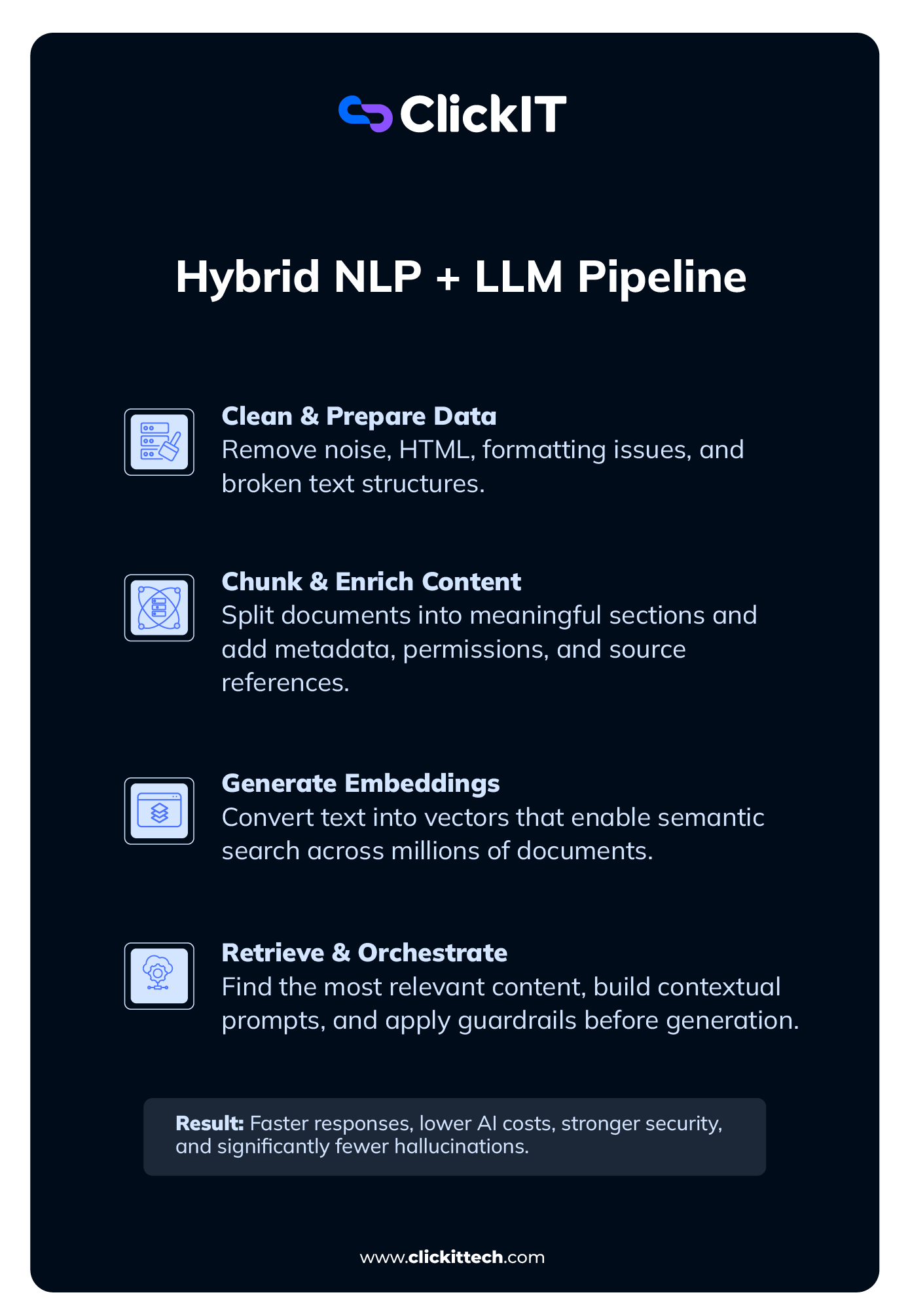
Step 1: Pre-processing and Cleaning
Enterprise data is notoriously messy. If you’re pulling from old PDFs, internal wikis, or customer support database dumps, your raw data will be choked with HTML tags, broken Markdown, system timestamps, and weird character encodings.
You don’t need an expensive, heavy transformer model just to clean up strings. That’s a massive waste of compute. This is exactly where lightweight, old-school libraries like spaCy or NLTK are still king. They do the basic grunt work in milliseconds for practically zero cost.
At this stage, the code handles a few quick, aggressive tasks:
- Cleaning up formatting junk: This means running regex or BeautifulSoup to kill HTML, inline styles, and tracking scripts. Leaving in erratic double spacing, rogue page breaks, and hidden control characters just burns up your token budget for zero reason.
- Intelligent sentence boundaries: You can’t just split text everywhere you find a period, that breaks the moment you hit basic abbreviations like etc., vs., or Inc. You need code that actually understands where a complete thought ends based on grammar rules.
Word of advice: Don’t over-optimize. Old-school search tricks like aggressive stemming (chopping words down to their roots) or stripping out every single stopword will backfire here. Modern transformer models actually need those tiny connecting words to figure out the exact nuance and intent of a sentence.
Step 2: Chunking and Semantic Enrichment
Once the text is clean, you have to break it into digestible pieces. You obviously can’t feed a 200-page vendor contract into an embedding model in one shot.
The wrong way to handle this is fixed-character splitting like blindly cutting the text every 500 characters. If you do that, you’ll slice critical sentences right down the middle, disconnect a subject from its verb, and completely ruin the context.
Production pipelines often combine tokenizers with document structure analysis, recursive splitters, or embedding-based chunking strategies to identify logical breakpoints. It then splits the text there, usually keeping a small rolling window of overlapping tokens between chunks so context doesn’t get lost at the edges.
While the pipeline is slicing up the text, it simultaneously slaps a structured metadata payload onto every chunk. A block of text is useless during a search if it doesn’t know its own history.
The pipeline injects tags like:
- Source Lineage: File paths or URLs so the final UI can cite exactly where the answer came from.
- Hierarchy Trees: Parent-child relationships to map data structure.
- Timestamps: Essential for flagging outdated info. If a company policy changes, you need a temporal anchor so the system knows to ignore the stale version from two years ago.
- Access Control Lists (ACLs): Security tags that map directly to user permissions. The pipeline has to enforce this at the structural level so a user never accidentally pulls context from a document they aren’t cleared to read.
Step 3: Vectorization and Embedding Generation
Once your text blocks are cleaned and tagged, you have to translate human language into something a machine can calculate. That’s where embedding models enter the picture.
Instead of index-matching static keyword IDs like an old-school search database, an embedding maps text chunks into a multidimensional vector space. The output is a dense vector, basically a massive array of floating-point numbers that represents the conceptual meaning of that text.
This completely flips the search paradigm. Because the system tracks concepts instead of literal words, phrases with entirely different vocabularies align automatically in the vector space.
The pipeline writes these vectors straight into a specialized Vector Database (think Pinecone, Qdrant, Milvus, or pgvector).
Most production vector databases rely on Approximate Nearest Neighbor (ANN) indexes to scan millions of vectors and identify relevant context chunks in milliseconds.
Step 4: LLM Orchestration
At this point, your data is cleaned, indexed, and stored. The final layer is orchestration; the runtime workflow that connects a user’s live question to the underlying knowledge base.
In most enterprise RAG applications, users rarely interact directly with an LLM without retrieval and orchestration layers. Frameworks like LangChain or LlamaIndex act as the glue to manage a strict, stateful sequence behind the scenes.
- Vectorizing the Query: The moment a user submits a question, the backend converts the text into a mathematical representation. You should use the same embedding model that was used to index the documents from Step 3 here, the vector space matching will completely break.
- Context Retrieval: The system hits your database with that fresh query vector to run a quick similarity scan. This pulls back the top 3 or 5 closest matching text fragments, along with all the metadata tags we injected earlier.
- Building the prompt: The orchestrator takes those retrieved data snippets and drops them straight into a dynamic prompt template. By sandwiching the user’s original question right next to those verified text blocks, you pin the LLM down to a hard boundary. You’re essentially telling it: “Only use the text blocks below. If the answer isn’t in there, just admit you don’t know.”
- Execution & Guardrails: Once the structured prompt hits the LLM, the framework grabs the raw output stream. It passes the output through validation and guardrail checks to verify formatting, citations, and policy compliance before pushing a clean answer back to the UI.
Read the blog LangChain vs LlamaIndex
The Takeaway
Building enterprise AI isn’t an “either/or” choice between classical software engineering and LLMs. It’s a hybrid architecture.
This layered approach is exactly why NLP Pipelines in Modern AI Frameworks have become such a critical architectural pattern. They allow organizations to combine the speed and reliability of traditional NLP techniques with the flexibility and reasoning capabilities of modern LLMs. Spend the time to build a tight pipeline upfront, and your downstream application will be faster, cheaper, and vastly more accurate.
Code Blueprint: Wiring spaCy into an AI Framework
Understanding the theory behind data preparation is one thing, but seeing how data structures actually flow from a deterministic library to a generative orchestrator is when things click.
A common mistake when hacking together a prototype is throwing raw documents directly at an embedding model or an API endpoint. Production data is full of formatting noise, metadata corruption, and structural garbage that poisons your vector search.
The script below shows how to build a clean engineering loop. We use spaCy for cheap, deterministic preprocessing, generate our math representation with a Hugging Face encoder, and let LangChain handle local vector indexing.
# -----------------------------------------
# Step 1: Import Required Libraries
# -----------------------------------------

import spacy

from langchain.text_splitter import RecursiveCharacterTextSplitter
from langchain_huggingface import HuggingFaceEmbeddings
from langchain.vectorstores import FAISS

# Load spaCy language model
nlp = spacy.load("en_core_web_sm")


# -----------------------------------------
# Step 2: Clean and Normalize Raw Text
# -----------------------------------------

def preprocess_text(raw_text):
    """
    Classical NLP layer.

    spaCy handles tokenization, sentence parsing,
    and basic text normalization before the text
    reaches embedding models or LLMs.
    """

    doc = nlp(raw_text)

    cleaned_tokens = []

    for token in doc:

        # Ignore punctuation and extra spaces
        if token.is_punct or token.is_space:
            continue

        cleaned_tokens.append(token.text)

    return " ".join(cleaned_tokens)


# Example source document
raw_document = """
Artificial Intelligence is transforming modern enterprises.
Many organizations are building Retrieval-Augmented Generation
systems to improve answer quality and reduce hallucinations.
"""

clean_document = preprocess_text(raw_document)


# -----------------------------------------
# Step 3: Document Chunking
# -----------------------------------------

text_splitter = RecursiveCharacterTextSplitter(
    chunk_size=500,
    chunk_overlap=50
)

chunks = text_splitter.split_text(clean_document)


# -----------------------------------------
# Step 4: Generate Embeddings
# -----------------------------------------

embedding_model = HuggingFaceEmbeddings(
    model_name="sentence-transformers/all-MiniLM-L6-v2"
)

# Convert text chunks into vectors
vector_store = FAISS.from_texts(
    texts=chunks,
    embedding=embedding_model
)


# -----------------------------------------
# Step 5: Retrieve Context
# -----------------------------------------

query = "How does RAG reduce hallucinations?"

retrieved_docs = vector_store.similarity_search(
    query,
    k=3
)


# -----------------------------------------
# Step 6: Pass Context to the LLM
# -----------------------------------------

context = "\n".join(
    [doc.page_content for doc in retrieved_docs]
)

prompt = f"""
Answer the question using only the provided context.

Context:
{context}

Question:
{query}
"""

# Prompt is now ready to be sent to an LLM
# through LangChain, OpenAI, Anthropic, etc.

print(prompt)
Note: For simplicity, this example uses LangChain’s RecursiveCharacterTextSplitter. Many production RAG systems use semantic or embedding-aware chunking strategies to preserve topic boundaries and improve retrieval accuracy.
What’s Happening Under the Hood?
Instead of relying on a single model to magically figure out your data, this script distributes the workload across three highly specialized layers.
- The process kicks off at the string level. Rather than booting up a giant, resource-heavy model just to parse text, spaCy acts as an initial filter. It strips out whitespace and structural noise on local CPU cores in milliseconds.
- Once that text is normalized, the Recursive Splitter slices the documents down into predictable context blocks, which are immediately passed to the Sentence Transformers engine. This engine doesn’t look at word matches; it calculates the conceptual geometry of the text and writes those math arrays directly into our FAISS index.
- At the very end of the line, LangChain handles the glue logic. It translates the incoming user question, scans the vector database, extracts the relevant pieces, and packages everything inside a strict context window. By the time the final prompt hits your LLM, the raw, chaotic enterprise data has been thoroughly structured into a safe, factual baseline.
When developers talk about building production-ready RAG applications, this hybrid approach is exactly what they’re referring to: a pipeline in which traditional NLP prepares the data, retrieval systems surface the relevant context, and LLMs transform that context into useful answers.

Key Performance Bottlenecks in Modern AI Pipelines
One of the most predictable questions that hits engineering team channels a few weeks after a RAG system goes live is: “Why is our retrieval loop taking forever?”
The knee-jerk reaction is almost always to blame the Large Language Model. It’s the highest-profile, most expensive asset in the infrastructure stack, so it makes an easy target.
But once you start profiling production metrics, you quickly realize that latency spikes can trigger at multiple points along the wire and the root cause frequently has nothing to do with model inference.
Fixing performance issues requires recognizing that NLP Pipelines in Modern AI Frameworks run on two fundamentally different processing profiles:
- The CPU-Bound Workloads: Low-level text parsing, string adjustments, and deterministic file cleaning.
- The GPU-Bound Workloads: Tensor-based matrix multiplications, embedding generation, and token generation.
Misjudging where your data is stacking up leads to wasted engineering hours and bloated cloud infrastructure bills.
CPU-Bound Bottlenecks
Before an embedding model computes a single vector coordinate, your application spends massive amounts of time handling document logistics. This means pulling data from messy PDFs, stripping raw HTML strings, parsing text into sentences, extracting metadata, and verifying user permissions.
Because these are deterministic string manipulation tasks, they run entirely on standard host CPUs. If you are indexing a couple of dozen policy briefs, this execution phase is practically instantaneous.
However, the moment your enterprise ingestion system tries to consume hundreds of thousands of multi-page technical manuals or multi-year database backups, the preprocessing layer can completely paralyze your system.
How to spot a CPU-bound logjam:
- Ingestion pipelines completely stall out, leaving message queues backed up.
- Cluster monitoring shows host CPU cores pegged at 100% while expensive GPU instances sit completely idle waiting for data blocks.
- Indexing processes drag on for hours before the actual embedding steps even initialize.
Production Antipattern:
The biggest mistake teams make here is using an LLM to handle jobs that traditional software can often do in milliseconds. Do not call a multi-billion-parameter model to summarize document topics or extract keywords if a local spaCy pipeline or regex loop can parse them instantly for zero compute cost.
Fixing the Ingestion Engine:
- Parallel Worker Pools: Offload heavy document parsing (like OCR or complex PDF extraction) across distributed CPU worker groups using frameworks like Celery or multiprocessing.
- Decouple the Paths: Ensure your heavy offline ingestion engine runs on separate computing nodes from your live, user-facing query infrastructure so batch uploads don’t freeze user conversations.
GPU-Bound Bottlenecks
Once your text blocks are clean, structured, and chunked, the application drops the string processing and hands the workload off to tensor-intensive GPU operations. This is the vectorization and generation space.
Unlike string parsing, computing embeddings and executing LLM inference requires massive matrix math calculations that crawl along on a CPU but run in parallel on specialized hardware.
The Invisible Embedding Drag
Engineers regularly tune their LLM configurations while leaving their embedding layer completely unmonitored. When you run massive historical batch jobs, handle rolling document synchronization, or support live data streams, the embedding generation step can instantly overwhelm your GPU capacity.
If your application needs to handle millions of incoming data streams, scaling up your embedding resource allocation is critical to avoiding a massive system backup.
Inference Concurrency Crises
Live inference latency typically spikes under a few specific conditions:
- Context Bloat: Pulling too many document chunks and shoving a massive text payload into the context window, forcing the attention mechanism to process huge token arrays.
- Oversized Architectures: Deploying a massive 70B model for an internal application that would actually run faster and cheaper on an optimized 8B model paired with a tighter retrieval strategy.
The Dark Horse: Network and Search Latency
Sometimes, neither your processor cores nor your graphics cards are at fault. A significant portion of the latency in a RAG system comes down to basic IO and retrieval mechanics.
If your orchestration service is running in one region, your vector index is hosted across the country, and your model endpoint is managed by a third-party API, network transport delays will absolutely kill the user experience.
Furthermore, executing slow vector database queries over millions of records without a proper Approximate Nearest Neighbor (ANN) indexing strategy can make the system crawl, regardless of how fast your hardware is.
Quick Diagnostic Matrix
Before tweaking model hyperparameters or upgrading your cloud tier, use this high-level map to isolate where your system is actually struggling:
| System Symptom | Primary Suspect | Remediation Strategy |
| Processing queues stalling during document uploads | CPU Preprocessing / PDF Parsing | Spin up parallel CPU worker pools; swap out heavy regex loops for native spaCy components. |
| GPU utilization spikes to 100% during historical indexing | Embedding Compute Limits | Implement batch embedding processing; implement vector caching layers to prevent redundant runs. |
| High cloud bills with low throughput | Over-provisioned Model Architecture | Shift to a smaller, optimized model; restrict your context window to include only highly relevant fragments. |
| Erratic response latency on simple queries | IO / Network Roundtrips | Consolidate your architecture into a unified cloud zone; audit your vector database indexing setup. |
Building production-ready generative AI applications is no longer a race to select the biggest or most expensive model.
As the wrapper-app ecosystem matures, the real competitive advantage belongs to engineering teams who treat text preparation as a core infrastructure challenge. Designing robust NLP Pipelines in Modern AI Frameworks is the definitive way to bridge the gap between messy, unstructured corporate knowledge bases and deterministic, enterprise-grade AI applications.
By offloading the heavy lifting of string manipulation, layout stripping, and language rules to lightweight, local components, you free up your Large Language Models to do exactly what they do best: reason, synthesize, and interact.
Optimization doesn’t mean replacing one generation of tech with another; it means creating a tight, cost-efficient partnership between classical deterministic engineering and modern probabilistic neural networks.
When you spend the time to architect intelligent NLP Pipelines in Modern AI Frameworks upfront, you aren’t just making your application faster and cheaper. You are significantly increasing the likelihood that your AI has access to the context it needs to answer questions accurately and reliably.
FAQs
Think of them as the automated data factories that make raw, messy text digestible for an LLM. Instead of just running an isolated tool to get a single sentiment score like we used to, a modern pipeline handles the entire end-to-end data logistics chain.
It strings together text stripping, smart chunking, metadata labeling, vectorization, and the prompt-level guardrails. Essentially, it’s the infrastructure that turns chaotic corporate documents into a clean, searchable context stream for your models.
Because an LLM is a reasoning engine, not a database. If you feed it fragmented, poorly structured data stripped of its original context, you end up wasting massive amounts of money on blown context windows and increasing the likelihood of inaccurate or hallucinated responses.
Models don’t magically know which parts of your internal documentation are current, safe, or relevant. The pipeline handles all that grunt work upfront, ensuring the model only receives hyper-relevant, high-context facts to reason over.
Old-school NLP pipelines were built like single-purpose utility knives. You stood up a pipeline to do one specific job; like classify a support ticket, parse parts of speech, or tag names in a block of text.
NLP Pipelines in Modern AI Frameworks have shifted from those isolated tasks into foundational infrastructure layers. They are built to orchestrate complex, live workflows like vector search, document ingestion security, and grounding generative models through Retrieval-Augmented Generation (RAG).
Think of embeddings as a way of translating human language into geometric coordinates that a computer can actually run math on. Computers can’t read text, so you have to turn words into math.
That’s all an embedding is: it takes a chunk of text and spits out a massive array of numbers (a vector) that represents the core concept of that string.