Is AI a good investment? Yes, funding AI development is a good investment. This is true if your business can support it. Consider your context, your implementation maturity, your data systems, and your team readiness. As a CTO, one of the most important skills in 2026 and beyond is AI investment justification.
Why? Kyndryl’s 2025 Readiness Report found 61% of senior leaders feel more pressure to prove AI ROI than a year ago. Early pilots have not shown measurable results. This has not helped. Boards now demand P&L results for every dollar spent on AI.
In March 2026, I helped CTOs, CIOs, and other technical leads. They worked through the build-versus-buy AI decision. But if you are earlier in the process, that comes second.
First, you need to answer whether AI is a good investment at all, and what it needs to deliver to be worth it.
If you lead technology teams and need to explain your AI project, this blog is for you. It covers why it matters, what it will deliver, and how it will succeed.
I’ll explain why the board may reject your proposal. I’ll cover the questions you should expect, especially from non-technical members. I’ll also share a framework to build a solid AI investment case.
Blog Overview
In this article, I’ll walk you through the following:
- Assessing your team’s readiness for AI projects and what to do if your current team has gaps.
- Most AI investment proposals get rejected before they reach the decision maker. Here’s what to fix before you present.
- The questions boards and CFOs are most likely to ask, and how to answer each one clearly
- A CFO-level framework helps you justify AI investments in the board’s language. It covers business impact, financial modeling, and three projected scenarios.
- How to determine whether AI is the right investment for your business right now.
- A pre-board checklist with the seven elements your AI investment justification proposal needs before it can be approved.
- How to align key stakeholders before the board meeting, so the session feels like a confirmation, not their first impression.
How do you secure the right team for AI Projects and Investment justification?
IBM’s 2025 CEO Study found that a lack of AI expertise is a top execution barrier organizations face. If you’re justifying AI investment to a board, proving your team can actually deliver is non-negotiable.
ClickIT has 50+ AWS-certified AI and ML engineers who can fill key gaps in your existing team. They can help you hire the right permanent talent, letting internal engineers stay focused on current priorities.
You can have the right engineers in your team within 3 to 5 business days. Talk to an AI Engineer.
Why Most AI Investment Proposals Fail?
There are many reasons why AI projects fail, but a surprising number don’t even survive the boardroom. In my experience, here are reasons why your AI investment proposal will get thrown out:
Too technical, not business-driven
The most effective CTOs understand that the board’s primary concern is business impact.
From working with technical leadership teams, I know it’s tempting to fill an AI investment proposal with details. You may add model architecture, the retrieval pipeline, and benchmark comparisons. You may also share the excitement about what a fine-tuned LLM can do.
The problem is that the board is not judging your technical skills. They already know you are great at them.That is why you are the CTO. Rather, they’re evaluating business risk and expected return.
The board is thinking: what problem does this solve for us, and what does it cost us to leave it unsolved? If your deck is light on business impact framing, you have not justified an investment.
No financial clarity
A mentor once told me, “Proposals that skip the math get skipped.” Many CTOs go in without a realistic cost model.
That means no expected ROI. It also means there is no honest accounting of what implementation really involves. It includes compute costs, data cleaning, system integration, and ongoing human oversight that most AI systems need in production.
I’ve seen a team propose an AI-powered document processing system. They have no cost-per-document baseline. They also have no processing volume. They have not set a target efficiency improvement.
The board can’t approve what it can’t measure. If you don’t account for compute, data prep, integration, and ongoing human oversight, it will be delayed.
No baseline metrics
In your AI investment justification, you must describe the current state of the business (or at least the industry). This includes processing time, error rate, cost per transaction, and headcount involved.
For example, if the AI model should cut ticket resolution time, include today’s average handle time in minutes. Without it, you’re measuring improvement against nothing.
Overpromising results
While trying to get stakeholder buy-in for AI investment, don’t pitch AI as a “magic wand” that solves every business problem. First, it comes off as “hype” that’s too good to be true, and most boards will simply not be convinced.
Secondly, models often give probabilistic results instead of the deterministic outputs stakeholders expect. This creates an expectation gap.
In 2026, many organizations faced this issue directly. It often happened after a pilot that looked great in a demo. But in production, it still needed a lot of human review.
That’s why human-in-the-loop (HITL) validation is a standard requirement in real AI deployments, and framing that as a feature of a responsible system, rather than a limitation, is a more honest and defensible position to take from the start.

Ignoring adoption
According to BCG, successful AI adoption is roughly 70% people and process (10% algorithm and 20% tech and data).
Many employees are already (although secretly) scared of being replaced by AI. So, assuming your team will naturally use a new AI tool just because it exists is costly. It is one of the most expensive assumptions a CTO can make in a proposal.
You must ensure that your AI investment justification includes a clear change-management strategy. It should address job impact and workflow integration. If not, resistance will follow, starting from the boardroom.
Disconnected from business priorities
I’ve seen many AI projects fail because they appear as solutions in search of a problem. Also, proposals that originate entirely within the IT or engineering org, without active involvement from sales, operations, or finance stakeholders, tend to arrive at the board as solutions without a clearly owned problem.
Senior business leaders are more skeptical of AI projects that were not built around a core business workflow from the start. If your AI investment proposal was not built with the teams it is meant to help, that will be clear.
No clear ownership
Whether you like it or not, someone (or a team) has to be responsible for different aspects of an AI project. The board wants to know who.
Every project needs a product owner responsible for maintenance, model monitoring, retraining cycles, and production incidents. While technical leads own the build, someone else needs to own the business outcome.
This is also why collaboration with other teams, not just IT or engineering, is important from the get-go. So, look at your proposal. Does it define this accountability structure? If not, the board will conclude that governance is an afterthought.
Treating AI as innovation, not investment
If you frame AI as innovation work, not a capital investment, it gets R&D-style review. It faces less scrutiny than core business infrastructure.
Research already suggests that up to 95% of AI pilots fail to generate meaningful returns at scale, prompting boards and decision-makers to ask harder questions earlier in the process. For you, this means proposals without defined financial targets, measurable success criteria, and clear accountability will get stopped before they start.
Now that you know what to improve in your proposal, are you ready for the board’s questions? Below, I’ll cover some questions you should expect. These will come up when you defend your AI investment case.
The Real Questions Boards Ask Before Approving AI Investment
According to IBM’s 2025 CEO Study (2,000 CEOs across 33 countries), only 25% of AI initiatives have delivered expected ROI, and only 16% have scaled enterprise-wide. As a CTO walking into that room, expect that a skeptical CFO, COO, or board has read these numbers.
You should be prepared to answer hard financial and operational questions with specificity. Here are some questions to be prepared for when justifying AI investment:
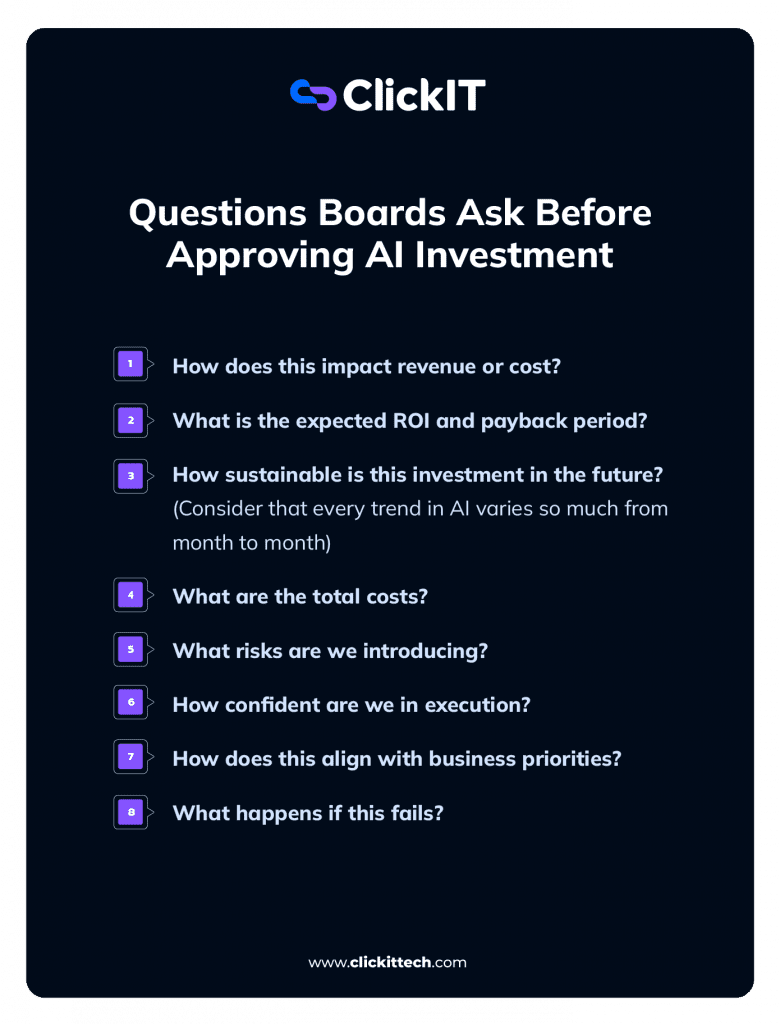
How does this impact revenue or cost?
This is question zero. The board wants to know what this initiative will do.
- Will it increase revenue?
- Will it protect profit margins?
- Will it lower operating costs?
- If so, by how much? “Improved efficiency” is not an answer. To answer, you’ll need to provide specific numbers and ranges tied to specific processes.
What is the expected ROI and payback period?
Earlier, I mentioned that 61% of senior business leaders feel more pressure to prove AI ROI than a year ago. Additionally, the Teneo Vision 2026 CEO and Investor Outlook Survey takes that further: 53% of investors expect positive returns within six months or less.
That’s an aggressive timeline for most AI deployments. To answer, make sure you’re upfront about realistic payback windows and what milestones precede full return.
How sustainable is this investment long term, given that AI trends change so much each month?
AI is constantly changing, sometimes even in weeks. As CTOs or technical leads, we’ll interpret that as an exciting digital transformation. However, a non-technical leader can see that as “AI hype” with volatility that’s not good for business.
For example, a model or vendor that’s best-in-class today can be commoditized within 18 months.
Boards will want to know if your investment is tied to one vendor. They will also want to know if the architecture is portable. It should adapt as technology changes.
To answer this, position your architecture around the business use case, not a specific model or vendor. This shows that you’ve built abstraction layers between your application logic and the underlying model, so swapping providers doesn’t mean rebuilding from scratch.
What are the total costs?
In my experience, the initial compute or licensing costs are rarely the full picture. Data preparation, integration work, ongoing model monitoring, human oversight, and retraining cycles all entail additional costs beyond the initial investment. And the board will want to know this.
CFOs typically classify these costs into four buckets:
- Foundation costs, which are data infrastructure, cloud compute, integration middleware, etc.
- Model costs, such as acquiring, training, fine-tuning, or licensing the AI models
- Operational costs like ongoing human effort to monitor, maintain, and retrain AI systems
- Change costs, which include training, process redesign, change management, and cultural transformation.
Understanding how CFOs classify these costs will help you provide the full picture in your proposal. So, make sure your proposal shows the total cost of ownership (TCO) over a realistic time period.Do not show only the entry price
What risks are we introducing?
Here, the board wants to know the operational, compliance, data privacy, and reputational risks the business faces, particularly if the system fails.
When answering, map each risk to a specific mitigation before you walk into the room. Examples of businesses mitigating those risks (if any) would be great for your case!
How confident are we in execution?
This is a question about the team, not the technology. Does your organization have the internal capability to deliver, or are you fully dependent on a vendor? Boards that have watched AI pilots stall will push hard here.
Make sure there’s a clear answer on internal skill coverage and where external support fills the gaps.
If execution capacity is the weak point in your proposal, ClickIT can secure AI engineers who have delivered successful projects for Sony, Adidas, and Mastercard, within 3 business days.
How does this align with business priorities?
As mentioned earlier, your AI investment justification has a better chance of being successful if it maps directly to a stated business priority, not when it introduces a new one. This allows key stakeholders to see the value in investing.
If your current proposal isn’t already connected to something on the CEO’s or board’s agenda, anchor it to one before you present.
What happens if this fails?
Studies from MIT have consistently shown that an AI project is more likely to fail than succeed. It’s not an indictment on you to admit this.
In fact, it actually signals to the board you’ve done your homework, and you’re also thinking like them because most boards I’ve worked with want the downside bounded.
To answer this question, define kill criteria upfront: specific metrics, specific timelines, and what stopping costs versus continuing.
AI Investment Justification Framework (CFO-Level)
“AI is the future” stopped being a compelling reason to approve budgets a while ago. Real capital is on the line, and the case has to be made in terms that a CFO will sign off on.
A board-ready AI investment justification proposal needs four structural components.
- Strategic context: why this investment is competitively necessary and what the cost of inaction looks like.
- Investment thesis: a specific, quantified value claim, not “AI will make us faster” but a precise hypothesis with numbers attached.
- Evidence base: performance data from live or comparable AI deployments, with clear attribution methodology.
- Forward ask: the specific resource request tied directly to the expected value outcome. Boards that receive proposals with all four components consistently make faster, more confident decisions.
So, when a CFO asks you: Is AI a good investment at all? Here’s a good framework to answer in their lingo.
Define Business Impact
Early GenAI adopters who aligned their projects to specific business outcomes are seeing real returns.
A Gartner survey found these organizations achieved an average 15.8% revenue increase, 15.2% in cost savings, and 22.6% productivity improvement.
The key to those numbers is defining the business outcome before the project starts, and tying every technical decision back to it.
Revenue impact
AI’s clearest top-line contributions come through:
- Conversion rate improvement: Personalized customer journeys and AI-optimized offers increase purchase probability at each stage of the funnel.
- Sales cycle compression: Automated lead qualification and AI-assisted sales support reduce time-to-close on deals that would otherwise stall in the pipeline.
- Customer retention: Predictive churn models identify at-risk accounts before they leave, enabling targeted intervention at the right moment.
- Recommendation engines: Product and content recommendations drive incremental purchases and increase average order value.
- Dynamic pricing: Real-time models that factor in demand signals, competitive data, and customer behavior optimize revenue per transaction without manual intervention.
- Upsell and cross-sell precision: AI surfaces the right offer to the right customer at the right point in their lifecycle, increasing attach rates across the existing customer base.
Cost reduction
The cost reduction case for AI is usually more straightforward than the revenue case, which makes it a useful anchor in any proposal:
- Process automation: Repetitive, rule-based tasks, data entry, document processing, and report generation can be automated at a fraction of the labor cost.
- Support cost reduction: Salesforce reported AI agents for customer service grew 2,199% in 6 months from January 2025, with organizations reporting substantial reductions in cost-per-resolution and tier-1 support headcount requirements.
- Operational overhead: Predictive maintenance and AI-driven resource scheduling reduce unplanned downtime and optimize capacity utilization across physical and digital infrastructure.
- Productivity gains: AI coding assistants, writing tools, and workflow automation compound across a workforce, compressing the hours required for knowledge work at scale.
- Error reduction and rework: In document-heavy processes like underwriting, compliance review, and financial reconciliation, AI can reduce error rates that generate expensive downstream corrections.
- Supply chain efficiency: Demand forecasting models reduce excess inventory, cut waste, and improve on-time delivery, each carrying a direct P&L impact.
Risk reduction
AI’s real-time pattern recognition has made it a priority for finance leaders specifically. In fact, 41% of CFOs rank real-time fraud and anomaly detection as their top AI use case.
This shows that CFOs and finance teams are not only looking for efficiency gains or cost savings from AI investments, but they are also looking to strengthen control.
For them, the right AI investment turns compliance from a reactive audit function into continuous monitoring, catching anomalies at the transaction level before they become reportable incidents. If you’re in a regulated industry, this alone can be the primary AI investment justification.
Build Financial Model
The standard formula, ROI = (Gain – Cost) / Cost, is every CFO’s first filter and a reasonable starting point. For AI investments that generate returns over multiple years, though, it understates the picture.
- Net Present Value is the more appropriate primary metric because AI costs are heavily front-loaded: implementation, data preparation, integration, and change management all happen before the system produces meaningful output, and the returns accelerate as adoption increases.
The formula for calculating NPV is:
NPV = Sum from t=0 to n of [ (Benefits_t – Costs_t) / (1 + r)^t ]
That is:
NPV = Σⁿₜ₌₀ [(Bₜ − Cₜ) / (1 + r)ᵗ]
Where B_t is the benefits in year, C_t is the costs in year, r is the discount rate, and t is the year. In practice, r is typically your company’s weighted average cost of capital (WACC) or an internally set hurdle rate.
- For clarity, a proposal evaluated on a 12-month horizon will almost always look marginal, because that’s usually where the costs peak and the benefits are just starting to compound.
Payback Period = Initial Investment / Annual Return (Length to recover initial outlay)
For high-value AI projects, a 12 to 18-month payback period has become the board-level benchmark, reflecting both tooling maturity and the pressure being applied to every capital allocation decision.
The catch is that payback period = initial investment / annual return only holds if “annual return” is modeled honestly.
Enterprise AI deployments typically realize 40 to 60% of their theoretical benefit ceiling in year one, rising to 75 to 90% by year three, because adoption takes time, workflows may need redesigning from time to time, and edge cases always take longer to handle than the pilot suggested.
I recommend that you build the adoption curve into your denominator, not just the go-live date.
Estimate Total Cost of Ownership
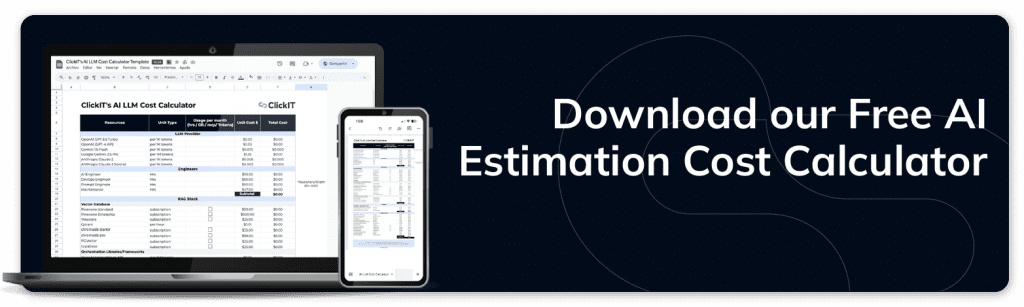
Before building your TCO model, it helps to have a realistic cost baseline across different LLM configurations and deployment approaches. The cost drivers that most proposals miss are:
- Inference costs, which are priced per input and output token, compound as context windows grow and prompt complexity increases.
- Vector database storage for RAG architectures, where costs scale with indexed data volume and query frequency across providers like Pinecone, Weaviate, or pgvector.
- Orchestration overhead from frameworks like LangChain or LlamaIndex, which introduce latency and compute costs that multiply significantly in multi-agent systems.
- ETL pipelines for ongoing data ingestion, which require continuous engineering time and infrastructure that scales with data volume, not just initial setup.
- Observability and monitoring tooling, which tracks token usage, latency, and model drift in production through platforms like LangSmith and Arize AI.
The Hidden Costs Most AI Proposals Miss
Engineering and Development is split across Model (initial build) and Operational (ongoing pipeline work). Maintenance and Retraining are Operational. Internal Training and Adoption is Change. That’s why your proposal should have the full picture, such as:
- Infrastructure: Cloud compute, GPU provisioning, and storage scale with usage. And this is hard to predict before production traffic hits. I recommend getting real usage estimates from your engineering team rather than extrapolating from vendor benchmarks.
- Engineering and development: Besides the initial build, pipeline maintenance, prompt engineering, evaluation frameworks, and the ongoing iteration cycle carry engineering costs. Data preparation often uses 40 to 60% of the total technical effort. It is also almost always scoped too narrowly during proposals.
- System integration: Connecting AI outputs to your CRM, ERP, or data systems is often underestimated in enterprise deployments. It often costs $50K to $300K, depending on stack complexity. Studies show that nearly 50% of CFOs want proof that AI integrates seamlessly with their core finance systems before approving it.
- Ongoing maintenance: Model performance degrades as real-world input data drifts away from the training distribution (also known as data drift). And this process is gradual enough that it could go unnoticed until accuracy has already declined meaningfully. Ensure you budget for monitoring tooling and the engineering time required for intervention.
- Model retraining: Depending on the use case, retraining cycles run quarterly to annually and incur both compute costs and engineering time, which compound across the project horizon.
- Internal training and adoption: If employees don’t trust the tool or fear it signals headcount reduction, adoption stalls regardless of model accuracy. You cannot defer change management to HR because it determines the difference between mediocre and strong adoption by year two.
I recommend you build in a 15 to 20% cost contingency across the total. If your AI investment justification was difficult the first time, imagine how hard it’ll be to come back to the board mid-flight, asking for more.
As a rule of thumb, model the total cost of ownership over a 24 to 36-month horizon, even if your target payback period is 12 to 18 months. The longer window accounts for the front-loaded cost structure of AI deployments and gives you a realistic picture of compounding returns.
Add Scenarios
Single-point projections are a credibility risk, and boards are increasingly skeptical of them, whether that’s a guaranteed ROI percentage or a fixed cost savings number presented without a confidence interval.
This is because AI is probabilistic by nature, which means your system will occasionally hallucinate, model drift will erode accuracy over time as production data diverges from training data, and data privacy exposure carries tail risk that may not show up in a single-number forecast.
Presenting one clean projection signals either that you haven’t thought through these risks or that you’re hoping the board hasn’t.
A scenario range paired with staged funding is increasingly viewed as the “responsible” approach to AI investments.
It demonstrates governance maturity and provides the board with a structured way to approve capital incrementally as the project reaches milestones, rather than committing the full budget to an unvalidated thesis.
A single projection, no matter how well-intentioned, tends to read as a hype-driven ask. Not only is it bad for your proposal, but also bad for your credibility as CTO.
Here’s how your AI justification scenario framework should look:
- Conservative (Minimum Outcome): This is your floor, built around significant implementation hurdles, slower-than-expected adoption, and accuracy rates that underperform vendor projections.
- Expected (Realistic Case): This is your base case, grounded in current pilot data or credible comparable deployments. When framing this, I’d recommend describing it as “steady but uneven progress” rather than a smooth ramp, because an experienced board would know the path is (usually) never linear and will trust a forecast that reflects that.
- Upside (Best-Case Scenario): This is your ceiling, mapping a future where adoption accelerates faster than modeled, secondary benefits compound, and AI begins to create new revenue streams or drive substantial margin expansion. I recommend that you present this as a possibility worth planning for, not a promise, and make clear what conditions must be met for it to materialize.
Is AI a Good Investment for Businesses?
Usually, yes. However, the full honest answer is that it depends on what you’re applying it to and whether your organization is ready for it. The framework above helps build the financial case, but below are the conditions that determine whether AI is a good investment or not for your business:
When is AI a good investment?
- High-volume repetitive workflows: AI is a good investment for document-heavy, rule-based, or high-volume processes. Examples include invoice processing, customer service triage, claims review, and data extraction from unstructured sources. This reduces human error and frees staff for higher-value work.
- Clear measurable KPIs: The most successful AI projects are not “set-and-forget.” They require pre-defined metrics (e.g., reducing cycle time, lowering cost per transaction, increasing conversion) to prove financial value. For example, you could cut the average cycle time from 4 hours to 60-90 minutes. You could lower the cost per transaction by 25% to 35%. Or you could increase inbound conversion by 12 percentage points. These specific targets give you a baseline to measure against. They also give the board a clear signal that the investment is working. Projects that launch without clear KPIs almost never deliver a solid ROI later. That’s because there’s no clear way to link results to specific improvements.
- Strong data availability: Data is the lifeblood of Artificial Intelligence. AI models (especially ML) require clean, accessible, and high-volume data to function. Without a strong, unified data layer, AI tools fail to deliver value.
- Direct link to revenue or cost: Finally, if an AI solution links directly to the P&L, it’s a strong investment. It can cut costs through automation. It can grow revenue through personalization or pricing optimization. It can reduce risk by detecting fraud.
When is AI not a good investment for your business?
- Experimental or “innovation lab” projects: Open-ended AI experiments are losing board support, and for good reason. The innovation framing suggests results are optional and timelines are flexible. That is the opposite of what boards will fund. If you keep treating AI as an innovation project, you will collect pilots that never reach production. This is sometimes called “pilot purgatory.” In this state, the organization spends real budget but produces no operational results. If a project can’t define what it will deliver and by when, it is not ready to be funded.
No defined owner: AI initiatives often stall without a clear owner.
They should have both a technical lead and an executive sponsor. The executive sponsor owns the business outcomes. When something goes wrong in production (and something always does), the absence of ownership means decisions are made slowly or not at all. - No measurable outcome: Without a baseline to measure against, it is impossible to justify the high initial costs of AI, usually resulting in projects that cost more than they create.
- No integration into workflows: AI tools must be embedded in daily operations (e.g., existing CRM or ERP systems) to be effective. Standalone, “disconnected” technology has a high failure rate. If adoption requires employees to change where they work, most won’t, or at least there’ll be strong pushback.
In summary, investing in AI is a good decision when it solves high-volume, repetitive, or complex data problems. It should also deliver a clear, measurable return on investment (ROI).
Conversely, AI is not a good investment if your business goal is unclear. It is also not a good investment if your data is messy or nonexistent. Avoid AI if your goal is only to adopt “shiny” technology without a clear use case.
What CTOs Should Present to the Board
To avoid getting a “we’ll revisit next quarter,” run your AI investment justification proposal against this checklist.
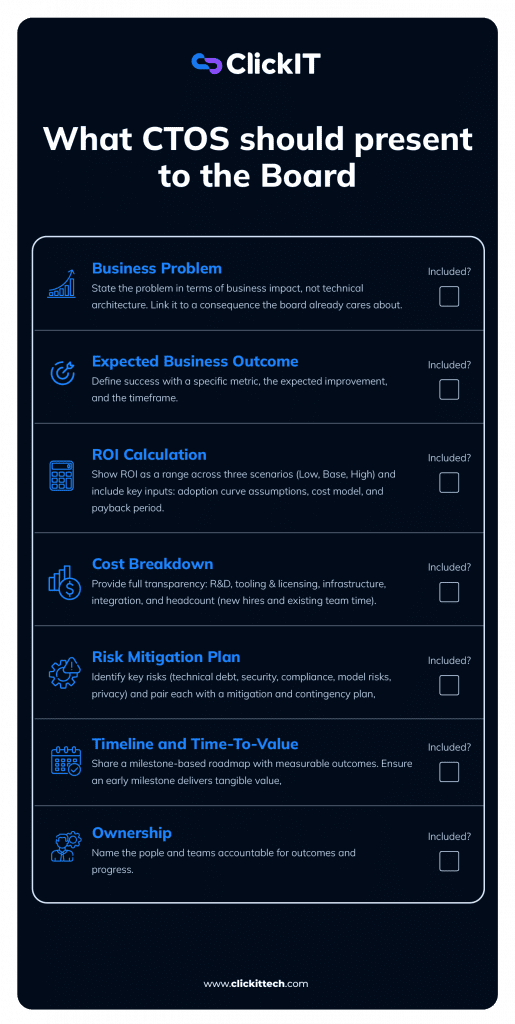
Ownership: Name the people and teams accountable for outcomes. Most boards need to know who to ask for progress. So, proactively defining ownership explicitly also signals that governance has been thought through, which is one of the quieter signals boards use to assess whether you’re ready to execute.
Business problem: The board needs to understand why they’re listening. Frame the problem in terms of business impact rather than technical architecture.
For example, “Legacy claims processing causes a 5% revenue loss each year.”This happens because of manual errors. It also happens because of delays. It is better than “We need to modernize the data pipeline.” Make sure your proposal connects the technical reality to a business consequence the board already cares about, making it their problem.
Expected business outcome: Define what success looks like in measurable terms. Specify the business metric you expect to move, the magnitude of improvement, and the timeframe in which you expect to see it.
For example, “Reduce average contract review time from four hours to 45 minutes within six months of deployment” is an outcome. “Improve operational efficiency” is a placeholder.
ROI calculation: Present this as a range across your three scenarios rather than a single projection, and show your inputs: the adoption curve assumptions, the cost model, and the payback period under each case.
A board that can see how the numbers were constructed will engage with them analytically. However, a board or CFO handed a single guaranteed ROI figure will look for the catch, because there always is one.
Cost breakdown: Full transparency on costs is to your advantage. Break out R&D, tooling and licensing, infrastructure, integration, and headcount, covering both new hires and existing team time being redirected.
If your board discovers hidden costs mid-project, they’ll quickly lose confidence in technical leadership, and that’s a harder problem to recover from than an honest number upfront. A complete cost picture enables informed trade-offs and signals that you’ve done all the background work. Get an AI cost estimation.
Risk mitigation plan: Boards carry fiduciary responsibility, which means they will find the risks in your proposal, whether you surface them or not.
Get ahead of it by identifying technical debt exposure, security vulnerabilities, industry-specific compliance requirements, and model-level risks such as accuracy degradation over time and data privacy implications. Then, pair each risk with a concrete mitigation and a contingency plan. This shows governance maturity.
Timeline and time-to-value: Stakeholders, especially investors, want to know when returns begin. A milestone-based roadmap that ties each phase to a measurable business outcome gives the board visibility into progress without requiring them to track technical delivery.
Where possible, structure the timeline so an early milestone delivers tangible value, something visible and attributable, before the full investment has been deployed.
Impact of Stakeholder Coalitions and Sustainability in AI Investment Justification
- Build stakeholder coalitions well before the board meeting. Pre-align your CFO, COO, and the business unit leaders whose teams will be most affected, well before you enter that room.
When the people who own budgets, manage affected workflows, and live with the downstream outcomes have already engaged with the proposal, the board meeting becomes a confirmation of what everyone already understands rather than a first impression.
In my experience, board meetings work best as a confirmation of existing consensus, not an introduction to new information.
- Another consideration is sustainability. Training, tuning, and running AI models at scale entail significant energy costs, and as ESG reporting requirements tighten, that carbon footprint is becoming a board-level consideration.
Factoring infrastructure efficiency and energy sourcing into your AI strategy early demonstrates foresight, and increasingly, it’s material to shareholder value.
- Finally, one cost category that consistently surprises teams after launch is model operations: monitoring for drift, managing retraining cycles, and keeping production accuracy from quietly degrading weeks after go-live.
ClickIT’s MLOps practice covers exactly this, from automated monitoring pipelines to retraining infrastructure, so your AI system performs in production the way it did in the pilot. Explore MLOps solutions.
Frequently Asked Questions
ROI on AI is measured by comparing quantified business outcomes (cost savings, revenue uplift, productivity gains, or risk reduction) against the total cost of ownership across a realistic time horizon, such as 24 to 36 months.
The formula is ROI = (Gain – Cost) / Cost. You also need to establish a pre-deployment baseline and apply honest adoption discounts to your projections, because most AI systems realize 40 to 60% of their theoretical benefit ceiling in year one, not 100%.
Yes, investing in AI is a good decision when it directly solves high-volume, repetitive, or complex data problems with a clear, measurable ROI.
However, AI is not a good investment if your business goal is unclear, data is messy or nonexistent, or you don’t have a specific use case.
For well-scoped AI projects with clear business outcomes and strong data foundations, a 12 to 18-month payback period is a reasonable benchmark for high-value deployments.
Risk reduction use cases like fraud detection can close faster, sometimes within 6 to 12 months, because the baseline loss is already quantified.
Revenue-focused use cases tend to take longer, typically 18 to 36 months, because attribution is harder and adoption curves are slower.
The most sought-after technical AI skills are agentic system design and multi-agent orchestration, retrieval-augmented generation (RAG) pipeline development, Python programming, and prompt engineering.
Demand for MLOps engineers who can maintain reliable production performance as data distributions evolve has also grown significantly as organizations move past deployment into long-term operations.
On the non-technical side, AI literacy, AI-driven data analysis, and no-code automation are increasingly expected across business functions.
Costs vary significantly by scope and complexity, ranging from roughly $10K for a small, well-defined pilot to $500K or more for a full enterprise deployment, depending on use case, data readiness, and integration requirements. You should speak to an experienced AI engineer or use an AI cost estimation calculator to understand the full costs.