
The 10-12-hour time zone gap between US offices and Indian engineering teams imposes a hidden tax on every sprint. Questions sit unanswered overnight, code reviews wait until tomorrow, and production incidents linger while half the team sleeps. That’s why companies are migrating from India to LATAM engineering teams,
This blog covers how to migrate from India to LATAM engineers:
- practical considerations
- time zone benefits
- cost comparisons
- talent availability by role
- country selection
- step-by-step migration plan for companies evaluating this transition.
Why Companies are Migrating from India to Latam Engineering teams
Migrating engineering operations from India to Latin America involves strategically shifting software development work from offshore teams in India to nearshore teams in Mexico, Colombia, Brazil, and Argentina.
The primary driver behind this shift is time zone alignment. LATAM engineers work during US business hours, enabling real-time collaboration rather than async-only communication.
This transition isn’t about the quality of Indian engineers. It’s about the practical reality that synchronous collaboration has become essential for agile software delivery.
Real-time collaboration challenges with offshore teams
The 10-12 hour time zone gap between US offices and Indian engineering teams creates what’s often called “velocity loss,” the cumulative delay caused by waiting for responses across time zones.
A question asked during a US morning standup isn’t answered until the next business day, and that delay compounds across sprints.
Consider a typical scenario: your frontend developer in New York discovers an API inconsistency at 10 am Eastern. With an offshore team in Bangalore, that question sits unanswered for 12 hours.
The developer either blocks on the issue or makes assumptions that might require rework later. Multiply this pattern across dozens of daily interactions, and the friction becomes significant.
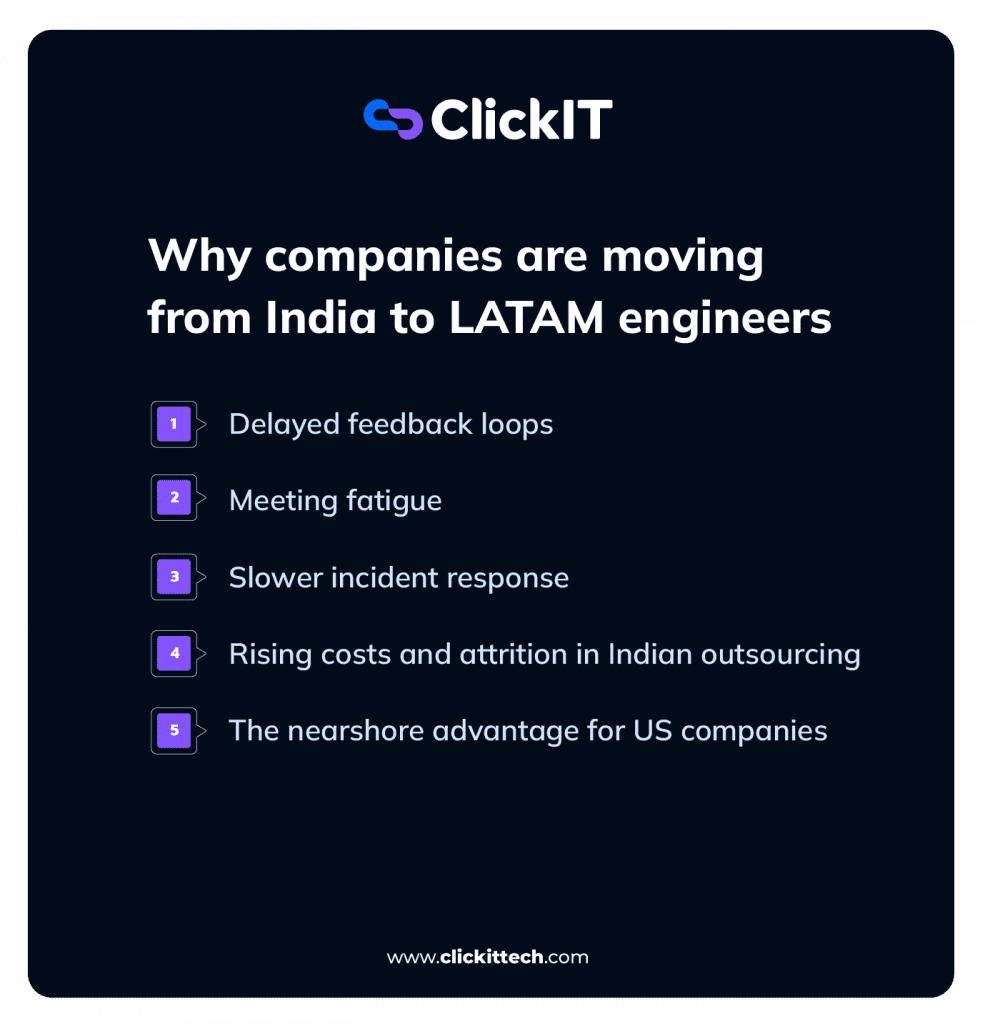
- Delayed feedback loops: Code reviews and clarification requests sit idle overnight, slowing iteration
- Meeting fatigue: Teams resort to 6 am or 10 pm calls to create overlap windows
- Slower incident response: Production issues discovered during US hours wait for the offshore team to come online
Rising costs and attrition in Indian outsourcing
The traditional cost advantage of Indian outsourcing has narrowed over the past decade. Salary inflation in major Indian tech hubs like Bangalore and Hyderabad, combined with high turnover rates, means companies often spend more on recruiting and knowledge transfer than they originally budgeted.
When engineers leave mid-project, institutional knowledge leaves with them. The replacement cycle, recruiting, interviewing, onboarding, and ramping, can take months.
And the new engineer still lacks the context that the previous team member built over time. This churn creates hidden costs that don’t show up in hourly rate comparisons.
The nearshore advantage for US companies
Nearshore refers to outsourcing to locations in the same or similar time zones, typically in the Americas, for US-based companies. Unlike offshore arrangements with India or Eastern Europe, nearshore teams in LATAM can participate in real-time standups, pair programming sessions, and same-day code reviews.
- This proximity matters most for teams practicing agile methodologies. When your sprint planning session happens at 10 am, and everyone can actually attend, you skip the awkward async handoffs and recorded meetings that slow down offshore collaboration.
- Nearshore also creates a more human working relationship between US companies and LATAM engineers. Because of cultural affinity, similar business hours, and geographic proximity, companies can interact more closely with their engineers instead of treating them as a distant delivery unit.
This makes it easier to run live workshops, invite engineers into product discussions, and even arrange in-person client visits when strategic alignment is needed.
This matters for engineering leaders because stronger team proximity usually means faster context sharing, better ownership, and fewer misunderstandings between product, engineering, and business stakeholders.
Time zone benefits of LATAM engineers for US teams
LATAM spans UTC-3 to UTC-6, which creates significant overlap with US business hours. A developer in Colombia or Mexico works nearly identical hours to those in New York, Chicago, or San Francisco.
| Location | Time Zone | US Eastern Overlap | US Pacific Overlap |
| Mexico City | UTC-6 | Full | Full |
| Colombia | UTC-5 | Full | Full |
| Brazil (São Paulo) | UTC-3 | Morning hours | Limited |
| Argentina | UTC-3 | Morning hours | Limited |
The practical benefits show up immediately. Same-day code reviews mean pull requests don’t sit open overnight. Live participation in sprint planning means engineers hear the context directly rather than reading meeting notes.
Real-time troubleshooting means production issues get addressed in hours, not the next business day.
LATAM vs India engineer salary and cost comparison
In the 2026 market, hiring Mid-level developers in India typically averages $25 – $50/hour, providing a significant 50-70% reduction in costs compared to US benchmarks.
Meanwhile, comparable talent in LATAM (Mexico, Colombia, and Brazil) ranges from $35 – $65/hour, yielding a 60-65% saving while offering the added benefit of time-zone alignment
LATAM engineering rates typically fall between India and the US, onshore higher than offshore, but significantly lower than domestic hiring.
However, base salary comparisons miss the bigger picture. Total cost of ownership includes factors that don’t appear on an invoice.
Total cost of ownership beyond base salaries
When evaluating the true cost of engineering talent, several factors beyond hourly rates come into play:
- Attrition and rehiring: Lower turnover reduces the recruiting and onboarding cycles that drain budget and momentum
- Management overhead: Real-time collaboration eliminates hours spent writing detailed async updates and waiting for responses
- Rework and delays: Faster feedback loops mean fewer misunderstandings that require correction later
- Travel costs: Geographic proximity makes occasional in-person meetings feasible without international flights
- Travel and relationship-building: LATAM proximity makes occasional in-person visits more realistic than traditional offshore models. For US companies, this can be valuable during discovery phases, roadmap planning, architecture reviews, or high-stakes delivery moments where face-to-face collaboration helps accelerate trust.
- Market context: LATAM engineers often have more exposure to North American business expectations. They also know SaaS delivery models and agile product teams. They are familiar with US client communication styles. This is often more than teams with much larger time-zone gaps.
This reduces onboarding friction and helps engineers understand not only the technical task, but the business pressure behind it.
Many organizations find that LATAM’s slightly higher base rates deliver better total cost of ownership when factoring in productivity gains and reduced churn.
LATAM engineering talent availability by role
LATAM has developed mature tech ecosystems with strong university programs and a growing startup culture. Engineers across the region often have prior experience working with US clients, which accelerates integration into American product teams.
LATAM is not just a lower-cost engineering market. It has already produced technology companies with global-level execution.
- MercadoLibre, for example, is one of Latin America’s strongest technology success stories and reports its financial results publicly through SEC filings as a NASDAQ-listed company.
- Rappi also describes itself as a Latin American technology company focused on accelerating e-commerce adoption across the region.
- GitHub has also reported rapid developer growth across Latin America, with Brazil specifically highlighted among countries that more than quadrupled their developer numbers from 2020 to 2025.
These examples show that the region is not only exporting engineering talent; it is also building complex, high-scale digital platforms.
That growth reinforces the idea that LATAM is becoming a stronger software talent ecosystem, not just an outsourcing destination.
AI and machine learning engineers
The AI/ML talent pool in LATAM is growing rapidly. Engineers with TensorFlow, PyTorch, and AWS SageMaker experience are increasingly available, though competition for senior ML talent remains high across all markets.
Full-stack and frontend developers
React, Node.js, and Vue.js expertise is widely available across LATAM. Many developers have built products for US startups and understand American product development practices, including agile ceremonies, code review expectations, and documentation standards.
DevOps and cloud engineers
AWS, Kubernetes, and Terraform skills are prevalent, particularly in Colombia, Mexico, and Brazil. The region has a strong culture of cloud certification, and many engineers hold AWS or Google Cloud credentials.

Cultural fit and communication with LATAM teams
Cultural alignment accelerates team integration in ways that are hard to quantify but easy to feel. LATAM engineers often share communication styles and work expectations with US teams, which reduces the adjustment period when onboarding new team members.
For US engineering teams, cultural fit is not about speaking the same language perfectly. It is about how quickly engineers understand priorities, communicate blockers, challenge assumptions, and participate in product decisions.
LATAM teams often bring a stronger sense of cultural affinity with US companies because they work in overlapping hours, consume similar business and technology trends, and can build closer relationships with client stakeholders.
This can be especially valuable for VPs of Engineering and CTOs who need engineers to act as embedded team members, not just assigned resources.
English proficiency across LATAM countries
English proficiency varies by country and individual, but top engineering talent typically demonstrates professional-level English.
Technical communication discussing architecture decisions, writing documentation, and participating in code reviews tends to be strong even when conversational fluency varies.
The key distinction is technical English versus social English. An engineer might not catch every idiom in casual conversation, but can clearly explain a database schema or debug a deployment issue.
Work style and feedback culture
LATAM work culture often emphasizes direct communication and individual ownership, which aligns well with agile teams that value autonomy:
- Direct feedback: Engineers are generally comfortable challenging ideas and raising concerns in standups
- Ownership mentality: A tendency to take initiative rather than wait for detailed instructions
- Collaborative problem-solving: Preference for discussion over documentation-only communication
These traits reduce the management overhead sometimes associated with offshore teams, where cultural norms around hierarchy can make engineers hesitant to push back on unclear requirements.
Which LATAM country to choose for engineering teams
| Country | Key Advantages for US Companies | Best Fit |
| Mexico | Same time zones as Central and Mountain US, large engineering talent pool, strong infrastructure, and easier travel for in-person collaboration. Many engineers already have experience working with US companies. | Companies prioritizing real-time collaboration, fast onboarding, and frequent client interaction |
| Colombia | Rapidly growing tech ecosystem with government investment in tech education, competitive rates, and improving English proficiency among engineers. | Companies building their first LATAM engineering team or seeking cost-efficient scaling |
| Brazil | Largest engineering talent pool in LATAM, especially strong in fintech and enterprise software development. Growing cloud and AI expertise in major cities like São Paulo. | Large-scale engineering needs, enterprise platforms, and fintech products |
| Argentina | Strong technical education, high software engineering quality, and strong problem-solving culture. Favorable economic conditions can create competitive pricing opportunities. | Startups and product companies looking for highly skilled senior engineering talent |
How to build your India-to-LATAM migration plan
Migration works best as a phased approach rather than an overnight switch. Structured planning minimizes disruption and protects institutional knowledge during the transition.

1. Assess current state and define objectives
Start by documenting your current team structure, knowledge dependencies, and the specific pain points driving the migration. Establish baseline metrics for deployment frequency, time to resolve blockers, and team satisfaction, so you can measure improvement after the transition.
2. Select roles and countries for transition
Prioritize roles where time zone alignment matters most. Frontend developers working closely with product teams, DevOps engineers handling production incidents, and tech leads participating in daily standups often benefit most from nearshore placement.
3. Choose your engagement model
Different engagement models fit different situations:
- Staff augmentation: Individual engineers embedded in your existing team, ideal for immediate skill gaps
- Dedicated teams: Full squads managed by a partner, suited for distinct product workstreams
- Project-based: Fixed-scope engagements for defined deliverables with clear start and end dates
4. Execute knowledge transfer
Structured handoffs prevent knowledge loss during transitions. Combine documentation with shadowing sessions and recorded walkthroughs. The outgoing team typically remains available for questions during an overlap period of two to four weeks.
5. Run parallel operations and validate
Overlap periods where both teams operate simultaneously allow you to validate the LATAM team’s readiness before completing the transition. This approach reduces risk and builds confidence in the new team’s capabilities.
Compliance and IP protection during team migration
Legal structure matters for protecting intellectual property and ensuring regulatory compliance. Getting this right from the start prevents complications later.
EOR and legal structures in LATAM
An Employer of Record (EOR) is a third-party organization that legally employs workers on your behalf, handling payroll, benefits, and local compliance. EOR arrangements simplify hiring in LATAM without the need to establish a local entity, which can take months and require significant legal overhead.
IP assignment and data security
Clear IP assignment agreements ensure that work product belongs to your company. Standard protections include NDAs, work-for-hire clauses, and data handling agreements that specify how sensitive information is stored and transmitted.
How to partner with a LATAM engineering provider
Working with an established provider accelerates migration and reduces risk. When evaluating partners, consider:
- Pre-vetted talent pool: Engineers already evaluated for technical and communication skills
- Compliance infrastructure: EOR capabilities and IP protections already in place
- Onboarding speed: Ability to place engineers in days rather than months
- Security and compliance: Certifications like SOC 2 and HIPAA compliance were needed
ClickIT provides certified LATAM engineers through staff augmentation, dedicated teams, or full project delivery.
With AWS and AI-certified engineers, rapid onboarding, and security compliance for regulated industries, the team supports organizations making this transition. Explore LATAM engineering services.
FAQs about migrating from India to LATAM engineers
Most migrations take three to six months, depending on team size and complexity. Initial engineers can onboard within the first few weeks, with full transition completing after knowledge transfer and parallel operation phases.
Yes, many organizations maintain hybrid models in which LATAM handles time-sensitive collaboration while India teams focus on async tasks or other product lines. Clear ownership boundaries make this approach work effectively.
Key indicators include deployment frequency, time to resolve blockers, quality of meeting participation, and overall velocity relative to baseline metrics established before migration.
US companies often choose LATAM engineers because they combine cost efficiency with real-time collaboration, cultural affinity, and easier access to in-person interaction.
Compared with traditional offshore models, LATAM teams can join daily standups, product conversations, architecture reviews, and urgent troubleshooting sessions during US business hours.
This makes the relationship feel closer to an embedded engineering team than an external delivery center.