Healthcare is no longer experimenting with AI; it’s deploying it.
From EHR integrations to AI-driven diagnostics and patient engagement platforms, the real challenge today is scaling innovation without breaking compliance, operations, or budgets.
That’s exactly why healthcare conferences matter in 2026. They’re where real implementations, partnerships, and decisions happen.
Why Healthcare Conferences Matter More Than Ever
- Learn how organizations move from AI pilots to production
- Understand HIPAA-compliant architectures in real environments
- Connect with C-level decision-makers and buyers
- Discover vendors solving integration and interoperability challenges
- See how companies control AI and cloud costs at scale
Top Healthcare Conferences in 2026
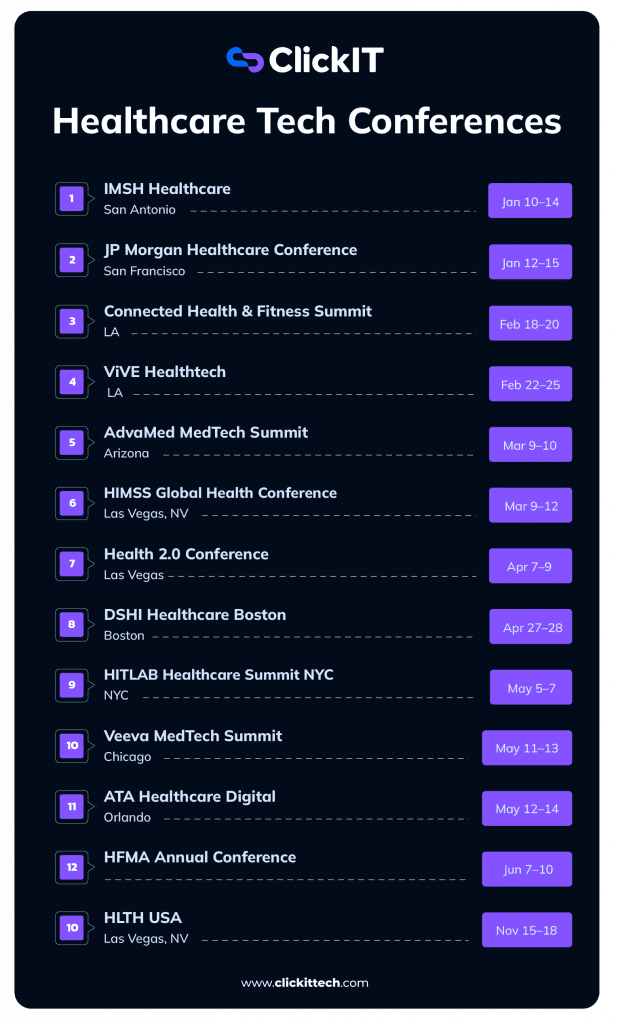
1. IMSH Healthcare | San Antonio, TX (Jan 10–14)
This is the largest global gathering for healthcare simulation, bringing together clinicians, educators, and simulation engineers for hands-on, workshop-heavy experiences rather than keynote-heavy sessions.
What actually happens:
- Live simulation labs (ER, ICU, surgical scenarios)
- VR/AR training environments you can test in real time
- Clinical educators sharing protocols, not theory
Who attends:
- Simulation directors
- Clinical educators
- Hospital training leaders
2. JP Morgan Healthcare Conference | San Francisco, CA (Jan 12–15)
This isn’t a traditional conference; it’s a closed-door ecosystem of meetings, side events, and private negotiations happening across hotels, offices, and investor suites.
What actually happens:
- Back-to-back investor meetings (not booths)
- Private deal conversations (M&A, partnerships, funding)
- Leadership presentations from major healthcare companies
Who attends:
- CEOs, investors, VCs
- Pharma, biotech, large healthcare orgs
4. ViVE Healthtech | Los Angeles, CA (Feb 22–25)
A curated, high-level event designed for decision-makers, not general attendees. Built specifically to create 1:1 meetings and business outcomes, not just exposure.
What actually happens:
- Pre-scheduled 1:1 meetings (core of the event)
- Executive roundtables (CIOs, CTOs, payers)
- Vendor + provider matchmaking
Who attends:
- Hospital CIOs / CTOs
- Digital health leaders
- Vendors + AI companies
3. Connected Health & Fitness Summit | Los Angeles, CA (Feb 23–25)
A product and ecosystem-focused event where consumer health companies showcase how they capture and use real-world health data.
What actually happens:
- Product demos (wearables, apps, platforms)
- Data partnerships discussions (device → platform → provider)
- Panels on monetizing health data
Who attends:
- Consumer health startups
- Fitness platforms
- Data/product leaders
5. AdvaMed MedTech Summit | Scottsdale, AZ (Mar 9–10)
A CEO and regulatory-heavy event where strategy revolves around bringing medical technologies to market under strict compliance.
What actually happens:
- Regulatory deep dives (FDA pathways, approvals)
- Executive panels on commercialization
- Strategy discussions for scaling medtech products
Who attends:
- Medtech executives
- Regulatory leaders
- Product strategy teams
6. HIMSS Global Health Conference | Las Vegas, NV (Mar 9–12)
The largest healthcare IT event globally, combining:
- Massive expo floor (hundreds of vendors)
- 600+ sessions across tracks
- Live product demos and interoperability showcases
What actually happens:
- Enterprise vendors showcasing full systems
- Hospitals evaluating solutions at scale
- Live interoperability demos (systems actually talking to each other)
Who attends:
- CIOs, IT leaders
- Health system decision-makers
- Tech vendors
7. Health 2.0 Conference | Las Vegas, NV (Apr 7–9)
A startup-heavy environment focused on new ideas, early-stage innovation, and future healthcare models.
What actually happens:
- Startup pitches and showcases
- Panels on new care models
- Networking between founders and early adopters
Who attends:
- Startups
- Innovators
- Early-stage investors
8. DSHI Healthcare Boston | Boston, MA (Apr 27–28)
A strategy + execution hybrid event focused on how organizations actually implement digital health systems.
What actually happens:
- Case studies from real implementations
- Peer discussions (what worked vs failed)
- Vendor + provider collaboration
Who attends:
- Innovation leaders
- Digital transformation teams
9. HITLAB Healthcare Summit NYC | New York, NY (May 5–7)
A bridge between academia, startups, and industry, where research meets commercialization.
What actually happens:
- Research-backed innovation presentations
- Startup showcases
- Collaboration between universities and companies
Who attends:
- Researchers
- Startups
- Innovation teams
11. Veeva MedTech Summit | Chicago, IL (May 11–13)
A platform-centric event focused on how life sciences companies manage data, workflows, and operations at scale.
What actually happens:
- Product demos (CRM, data platforms)
- Customer case studies
- Workflow optimization discussions
Who attends:
- Pharma / medtech companies
- Data & operations teams
10. ATA Healthcare Digital | Orlando, FL (May 12–14)
Focused on telehealth becoming a core healthcare infrastructure, not just a pandemic solution.
What actually happens:
- Platform demos (telemedicine, RPM)
- Policy and reimbursement discussions
- Scaling virtual care models
Who attends:
- Telehealth providers
- Health systems
- Policy stakeholders
12. HFMA Annual Conference | (Jun 7–10)
A finance-first event where healthcare is viewed through cost, margins, and operational sustainability.
What actually happens:
- CFO-level discussions
- Financial strategy sessions
- Cost optimization frameworks
Who attends:
- CFOs
- Finance leaders
- Operations executives
13. HLTH USA | Las Vegas, NV (nov 15–18)
A massive ecosystem event that combines:
- Startup innovation
- Enterprise players
- Investors
- Policy discussions
What actually happens:
- Huge expo floor + startup zones
- Partnership announcements
- Investor + enterprise networking
Who attends:
- Entire healthcare ecosystem

Trends You’ll See Across Healthcare Conferences in 2026
- AI moving from pilot → production environments
- Strong focus on compliance-first architectures
- Increasing pressure to control AI and cloud costs
- Integration between legacy systems and modern AI
- Rise of automation and agent-based workflows
- AI supporting clinicians, not replacing them
FAQs
-Healthcare leaders should attend conferences to:
-Learn how AI is being deployed in production environments
-Understand compliance requirements like HIPAA in real systems
-Connect with decision-makers and potential partners
-Discover solutions for interoperability and legacy system integration
-Explore strategies to control AI and cloud costs
These events are no longer theoretical; they focus on real-world execution.
Events like ViVE Healthtech, HIMSS, and HLTH USA are among the best for AI and digital transformation. They focus on:
AI-powered healthcare systems
Data interoperability
Digital patient engagement
Enterprise-level deployments
Yes. Conferences like HITLAB and Health 2.0 are especially valuable for startups because they provide:
Exposure to investors
Access to enterprise buyers
Partnership opportunities
Insights into market demand and trends
Key trends include:
AI moving from pilot to production
Compliance-first architectures
Cost optimization for AI and cloud
Integration with legacy healthcare systems
Rise of automation and AI agents
AI is augmenting clinicians instead of replacing them
To maximize ROI:
Define your goals (sales, partnerships, learning)
Research attendees and companies
Book meetings in advance
Prepare a clear value proposition
Focus on real problems you can solve