
As AI workloads grow, every CTO and VP of Engineering faces the same question: “How do we operate all of this safely, reliably, and at scale?”
The answer is LLMOps.
What is LLMOps?
LLMOps is the operational discipline for deploying, monitoring, and managing large language models in production.
Just as DevOps transformed software delivery and MLOps industrialized predictive modeling, LLMOps is quickly becoming the operational backbone of enterprise generative AI.
By now, you’ve learned how to shape model behavior with prompts, ground responses through RAG, and build agentic systems capable of taking action.
In this chapter, you’ll learn how to:
- Understand what LLMOps is and how it differs from traditional MLOps.
- Operate generative AI systems reliably in production.
- Balance reliability, latency, cost control, and compliance.
- Build an operational foundation for enterprise AI at scale.
Why LLMOps Is Not Just MLOps for LLMs
Before discussing infrastructure, it’s important to understand the architectural shift.
Traditional predictive ML models operate like appliances:
you train them → package them → serve them → monitor accuracy drift.
LLMs do not behave like that. They are live, highly dynamic systems whose behavior depends on variables such as:
- prompts
- embeddings
- retrieval quality
- context window content
- vendor model updates
- tool usage (agents)
- changes in prompt-to-model alignment over time
This requires an entirely different operational model.
The Core Challenge: Non-Determinism
In traditional MLOps, the same input typically provides the same output. In LLMOps, we face Non-Determinism. Because of the “temperature” and the probabilistic nature of LLMs, the same prompt can yield different results.
To operate this reliably, LLMOps uses strategies like Self-Consistency (running the same prompt multiple times to find the most frequent answer) and Majority Voting.
These techniques reduce variability and help prevent hallucinations and random responses in production workflows.
| Aspect | MLOps (Predictive ML) | LLMOps (Generative AI) |
|---|---|---|
| Focus | Accuracy | Safety, grounding, cost, latency |
| Core Assets | Features, model weights | Prompt Registry, embeddings, RAG, context |
| Failure Modes | Model drift, stale features | Non-determinism, hallucinations, prompt drift |
| Deployment | Endpoints, batch jobs | Agents, workflows, API chains |
| Monitoring | Precision, Recall, F1 Score | Faithfulness, grounding, safety violations |
This difference matters because generative AI fails in ways predictive systems never could.
To manage these new failure modes and ensure the entire ecosystem remains resilient, enterprise LLMOps introduces a critical architectural component: the AI-Optimized API Gateway.
Instead of applications connecting directly to a model provider, they communicate with a centralized gateway (using tools like LiteLLM or Kong) that manages the “traffic” of intelligence.
Why an AI Gateway is Non-Negotiable:
- Automatic Failover & Redundancy: This is the ultimate safety net. If a provider hits a rate limit or goes down, the gateway automatically routes requests to a fallback model (like from GPT to Claude) without downtime.
- Load Balancing: It distributes requests across multiple regions or providers to maintain sub-second latency during peak demand.
- Centralized Security: It centralizes API key rotation and authentication, eliminating the risk of exposed credentials across microservices.
- Cost Guardrails: It enables global rate-limiting and budget tracking per project, preventing runaway costs before they escalate.
From LLMOps to GenAI Ops: Operating the Whole Factory
Just as RAG is more than retrieval and agents are more than LLMs with tools, LLMOps is one component within the broader systems engineering framework: GenAI Ops.
The distinction is critical for scaling AI systems. While LLMOps ensures the model itself performs, GenAI Ops ensures the entire ecosystem (the data, the infrastructure, and the workflows) remains operational.
| LLMOps Focus | GenAI Ops Focus |
|---|---|
| Inference-Level Reliability: | Holistic System Orchestration: |
| Monitoring grounding & hallucinations | Data Ingestion & Embedding Pipelines |
| Managing prompt-to-model drift | Vector Database Health & Performance |
| Controlling unit-token costs | Multi-Agent Execution Cycles |
| Optimizing routing and semantic caching | Multimodal & Diffusion System integration |
If LLMOps is maintaining the engine, GenAI Ops is operating the entire autonomous industrial plant.
With larger systems come more moving parts. A failure in the vector database or a latency spike in an embedding API can be just as critical as a model hallucination.
The next section focuses on Workflow Automation, the layer where generative AI integrates with core business operations to create measurable value.
AI Workflow Automation: Turning Reasoning into Revenue
Generative AI delivers measurable ROI only when it leaves the “sandbox” and becomes part of your core business processes.
This integration layer is where Knowledge (RAG) and Action (Agents) connect through AI workflow automation tools that integrate with CRMs, ERPs, and legacy databases.
Examples across industries:
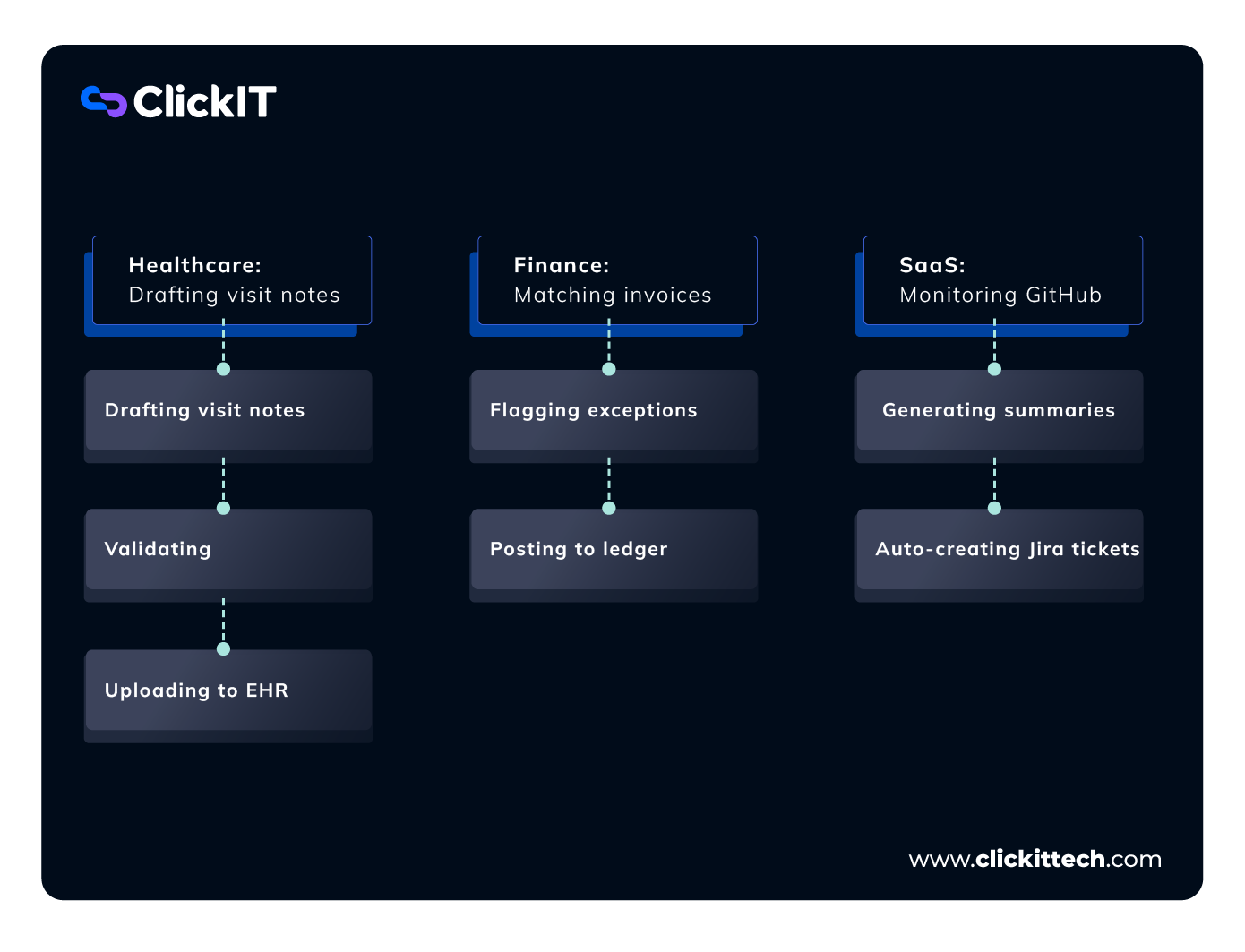
Workflow automation turns AI from a chat assistant into an operational system that creates measurable business value.
But different teams require different tools. The next section explores the technologies that support them.
AI Workflow Automation Tools for Business and Engineering
There are two important categories of orchestrators:
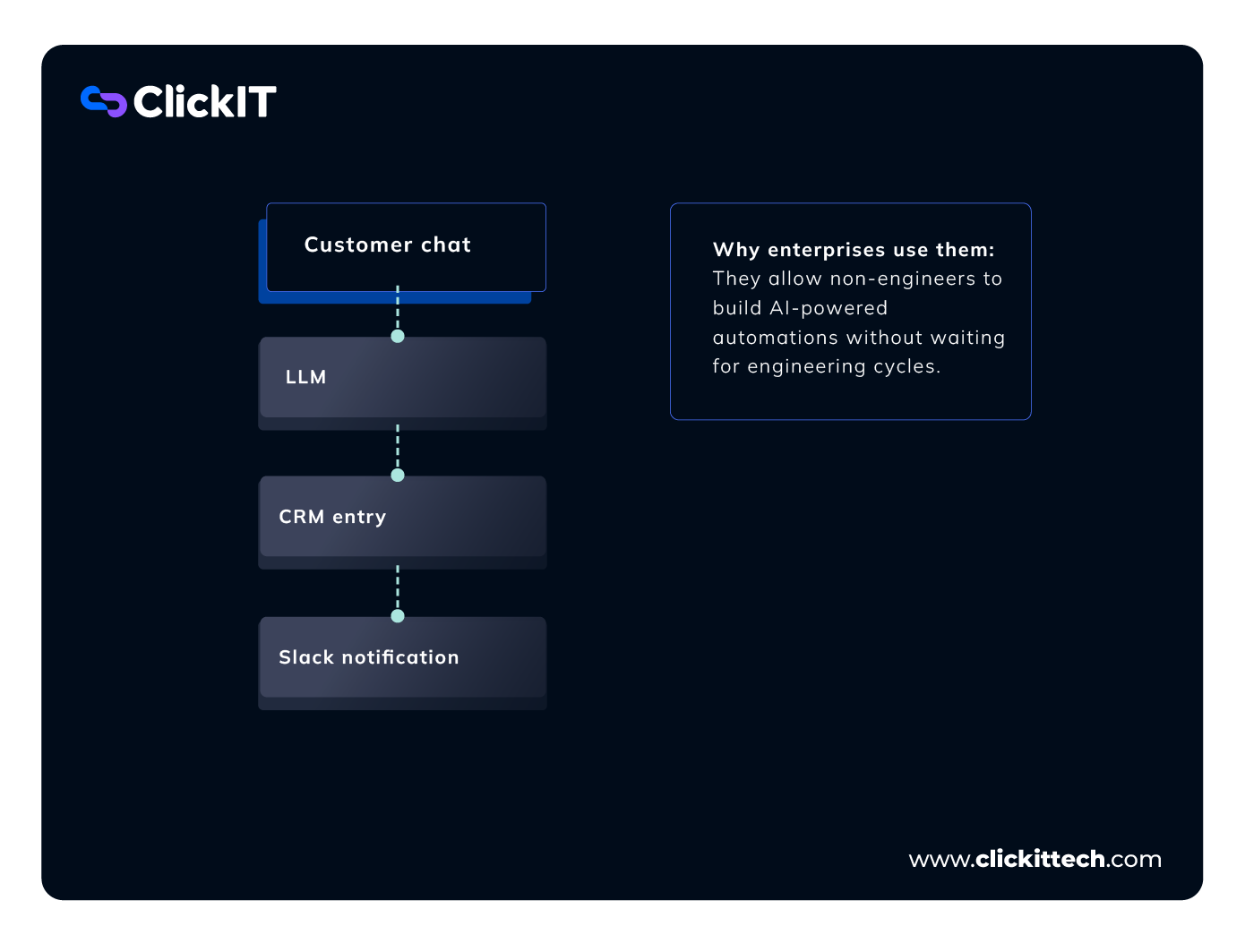
1. Business-Friendly Orchestrators (Low/No-Code)
Examples: n8n, Make
Ideal for:
- Fast prototyping
- Connecting SaaS tools
- Business automation
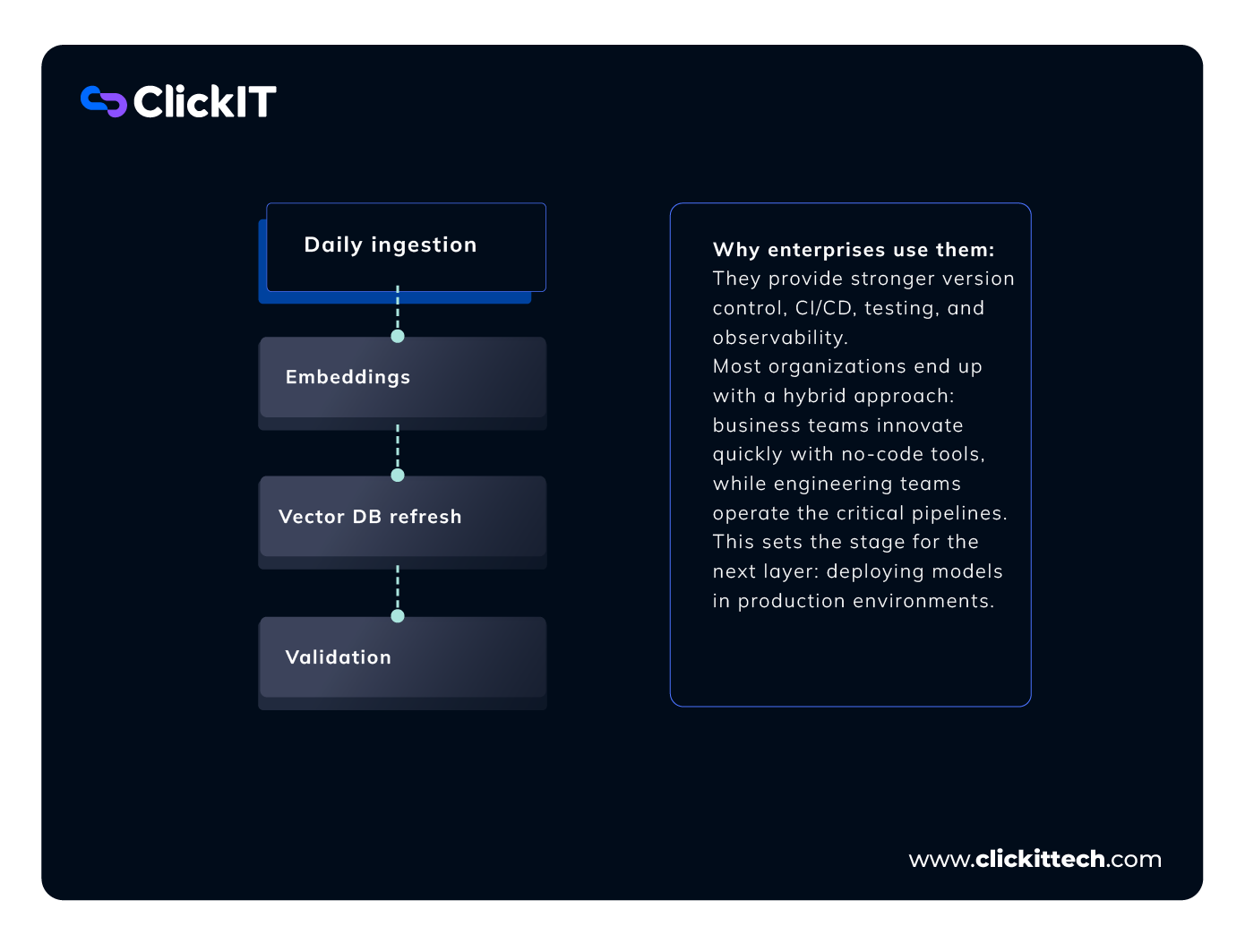
2. Engineering-Oriented Orchestrators
Examples: Airflow, Dagster
Ideal for:
- RAG ingestion pipelines
- Embedding updates
- Multi-step data workflows
- Batch and event-driven processes
LLMs in Production: Balance Performance, Scale, and Unit Economics
Once an LLM moves from a sandbox to a customer-facing system, every architectural flaw becomes a business risk.
Moving beyond the “prompt” means solving for the four primary constraints that separate a prototype from a Production-Grade System:
- Perceived Latency: In agentic workflows, sub-second responses are a requirement for adoption. High latency leads to "abandonment rates" that can kill an AI initiative before it scales.
- Systemic Scalability: Unlike traditional APIs, AI workloads spike unpredictably. This is compounded in multi-agent systems where "agents triggering agents" can create exponential demand on infrastructure in seconds.
- Unit Economics (The Cost Trap): Token usage is the most underestimated operational expense. Costs grow aggressively with longer prompts, larger context windows, and RAG documents. Without optimization, a successful product can quickly become financially unsustainable.
- Operational Resilience: LLMs fail in non-linear ways. Models time out, APIs hit rate limits, and context windows overflow. A production system requires Graceful Degradation, the ability to switch to fallback models or human escalation paths without breaking the user experience.
LLMOps Best Practices for Production
To move from a pilot to a mission-critical system, you must optimize for the “Three Horsemen” of LLMOps: Latency, Cost, and Reliability.
- Advanced Caching Strategies:
- Exact Cache (like Redis): Matches identical queries. It is 100% reliable but only works if the user uses the exact same phrasing.
- Semantic Cache (like GPTCache): Uses vector similarity to identify queries that mean the same thing, even if worded differently.
- The Trade-off: While Semantic Cache dramatically reduces token costs and latency, it introduces a small risk of providing a "near-match" answer that might be slightly outdated or out of context.
- Model Routing: Implement a "router" that directs high-volume, routine tasks to Small Language Models (SLMs) or cost-efficient versions of GPT and Llama, while reserving Frontier Models (like the Claude or Gemini series) for high-stakes, complex reasoning.
- Infrastructure-Level Token Quotas: To prevent "runaway costs", often caused by infinite agent loops, you must implement hard limits on tokens-per-API-key at the gateway layer. This ensures that a single malfunctioning agent cannot drain your entire monthly budget in minutes.
- Prompt Versioning & Registry: Treat prompts as code. Use a registry to track which prompt version was active during a specific failure, allowing for instant rollbacks.
Deploying a model and optimizing its cost is only half the battle. Enterprises also need to decide where and how to deploy it, as compliance and data sovereignty become the final hurdles for production.
Optimization is not a one-time event; it is an operational standard.
Understanding what LLMOps is means recognizing that production systems require monitoring, optimization, and governance.
To help you measure the maturity of your production stack, download our free Production-Grade LLMOps Audit.
This 10-point benchmark will help you identify financial leaks, security gaps, and performance bottlenecks before they affect your bottom line.
Quick and Easy LLMOps Audit
Free DownloadDeployment Decisions: APIs, Private Cloud, or On-Premises?
Choosing where to deploy an AI system is a strategic decision that affects security, compliance, cost, and operational complexity.
1. Cloud API (e.g., OpenAI, Anthropic)
- Pros: Fastest path to value
- Cons: Less control, data governance considerations
2. Private Cloud / Enterprise SaaS (Azure OpenAI, AWS Bedrock)
- Pros: Better compliance, network isolation
- Cons: Higher cost, less model flexibility
3. On-Premises / Self-Hosted (LLaMA, Mistral, Falcon)
- Pros: Maximum control & data sovereignty
- Cons: Most operational overhead
Enterprise Reality:
Most organizations adopt a hybrid deployment strategy:
- APIs for speed
- Self-hosted or Bedrock/Azure for sensitive workloads
Deployment is only the beginning. Production systems require continuous monitoring for performance, correctness, and safety.
LLMOps Monitoring & Observability
Predictive models relied on static accuracy metrics. LLMs require a dynamic observability stack that monitors what the model says and how it behaves in production.
In enterprise GenAI, reviewing logs after the fact is not enough. We must distinguish between two levels of protection:
- Post-Hoc Monitoring: Analyzing traces and logs after the interaction to identify trends, drift, or systematic errors. This is essential for long-term optimization.
- Active Filtering (Real-Time Guardrails): Using specialized tools like NeMo Guardrails or Llama Guard to intercept prompts and responses before they reach the end user. This "firewall" can block toxic content, prevent PII leakage, or halt off-brand responses in real time.
What Enterprises Must Monitor
- Performance & Perceived Speed
- TTFT (Time to First Token): In chat or streaming applications, this is the most critical metric. It measures how long the user waits to see the start of an answer, which defines the perception of speed.
- Total Latency & Throughput: The end-to-end time and the number of requests the system handles concurrently.
- Quality & Grounding
- Faithfulness: Is the model strictly using the provided context?
- Retrieval Success: Are the vector searches returning the correct documents?
- Cost & Infrastructure
- Token Consumption: Tracking spend per user or per agent workflow.
- Context Window Utilization: Ensuring we aren't "wasting" tokens by sending irrelevant data.
- Safety & Compliance
- Active Violation Rate: How many times the real-time guardrails had to intervene.
- PII Leakage & Toxicity: Detecting and blocking sensitive or harmful content.
These metrics require specialized tools such as Arize AI, WhyLabs, LangSmith, or Weights & Biases. In collaboration, they transform raw logs into actionable engineering insights.
Leader Tip:
Create two dashboards:
- One for engineers (latency, grounding, errors)
- One for executives (cost, usage, adoption)
With these pillars in place, enterprises can move from pilot experiments and to stable, scalable generative AI operations.
Why LLMOps and GenAI Ops Matter
LLMOps and GenAI Ops are the foundation for any AI system that must be reliable, compliant, scalable, cost-efficient, and grounded in enterprise knowledge.
Without LLMOps, even the best-designed RAG or agentic system collapses under production pressure. If you’ve been asking what LLMOps is, it’s what AI uses to move from isolated experiments to mission-critical infrastructure.


© ClickIT DevOps & Software Development | 2015 – 2023 | All Rights Reserved
Privacy Policy · Terms of Service · Cookies Policy