
CHAPTER 4
AI Agent Orchestration: Building Agentic Systems
LLMs can write, classify, summarize, and reason, but they stop at the edge of text. They can explain what to do, yet they cannot take action on their own. This is where agentic systems come in.
AI agent orchestration enables LLMs to execute real-world tasks through function calling, tool use, and structured workflows.
In enterprise environments, most “action-capable AI” is not powered by exotic Large Action Models. Instead, it relies on Frontier LLMs (such as GPT, Claude, or Gemini models) optimized for Function Calling and Tool Use.
The model doesn’t “push the button” itself; it generates the Intent.
Through a process of Schema Declaration, the model identifies the correct tool from your provided list and produces a Structured Output (JSON). This machine-readable instruction is then intercepted by your application to trigger real-world actions:
- Calling APIs to fetch live customer data.
- Querying databases for real-time inventory.
- Triggering complex ERP or CI/CD workflows.
In practice:
- LLMs: Act as the "Brain," generating reasoning, intent, and structured parameters.
- Tool Use / Orchestration: Acts as the "Hands," executing code safely through your existing infrastructure.
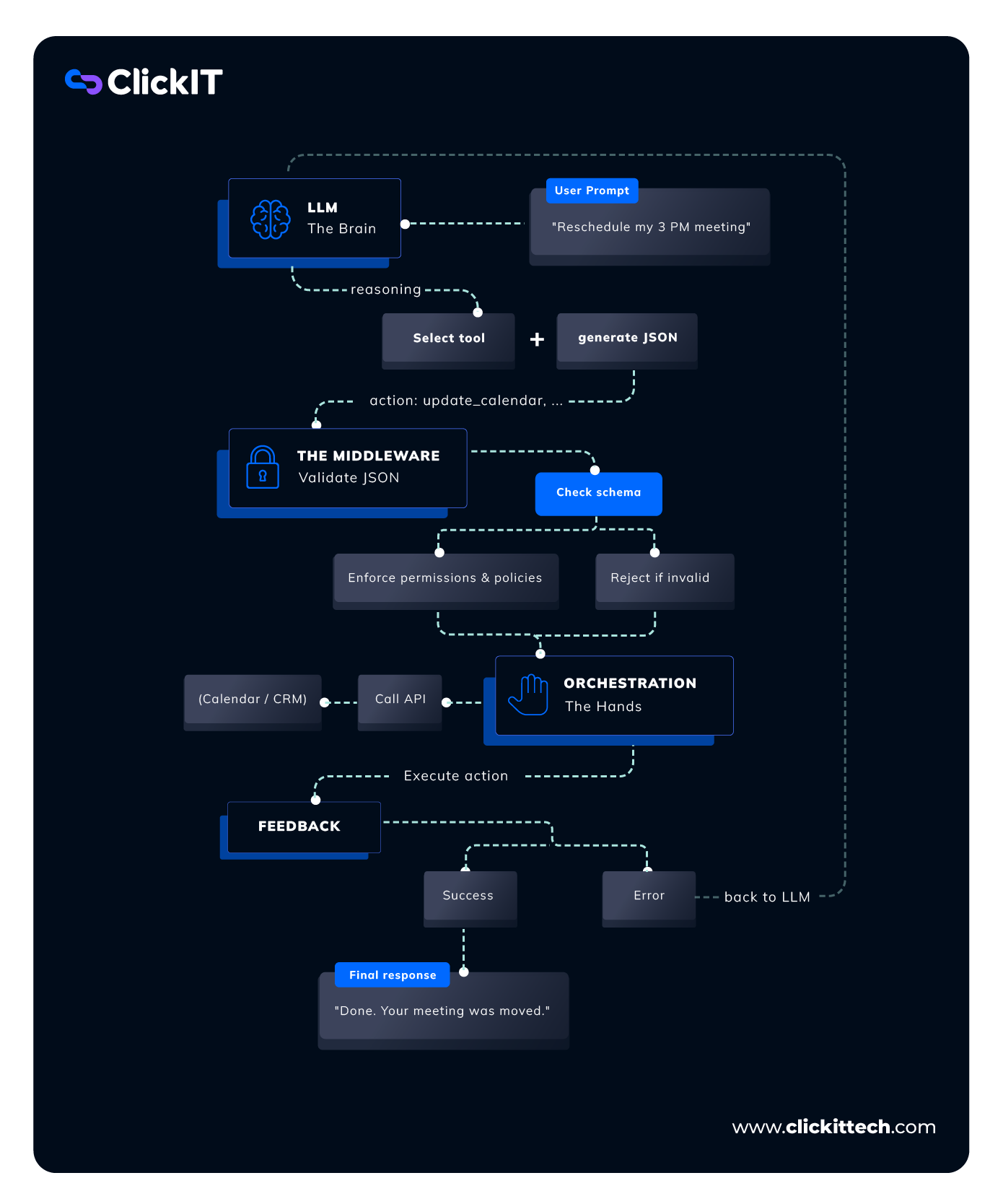
AI moves from being an “assistant that suggests” to a digital worker that participates in workflows.
Because enterprises like yours run on workflows, not answers, this evolution unlocks real operational value.
But for your AI to act safely and reliably, it must be structured, orchestrated, and governed like any other operational unit in the organization.
That’s what we’ll dive into in this chapter.
Autonomous AI Agents: When Models Become Workers
Moving from LLMs to agentic systems requires shifting from stateless inference to stateful orchestration.
An AI agent is an encapsulated execution unit designed to manage iterative reasoning loops, persistent memory, and tool-calling boundaries.
This means moving beyond simple prompt-response cycles and into designing systems where the agent manages its own state and executes tasks with minimal human intervention.
High-Impact Enterprise Applications
Instead of simply answering questions, AI agents can manage complex, multi-step workflows such as:
- Customer Experience: End-to-end resolution of complex support tickets, including cross-referencing legacy databases and real-time CRM updates.
- FinOps & Compliance: Automated reconciliation and compliance auditing across disparate financial platforms, flagging anomalies and categorizing transactions with institutional-grade precision.
- Self-Healing IT Infrastructure: Agents that monitor logs, run diagnostic scripts, and trigger automated remediation before a human is even alerted to a latency spike.
- Logistics & Supply Chain: Autonomous coordination of delivery schedules and inventory updates, ensuring that data moves as fast as the physical goods.
Governance, Risks, and Oversight
Agents bring new capabilities, but also significant responsibilities. Deploying a “digital worker” requires a governance framework far more rigorous than a simple chatbot:
- Human-in-the-Loop (HITL): High-stakes decisions (e.g., in Finance or Healthcare) must include mandatory human checkpoints. A human should approve any high-responsibility action before execution.
- Data Privacy (API-First): Agents should never have direct access to raw databases. They must interact with intermediate APIs that process and redact PII (Personally Identifiable Information) before the agent sees it.
- Cybersecurity (Prompt Injection): Unlike traditional code, agents can be "hijacked" by malicious prompts. Security teams must implement robust filters to prevent external inputs from overriding the agent's core instructions.
- Auditability & Oversight: Every reasoning step and tool call must be logged. This enables for periodic oversight and helps ensure the agent remains compliant with corporate policies.
At ClickIT, we are already implementing these Governance Frameworks for our partners in Real Estate and Logistics. Learn more about our success stories here.
An agent is not a chat interface, it’s a worker. And like any worker, it needs onboarding, tools, supervision, and restricted access.
This is why for complex operations, we shift toward Multi-Agent Designs to distribute responsibility and increase safety.
Multi-Agent Systems: Distributed Intelligence & Task Decomposition
As AI responsibilities grow, the complexity often exceeds what a single agent can reliably handle. In high-stakes environments, a “monolithic” agent, one that tries to do everything, becomes a single point of failure and a source of high latency.
That’s when you can move toward Multi-Agent Systems (MAS), where complex operations are broken down into specialized, autonomous units. This mirrors high-performance engineering teams, where role division leads to higher precision and auditable outputs.
The Benefits of an Agentic Team
- Specialization (Reduced Error Rate): By limiting each agent’s scope (e.g., an agent specialized only in SQL Query Generation vs. one in Data Verification), you minimize the "distraction" that causes hallucinations.
- Parallel Execution (Scalability): Independent agents can process different branches of a workflow simultaneously, drastically reducing the time-to-completion for complex tasks.
- Traceability (Granular Auditing): Each agent leaves a discrete reasoning path. If an error occurs, you can pinpoint exactly which "specialist" failed and why, without retraining the entire system.
Choosing between a single-agent or a multi-agent setup architecture depends on factors like cost and complexity:
| Feature | Single-Agent Orchestration | Multi-Agent Orchestration |
|---|---|---|
| Focus | Managing one agent's tasks, retries, and tool access. | Coordinating handoffs and consensus between specialized agents. |
| Complexity | Low. Easier to debug and maintain a linear flow. | High. Requires managing turn-taking and conflict resolution. |
| Cost (Tokens) | Lower. Fewer reasoning loops and internal "chatter." | Higher. Each coordination step and "handshake" consumes tokens. |
| Reliability | Best for routine, well-defined tasks (e.g., "Summarize this"). | Best for complex tasks requiring "checks and balances." |
| The Trade-off | Fast & Cheap, but risks performance degradation as task complexity grows. | Accurate & Specialized, but significantly increases latency and infrastructure overhead. |
The Multi-Agent Challenge
However, distributed intelligence introduces a new set of engineering hurdles: state synchronization, complex handoffs, and feedback loops.
Without a centralized logic to manage these interactions, a multi-agent team can lead to “infinite loops” or inconsistent decision-making.
A team of specialized agents is a powerful asset, but without a robust control plane to synchronize their actions, the system risks operational chaos.
This is why the most critical component of a Multi-Agent strategy is the orchestration layer that governs them.
The next section explores how AI agent orchestration coordinates these agents and keeps complex systems controlled.
AI Agent Orchestration: The Project Manager of AI Systems
Orchestration is the control plane of your agentic strategy. It transforms independent scripts into a cohesive, stateful system.
Agents are the “workers,” and orchestration is the logic that ensures they act correctly, consistently, and in the predefined order.
In an enterprise environment, orchestration is about managing three critical engineering challenges:
- State Management: Maintaining a persistent memory of the workflow’s progress so the system doesn't lose track of the objective across multiple steps.
- Deterministic Guardrails: Forcing the AI to follow specific business logic (if/then paths) rather than relying solely on the model’s "best guess."
- Conflict Resolution: Managing the "handoffs" between agents and resolving disagreements when two specialized models produce conflicting outputs.
From Frameworks to Foundational Infrastructure
To solve these challenges, your organization should adopt standardized frameworks that treat coordination as a first-class citizen of your software stack.
These tools allow you to design cyclic workflows (where an agent can go back and fix an error) and stateful graphs, ensuring that as your agentic library grows, your infrastructure remains scalable, debuggable, and auditable.
Orchestration solves the coordination problem. But, as systems begin to run autonomously, enterprises need a new discipline to monitor their performance, costs, and safety. This brings us to AgentOps.
The Agentic Workflow Architect’s Map
Designing an agent that “chats” is the easy part. Designing a digital worker that “acts” within complex enterprise systems without creating operational chaos is an engineering discipline.
To help you map out your first autonomous workflows, we’ve developed The Agentic Workflow Architect’s Map.
This 1-page schematic will help you define reasoning loops, establish tool permissions, and implement the mandatory “Kill-Switches” required for safe, cost-governed enterprise autonomy.
Get your free Architect’s Map here
Free DownloadAgentOps: Making Autonomous Systems Safe and Reliable
As soon as agents move from experimentation to production, enterprises face a familiar challenge: “Who’s monitoring the agents?”
This relatively new field, AgentOps, extends DevOps and MLOps into the world of autonomous systems.
To ensure digital workers remain reliable and cost-effective, organizations should implement a framework based on three architectural pillars:
- Observability & Traceability: Implementing deep "traces" to solve the black box problem. You need to see not just the result, but the step-by-step reasoning: Why did the agent choose Tool A over Tool B?
- Lifecycle Management: Treating agents like employees. This includes versioning (to ensure updates don't break skills) and CI/CD for agents (testing in sandboxes before they touch production data).
- Security Guardrails: Real-time interception of actions to prevent prompt injection and automated budget caps to stop "infinite loops" from inflating your cloud bill.
The AgentOps Metrics
By establishing these pillars, leaders gain visibility into the metrics that matter for the business:
- Agent Loop Detection: Identifying and killing runaway processes before they skyrocket costs.
- Token-to-Goal Efficiency: Measuring the ROI of every automated workflow.
- Groundedness & Safety: Ensuring 0% leakage of PII or corporate secrets.
- Task Completion Rate (TCR): The "Performance Review" of your digital workforce.
AgentOps ensures agents behave like reliable teammates, not unpredictable scripts. Once this foundation is in place, you can safely move into building full agentic workflows.
Agentic Workflows: When Agents Begin to Run the Process
An agentic workflow is where knowledge (RAG) and reasoning (LLM) meet execution (tool use) to complete a business process from end to end.
Instead of a single prompt, these workflows manage state and context across multiple systems. The following examples show how to build agentic workflows that move organizations from simple automation to autonomous operations:
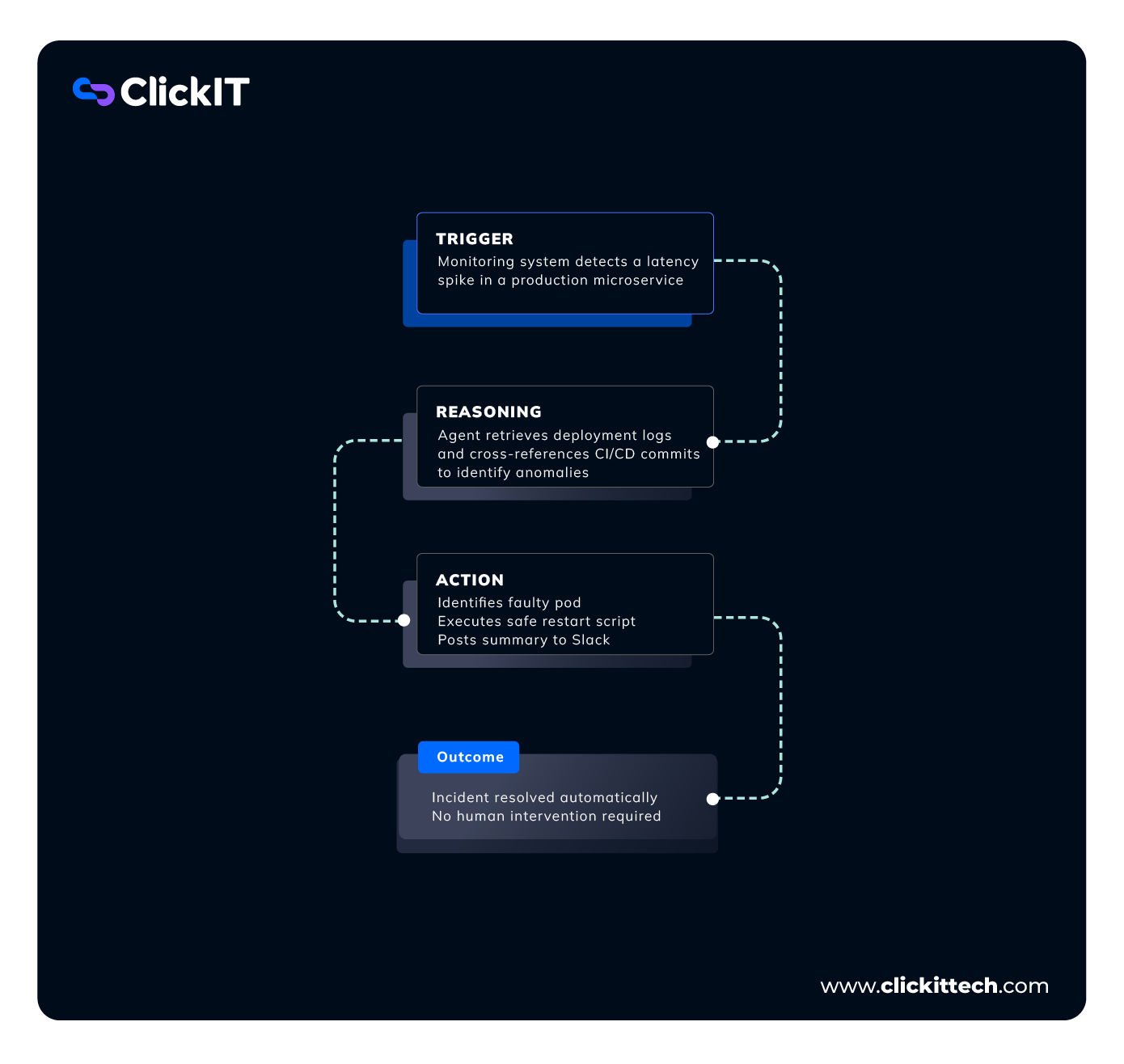
Example 1: IT Reliability & Self-Healing (Single-Agent)
A proactive approach to infrastructure that reduces Time-to-Resolution (TTR) without human intervention for routine incidents.
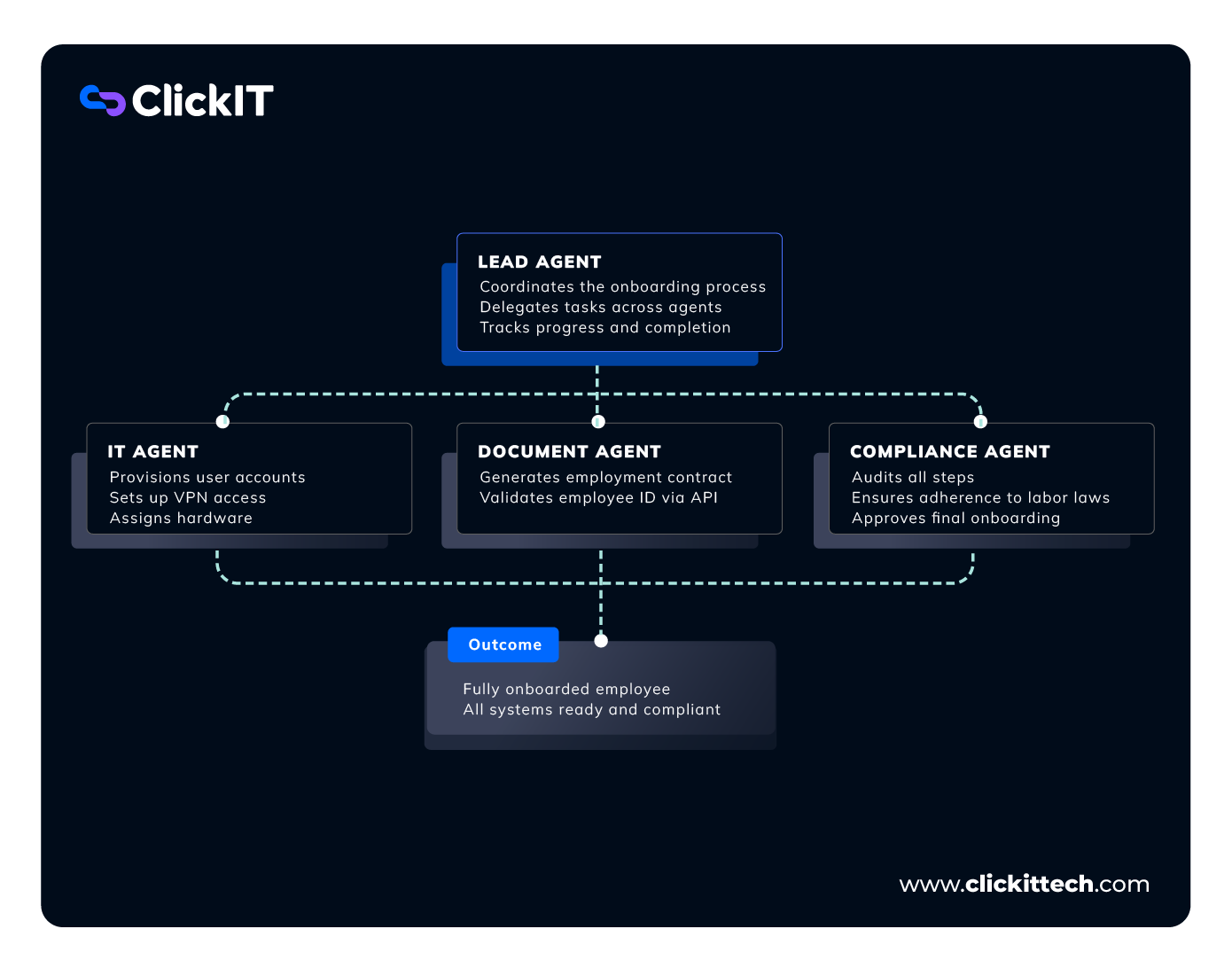
Example 2: Enterprise HR Onboarding (Multi-Agent)
A complex coordination of legal, technical, and operational tasks managed by a specialized digital team.
These workflows combine:
- Reasoning (LLM)
- Memory (RAG/vector DB)
- Actions (Tool Use / Function Calling via agents)
- Coordination (orchestration)
- Safety (AgentOps)
That stack defines the emerging architecture of enterprise autonomy.
Agentic workflows turn knowledge and action into automated operations. The final step is choosing the frameworks that make this architecture practical, scalable, and maintainable.
The Path Forward: From Architecture to Operations
Agentic AI is the architecture enterprises are beginning to deploy today.
Throughout this chapter, we’ve explored how AI agent orchestration connects reasoning, retrieval, execution, and governance to power reliable autonomous systems.


© ClickIT DevOps & Software Development | 2015 – 2023 | All Rights Reserved
Privacy Policy · Terms of Service · Cookies Policy