
CHAPTER 3
RAG Architecture Explained: How Retrieval-Augmented Generation Works
After mastering how to shape model outputs through prompts and tuning, the next question you may face is:
“How do we make the LLM model know what we know?”
LLMs are brilliant at reasoning but limited by static knowledge. They can’t recall your latest documentation, policies, or research unless you provide that context.
To bridge this gap, teams typically consider three approaches:
- Fine-Tuning, to bake specialized behavior into the model
- Long-Context Windows, to process large documents in a single session
- And Retrieval-Augmented Generation (RAG), the architecture we’ll explain through this chapter, to connect models to vast, dynamic knowledge bases.
While Fine-Tuning excels at teaching “form” and Long-Context is ideal for deep analysis of specific files, RAG has emerged as the architectural standard.
It is specifically designed for scenarios where data is too massive to fit in a prompt, changes too frequently to retrain, and requires strict factual grounding.
RAG transforms an LLM from a closed book into a connected system. It allows the model to fetch real-time, internal knowledge (manuals, tickets, or research) before answering, grounding every response in your enterprise’s verified data.
For most organizations, this is the moment AI becomes infrastructure: reliable, auditable, and aligned with company truth.
What Is RAG and How Does It Work?
RAG combines an LLM with an external knowledge base (often a vector database) so that the model can retrieve the most relevant documents before generating an answer.
This retrieval step is the foundation of RAG architecture, allowing the model to access relevant information before generating an answer.
Instead of hallucinating, the LLM grounds its responses in your company’s data: manuals, policies, tickets, research papers, or product docs.
Understanding the Vector Database
Unlike traditional databases that store text or numbers in rows and columns, a vector database stores information as embeddings; mathematical representations of meaning in a high-dimensional space.
- How it works: An embedding model converts your text (sentences, paragraphs, or whole documents) into a long string of numbers (vectors).
- What it stores: It captures the context and relationships between ideas. For example, in a vector space, the concepts "refund policy" and "money-back guarantee" are mathematically close to each other, even if they don't share the same words.
- Why it’s a game-changer for High-Scale Engineering: In a vector space, the concepts "latency spikes in the microservices mesh" and "bottlenecks in the sidecar proxy" are mathematically close to each other.
Even if they don’t share the same keywords, the system understands they both refer to network performance degradation.
This allows your system to find information based on architectural intent.
If an engineer asks about “deployment failures in the staging environment,” the RAG system can instantly retrieve documents related to “image pull errors,” “RBAC permission denied,” and “insufficient node resources,” because it understands the semantic root of the failure.
RAG Architecture Diagram: Step by Step
Think of RAG as a search engine and an LLM working together:
- User Query → Customer asks a question.
- Retrieval Step → A vector database finds the top relevant documents.
- Augmentation → Retrieved documents are injected into the LLM prompt.
- Generation → LLM produces an answer based on both its training and your data.
- Output → A grounded, context-aware response.
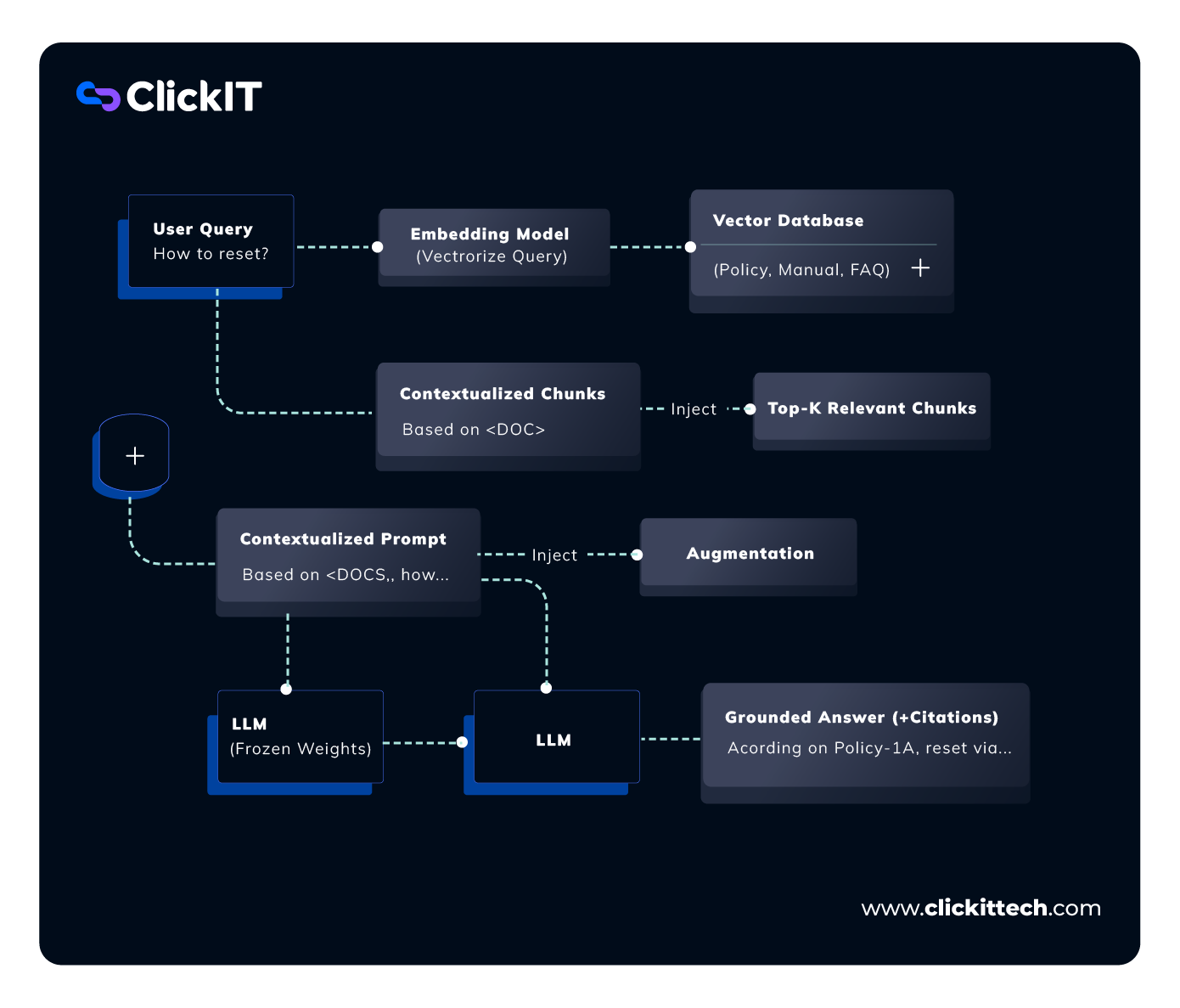
Each step can be optimized independently to improve retrieval quality, response accuracy, and overall system performance.
What is Agentic RAG?
Traditional RAG pipelines work well for straightforward lookups: answering FAQs, retrieving documentation, or summarizing static content.
But as your enterprise starts using AI for decision support, compliance analysis, and dynamic operations, those simple retrievals fall short.
Why? Because most business questions aren’t answered in a single step. They require context switching, reasoning, and validation.
An employee might ask, “What’s our refund policy for enterprise customers in Europe with annual contracts?” and a single retrieval won’t be enough.
The model needs to combine multiple policies, regional clauses, and recent updates to produce an accurate answer.
That’s where Agentic RAG comes in.
Agentic RAG enhances the standard RAG pipeline by introducing autonomous reasoning loops, allowing the system to reason, verify, and refine before answering.
Instead of retrieving once and generating an answer, an agent orchestrates multiple retrieval rounds, checks for missing information, and validates its reasoning steps, much like a human analyst conducting research.
Example:
- Step 1: Retrieve the main refund policy.
- Step 2: Retrieve the regional addendum for the EU.
- Step 3: Cross-check the effective date and compliance tags.
- Step 4: Generate a response that merges and cites all relevant documents.
This multi-step, self-verifying process significantly reduces hallucinations and ensures that outputs are consistent with enterprise data, even in complex queries.
GraphRAG: From Retrieval to Structured Reasoning
As RAG systems evolve beyond simple document retrieval, many business questions depend not on isolated documents, but on the relationships between them.
Policies reference other policies. Regulations depend on jurisdictions and effective dates. Incidents connect to machines, locations, and maintenance histories.
Traditional RAG retrieves documents. GraphRAG retrieves and reasons over relationships.
GraphRAG extends the RAG architecture by introducing knowledge graphs as part of the retrieval layer.
Instead of treating documents as independent chunks, GraphRAG models information as interconnected entities. These entities can represent people, systems, contracts, products, regulations, and events.
This allows the system to answer questions that require contextual reasoning, not just semantic similarity.
Why This Evolution Matters
As AI systems scale, Agentic RAG and GraphRAG provide three key advantages:
- Deeper Reliability: Multi-step retrieval reduces false confidence and improves factual grounding.
- Explainability: Each retrieval round can be logged and traced, supporting governance and compliance audits.
- Scalability: The system adapts automatically as your knowledge base grows without manual prompt redesigns.
In practice, Agentic RAG is the bridge between today’s knowledge-grounded systems and tomorrow’s autonomous, workflow-driven agents, which we’ll explore in the next chapter.
Chunking and Ingestion Pipeline
While Agentic and GraphRAG provide the reasoning layers, their performance ultimately depends on how data is prepared. This process is known as the Ingestion Pipeline, and its most critical step is Chunking.
Why Chunking Matters in RAG
LLMs have a limited “context window.” A single retrieval step can’t process a 300-page manual without sacrificing precision or significantly increasing costs.
Chunking means breaking complex documents into smaller, meaningful pieces (chunks) that the system can index and retrieve efficiently.
The Hierarchy of Chunking Strategies:
- Fixed-size Chunking: Breaking text every X characters or tokens. It’s fast but risks cutting a sentence or a mathematical formula in half, losing the core meaning.
- Recursive Character Chunking: The current enterprise standard. It breaks text at logical boundaries (paragraphs, then sentences) to keep related ideas together.
- Semantic Chunking: Using a smaller model to "read" the text and break it only when the topic changes. It’s more expensive but results in the highest retrieval accuracy.
The Engineering Challenges
Moving data to a Vector Database involves more than just uploading files. Technical teams must solve for:
- Context Fragmentation: If a chunk says "This applies to all," but the context of "all" was in the previous paragraph, the retrieval is useless. To fix this, we implement Overlapping, where each chunk shares 10-20% of its content with the next.
- The Reach of the Technique: Even with perfect chunking, "Simple RAG" stays at the document level. It falls short when an answer requires aggregating data from across the entire corpus, which is why more advanced architectures like GraphRAG (to see relationships) and Agentic RAG (to iterate on findings) become necessary.
How to Run RAG in Production?
Up to this point, we’ve explored the core components of RAG architecture and why they matter.
But a RAG pipeline that looks great in a demo can completely fall apart once it meets real production conditions: multiple users, large document volumes, messy source systems, conflicting policies, and strict latency requirements.
RAG is infrastructure. And like any enterprise-grade infrastructure, the value comes not from theory but from the ability to operate it reliably, securely, and continuously.
We need to think about four operational pillars:
1. Data Freshness
The strongest RAG pipeline will give weak answers if the underlying data is outdated.
Enterprise knowledge is dynamic: Policies get updated, product documentation changes, tickets and logs stream in, and regulatory requirements evolve.
A static index becomes a liability.
What leaders must decide:
- What knowledge must update in real time (incident reports, customer tickets)?
- What knowledge updates daily (pricing tables, documentation)?
- What knowledge updates monthly (policies, manuals)?
The refresh cadence determines accuracy and therefore trust.
2. Latency
Retrieval adds an extra step before generation. This is invisible in prototypes but deeply felt in production. If a knowledge assistant responds in 3 seconds instead of 0.5, users will avoid it.
Latency considerations tech leaders often underestimate:
- Vector database query time
- Re-ranking steps
- Prompt assembly time
- Model generation time
- Network hops across internal systems
A good RAG pipeline with the best answers is fine, but the winner is the one with the best answer-to-wait-time ratio.
3. Security and Access Control
RAG retrieves real internal documents. If access is not governed at the retrieval layer, the AI can unintentionally expose confidential contracts, sensitive HR records, customer PII, regulated data (HIPAA, PCI, GDPR), etc.
This is why RAG demands a new kind of enterprise security thinking: document-level permissions embedded directly into the retrieval pipeline.
Leaders need to ensure:
- Retrieval respects RBAC
- Sensitive content is redacted or excluded
- Prompts do not leak internal data
- Logs don’t capture confidential fragments
- Retrieval events are auditable
RAG without security is a data breach waiting.
4. Monitoring & Observability: The RAG Scorecard
Unlike a traditional service, RAG doesn’t fail loudly. It fails quietly, slowly drifting from accurate to “plausible but wrong.”
To maintain a healthy ecosystem, leaders must track retrieval success rate, grounding strength, latency and throughput, data drift, and user satisfaction.
For this, we can implement a multi-layered evaluation framework:
| Category | Metric | What it measures | Target |
|---|---|---|---|
| Retrieval | Context Precision | Are we finding the right documents? | > 85% Hit Rate |
| Generation | Faithfulness | Is the AI sticking to the provided data? | > 90% Groundedness |
| Performance | P95 Latency | How long do users wait for an answer? | < 2.5 seconds |
| Freshness | Time-to-Index | How fast do updates become searchable? | < 15 minutes |
| Safety | Leakage Rate | Does the AI expose unauthorized data? | 0% |
Is your RAG pipeline production-ready?
Download our Enterprise RAG Readiness Checklist: a 15-point audit tool designed for VPs of Engineering and CTOs to ensure security, speed, and accuracy at scale.
Get Your Readiness Checklist
Free DownloadThe Retrieval Layer: Vector Databases and Hybrid Search
Once leaders understand the operational pillars of RAG, the role of the retrieval layer becomes clearer.
In enterprise systems, retrieval is about reliably finding the right information, whether the query is semantic, exact, or a mix of both.
Vector databases play a central role as the semantic memory layer, enabling fast similarity search across large knowledge bases. They allow LLMs to retrieve relevant context based on meaning, not just keywords.
However, semantic search alone is not enough for enterprise use cases.
Dense vector retrieval excels at understanding intent.
But, it often struggles with exact matches, such as policy IDs, contract numbers, SKUs, version names, or internal codes.
A purely vector-based system may fail on queries like “Policy #12345” or “Contract AC-7789”, which are common in real business workflows.
For this reason, most production RAG systems rely on hybrid search:
- Dense retrieval (vector embeddings) for semantic understanding
- Sparse retrieval (keyword or BM25 search) for exact matches
- Re-ranking to select and order the most relevant results
This combination significantly improves accuracy and reliability, especially in environments where precision matters as much as relevance.
From an enterprise perspective, the retrieval layer matters because:
- Data freshness depends on fast, reliable re-indexing
- Latency depends on efficient hybrid queries under load
- Security depends on access-controlled retrieval across all search modes
- Observability depends on rich query logs and relevance signals
- Scalability depends on handling millions or billions of documents efficiently
What tech leaders need to evaluate is not “which vector database is best,” but whether the retrieval stack as a whole supports a reliable, secure, and maintainable RAG system.
That retrieval layer ultimately determines whether RAG works as a demo, or as enterprise infrastructure.
Quick-Scan: RAG Benefits & Trade-offs
By now, RAG architecture explained how grounding, retrieval, indexing, permissions, latency, and monitoring come together to support reliable production AI.
With this foundation in place, we can step back and look at RAG holistically, its advantages, trade-offs. How you can rely on it as the foundation for accurate, compliant, and scalable AI.
| Benefit | Why it matters for enterprises | Trade-offs / Challenges |
|---|---|---|
| Reduces hallucinations | Answers are grounded in company-verified data → improves trust with employees & customers | Requires clean, updated data pipelines |
| Scales domain knowledge | Teams can query vast corpuses instantly → faster onboarding, decision-making | Vector DB costs grow with data size |
| Easy customization | Add/remove docs without retraining models → fast iteration for changing industries | Needs automated ingestion pipelines |
| Agentic RAG and GraphRAG | Multi-step retrieval and relational reasoning improve accuracy, explainability, and self-verification | Higher infra complexity, modeling effort, and latency |
| Optimized Ingestion & Chunking | Precise retrieval: ensures your system only pulls the exact context needed, saving costs and context window space. | Requires deep architectural decisions on chunk size and semantic overlapping to avoid context loss. |
| Cost efficiency | Cheaper than fine-tuning or training new LLMs from scratch | Still incurs vector DB + infra costs |
| Regulatory compliance | Can limit answers only to verified policy/legal docs → reduces risk in healthcare/finance | Must implement access controls and audit logs |
| Faster innovation | Teams can experiment with new knowledge sources quickly without retraining | May require orchestration tools for large deployments |
RAG is the mechanism that allows an LLM to operate inside a real organization. It gives AI memory, context, and accountability.
It turns a model from a general-purpose generator into a system that speaks the language of your business, reflects your policies, and adapts to your knowledge in real time.
When implemented well, RAG is the step where AI stops being hypothetical and starts becoming operational. But grounding knowledge is only the beginning.


© ClickIT DevOps & Software Development | 2015 – 2023 | All Rights Reserved
Privacy Policy · Terms of Service · Cookies Policy