
CHAPTER 2
LLM Optimization: Prompt Engineering to Production AI
An LLM is only as effective as the way you interact with it. Even the most advanced LLMs can produce hallucinations, vague answers, or inconsistent results.
LLM optimization is the process of improving how language models respond through better prompts, tuning techniques and systematic evaluation.
That’s why the first step in LLM optimization is learning how to shape, control, and improve model outputs.
This is where prompt engineering and optimization strategies come in. This chapter covers three levels of control that every enterprise AI team should master:
- Prompt Engineering → craft better instructions.
- Prompt Optimization → automate and measure performance.
- Prompt Tuning → achieve consistency and deep alignment at scale.
Together, these techniques bridge the gap between a generic LLM and a production-ready system that meets business needs.
What is Prompt Engineering?
Prompt engineering is the practice of telling the model exactly what you need: tone, format, and context.
It’s the fastest way to improve output quality without modifying the model itself.
Prompt engineering is essential because LLMs don’t “understand” tasks the way humans do. They rely on patterns in text.
Factors like phrasing, order, and level of detail can completely change an LLM’s output.
Well-designed prompts reduce hallucinations, improve consistency, and save costs by minimizing retries.
Some examples include:
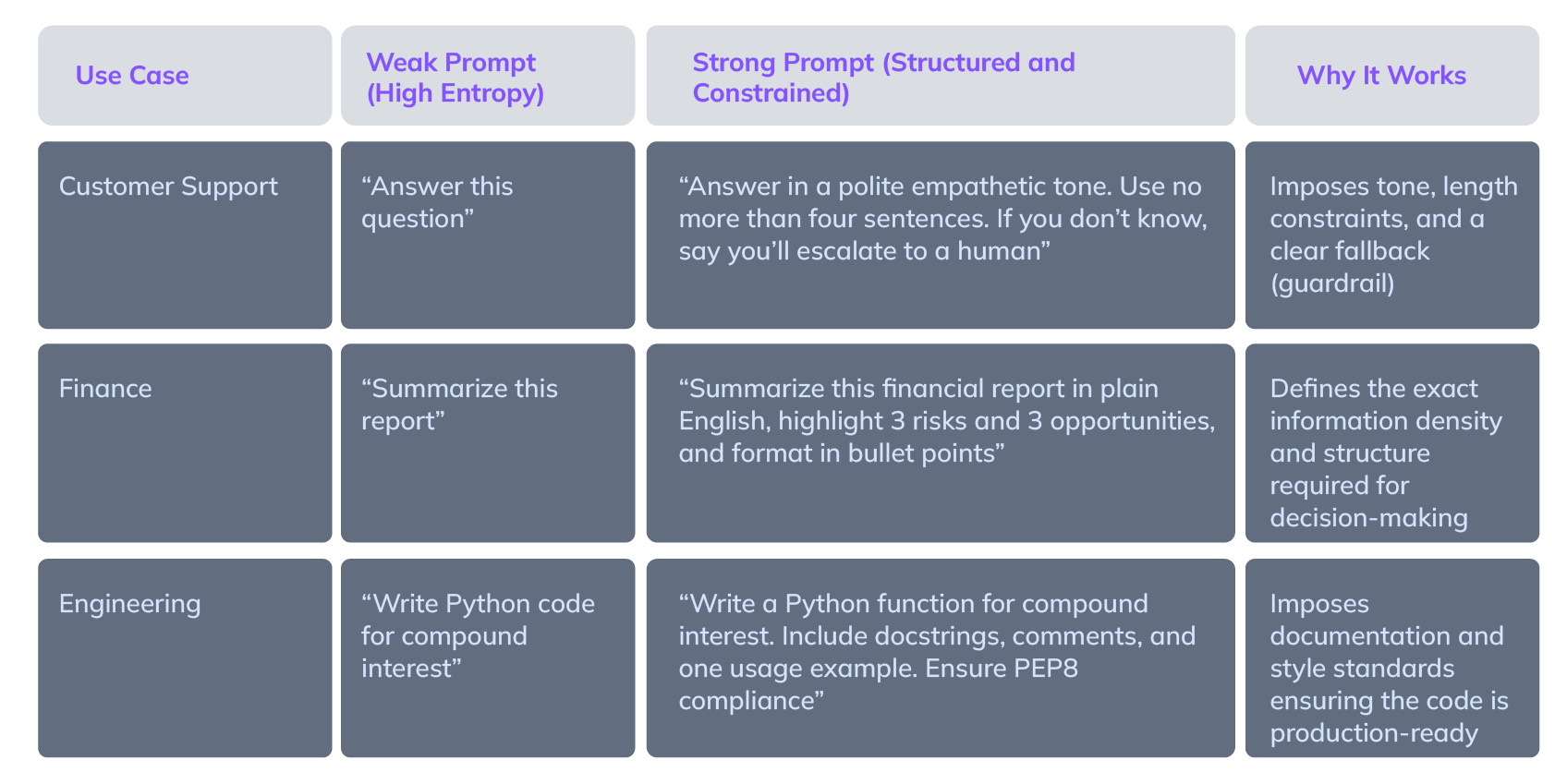
What are the Best Practices of Prompt Engineering for Your Enterprise?
Implement Few-Shot Prompting (In-Context Learning)
- Example: “Provide 2-3 examples of a complex support ticket and its ideal resolution before asking for the final answer.”
- Why: It is the most efficient way to condition the model’s output distribution toward a specific format or logic without modifying weights.
Use Chain-of-Thought (CoT)
- Example: “Think step-by-step to verify the financial calculations before providing the final summary.”
- Why: Forcing the model to generate intermediate reasoning traces significantly reduces hallucinations in logical, mathematical, or coding tasks.
Provide clear role and context
- Example: “You are a financial analyst preparing a risk summary for the board…”
- Why: Setting a role helps the model adopt the right tone, vocabulary, and decision boundaries.
Define formatting expectations
- Example: “Answer in a JSON object with keys: risks, opportunities, recommendation.”
- Why: Structured outputs integrate directly into systems (CRMs, BI dashboards, APIs), reducing manual cleanup.
Include guardrails
- Example: “If you are unsure, respond with: ‘This requires human review.’”
- Why: Prevents hallucinations and ensures risky cases are escalated to humans (important for regulated industries).
Test across multiple contexts
- Don’t assume one prompt works everywhere.
- Test prompts across languages, accents, user groups, and industries if your enterprise serves global audiences.
- Why: Improves robustness and fairness.
Document and version prompts
- Store prompts in repositories, track versions, and document why each was chosen.
- Why: Ensures consistency across teams, reduces “prompt drift,” and allows faster debugging.
Measure prompt performance
- Define KPIs such as accuracy, factual grounding, cost efficiency, and latency.
- Use benchmarks and regular re-testing.
- Why: Keeps outputs aligned with enterprise quality standards as models evolve.
How to Master Prompt Optimization?
Optimizing prompts goes beyond trial-and-error. Enterprises are replacing manual experimentation with a systematic, measurable process.
1. From Trial-and-Error to Programmatic Optimization
The paradigm is shifting from “Prompt Engineering” (manual string manipulation) to “Prompt Programming.” Instead of humans guessing which words work best, tools like DSPy treat prompts as parameters within a software pipeline.
- How it works: You define the "Signature" (input/output requirements) and a metric. A compiler then automatically generates the optimal prompt and few-shot examples.
- Why it matters: If you switch models, you don’t rewrite prompts by hand, you simply re-compile the pipeline for the new model.
2. Tracking Results with Prompt Management Tools
Once optimized, these prompts must be managed as production assets. Tools like LangSmith, PromptLayer, and Weights & Biases (W&B) let teams:
- Log every prompt and response (for auditability).
- Version control prompts (like code).
- Monitor performance drift over time (example: Prompt A worked in April, but now fails with new data).
- Collaborate across teams (marketing prompt library vs finance prompt library).
Enterprise tip:
Treat prompts like software assets. Store them in Git, attach metadata, and manage their lifecycle.
3. Automating Evaluation: The "LLM-as-a-Judge" Paradigm
The final piece of the optimization puzzle is closing the feedback loop through automated metrics. Traditional NLP metrics (like BLEU or ROUGE) are insufficient for modern AI because they measure word overlap rather than semantic coherence or grounding.
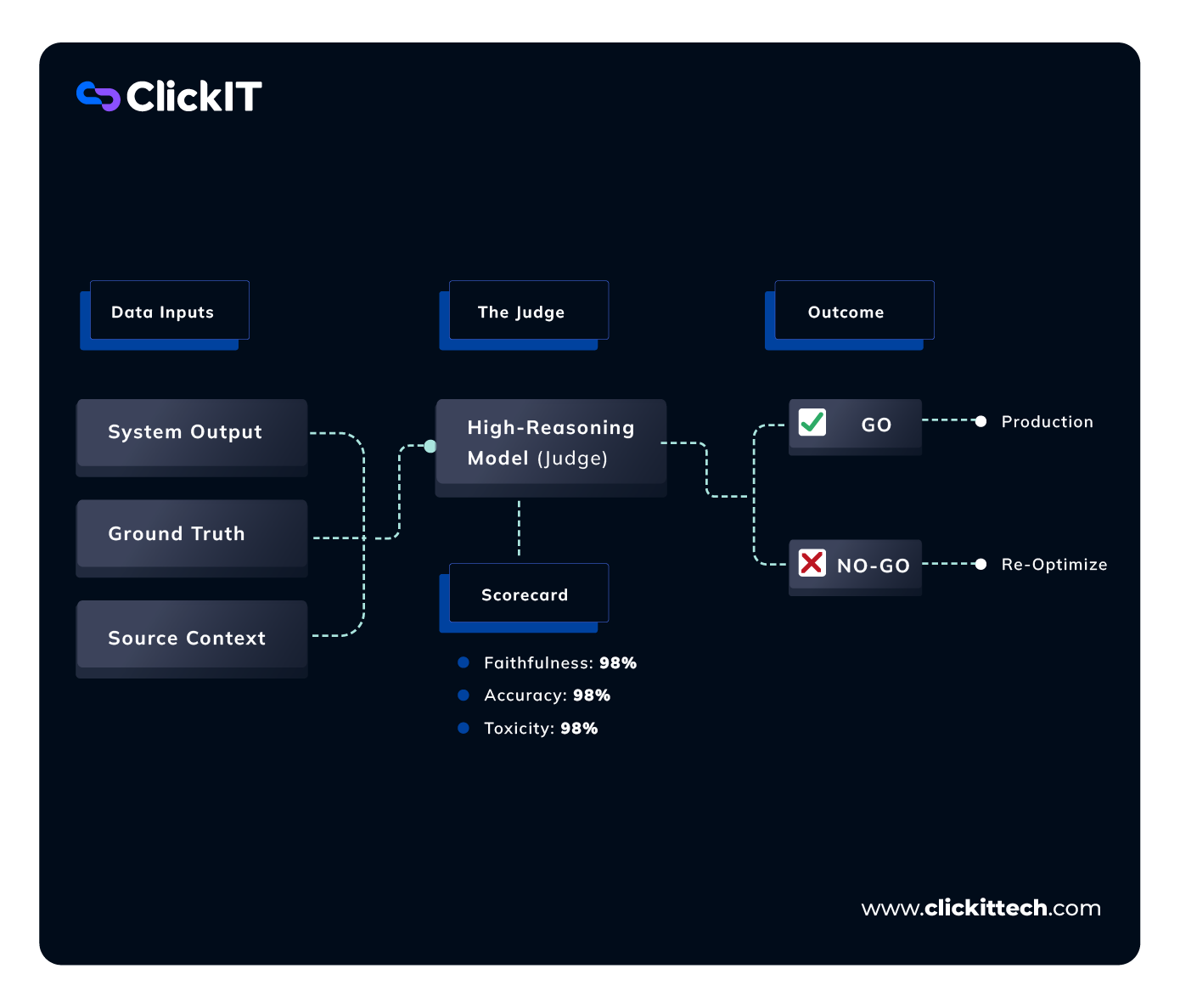
To scale without constant human intervention, the industry standard is to implement LLM-as-a-Judge. This involves using a high-reasoning model (like the latest GPT or Claude models) to evaluate and score the outputs of smaller, specialized, or distilled models.
Enterprises adopt these automated pipelines to measure:
- Accuracy & Factuality: Does the answer reflect the truth? The "Judge" compares the AI response against a verified ground-truth resolution.
- Faithfulness (Grounding): Crucial for RAG. The Judge ensures the answer is derived only from the provided context, flagging any hallucinated content.
- Toxicity, Bias & Brand Alignment: Automatically flag outputs that are unsafe or off-brand before they reach the end user.
- Readability & Verbosity: Detect and trim overly verbose responses to improve user experience and reduce costs.
- Latency & Cost: Measure how many tokens were consumed and the time-to-first-token.
By integrating this into a CI/CD pipeline for prompts, evaluation becomes continuous. If a new prompt version drops the “Faithfulness” score below a certain threshold, the deployment is automatically halted.
Example:
A bank uses a “Judge” model to test 5 different prompts for regulatory report summaries. The metrics show that one specific prompt reduces hallucinations by 15% while saving 20 tokens per call. This optimized prompt is then automatically promoted to production.
Understanding Prompt Tuning
Once an organization has mastered prompt design and learned how to measure what works, the next challenge is scaling consistency.
Manually maintaining hundreds of carefully crafted prompts across teams, products, and regions quickly becomes brittle and expensive.
This is where Prompt Tuning comes in.
What Prompt Tuning Really Is (and Isn’t)
Prompt tuning is not the same as rewriting prompts, and it is not full model fine-tuning. To understand the difference, we must distinguish between Discrete (Hard) Prompts and Soft Prompts.
- Prompt Engineering (Hard Prompts): Uses discrete tokens, human-readable text instructions. You are searching for the right words to trigger the desired response.
- Prompt Tuning (Soft Prompts): Instead of searching for words, you optimize continuous prompt vectors (embeddings) that are prepended to the input.
- The Mechanism: These tensors are learned through backpropagation while keeping the base model weights completely frozen.
- Non-Interpretability: Unlike text, Soft Prompts are not human-readable, they are mathematical abstractions that guide the model’s latent space toward your specific domain or task.
- PEFT / Fine-Tuning (LoRA, QLoRA): Goes one step further by modifying small, low-rank adapter weights inside the model architecture, rather than just the input prefix.
In prompt tuning, the model itself does not change internally. Instead, the system learns how to condition the model using trainable input vectors that represent your company’s specific tone, policy, or task structure without the overhead of full retraining.
Why Enterprises Use Prompt Tuning
Prompt tuning is a valuable LLM optimization technique when organizations want predictable behavior without the operational overhead of full fine-tuning.
Key benefits include:
- Consistency: Outputs follow the same structure, tone, and policy across teams and geographies.
- Efficiency: Less prompt text per request → lower token usage and cost.
- Stability: The base model remains untouched, reducing the risk of catastrophic changes.
- Governance: Soft prompt variants can be versioned, evaluated, rolled back, and audited.
Where PEFT Fits In
In practice, many enterprises go one step further and adopt Parameter-Efficient Fine-Tuning (PEFT) techniques such as LoRA or QLoRA.
These approaches:
- Adjust small adapter layers instead of the full model,
- Offer stronger task alignment than prompt tuning,
- Remain far cheaper and safer than full retraining.
This is the approach most production teams use today when prompt tuning alone isn’t sufficient.
Prompt Tuning Example
A global bank starts with prompt engineering to define compliant responses.
After identifying stable patterns, it introduces soft prompt tuning to enforce tone and structure.
For higher-risk workflows, it applies LoRA adapters trained on approved examples, achieving consistency without retraining the full model.
Stop Guessing, Start Architecting
Prompting is becoming an engineering discipline of its own. To help your engineering team maintain high standards and avoid “prompt drift,” we’ve created the Enterprise Prompt Architecture Blueprint.
It includes our 6-pillar framework and the 10-point checklist we use to validate mission-critical instructions.
Get your FREE Prompt Architecture Blueprint
Free DownloadLLM Optimization: Choosing the Right Level of Control
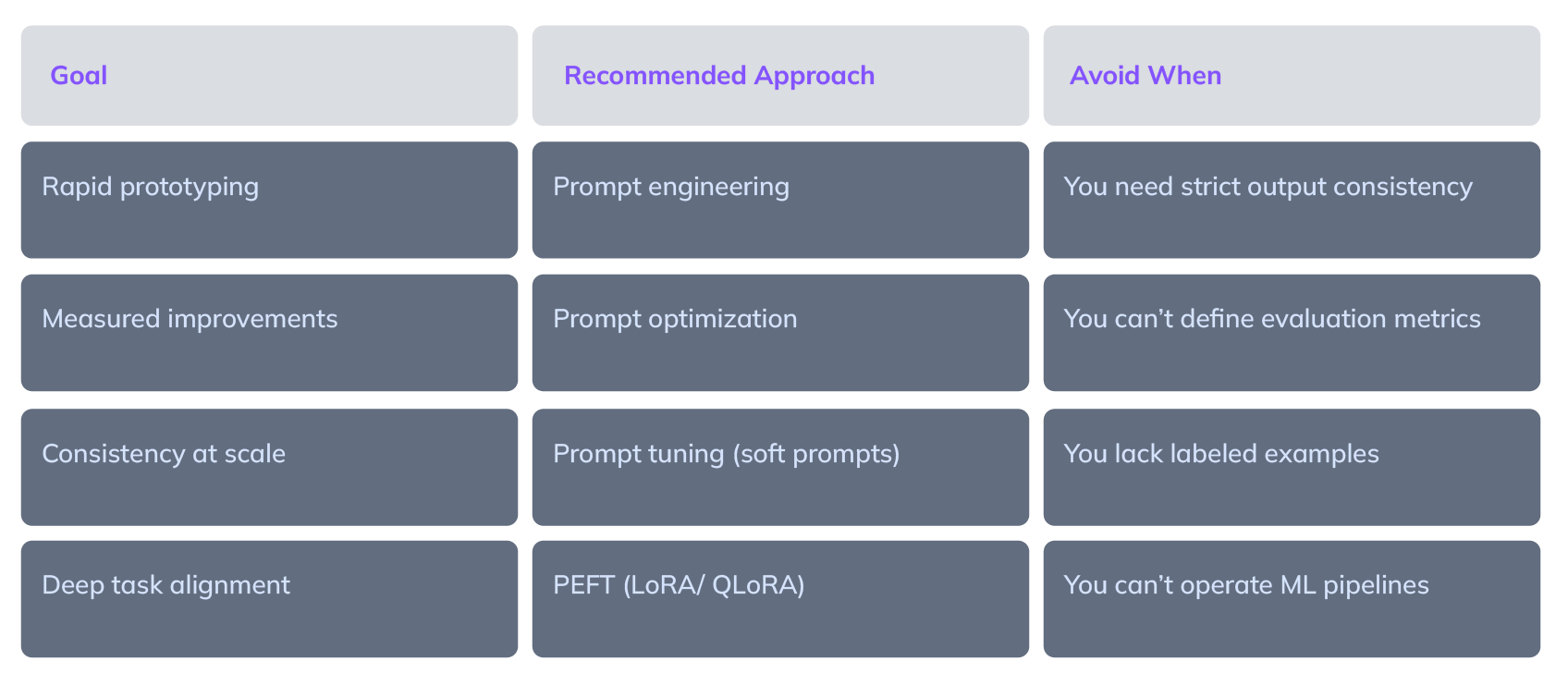
Optimizing LLMs is about progressive control:
- Prompt engineering teaches you how to communicate with the model.
- Prompt optimization tells you what actually works.
- Prompt tuning and PEFT scale that knowledge into repeatable, production-grade behavior.


© ClickIT DevOps & Software Development | 2015 – 2023 | All Rights Reserved
Privacy Policy · Terms of Service · Cookies Policy