
Generative AI vs Predictive AI
AI systems broadly fall into two categories: generative and predictive.
Generative AI creates new data outputs.
- Drafting a contract from a prompt.
- Writing software code.
- Generating synthetic medical images for training.
- Simulating marketing campaigns with AI-generated assets.
Predictive AI looks at patterns in past data to estimate what is likely to happen next.
- Fraud detection: “Is this transaction suspicious?”
- Forecasting: “Will sales increase next quarter?”
- Recommender systems: “What product is this user most likely to buy?”
- Predictive maintenance: “When will this machine fail?”
But in enterprise environments, these systems rarely operate in isolation.
Most high-impact AI applications combine both: predictive models trigger decisions, and generative models execute the next action.
For example, a predictive model may flag a high-risk transaction or detect customer churn, and that output becomes structured context that a generative model uses to draft a report, generate a recommended response, or automate a workflow.
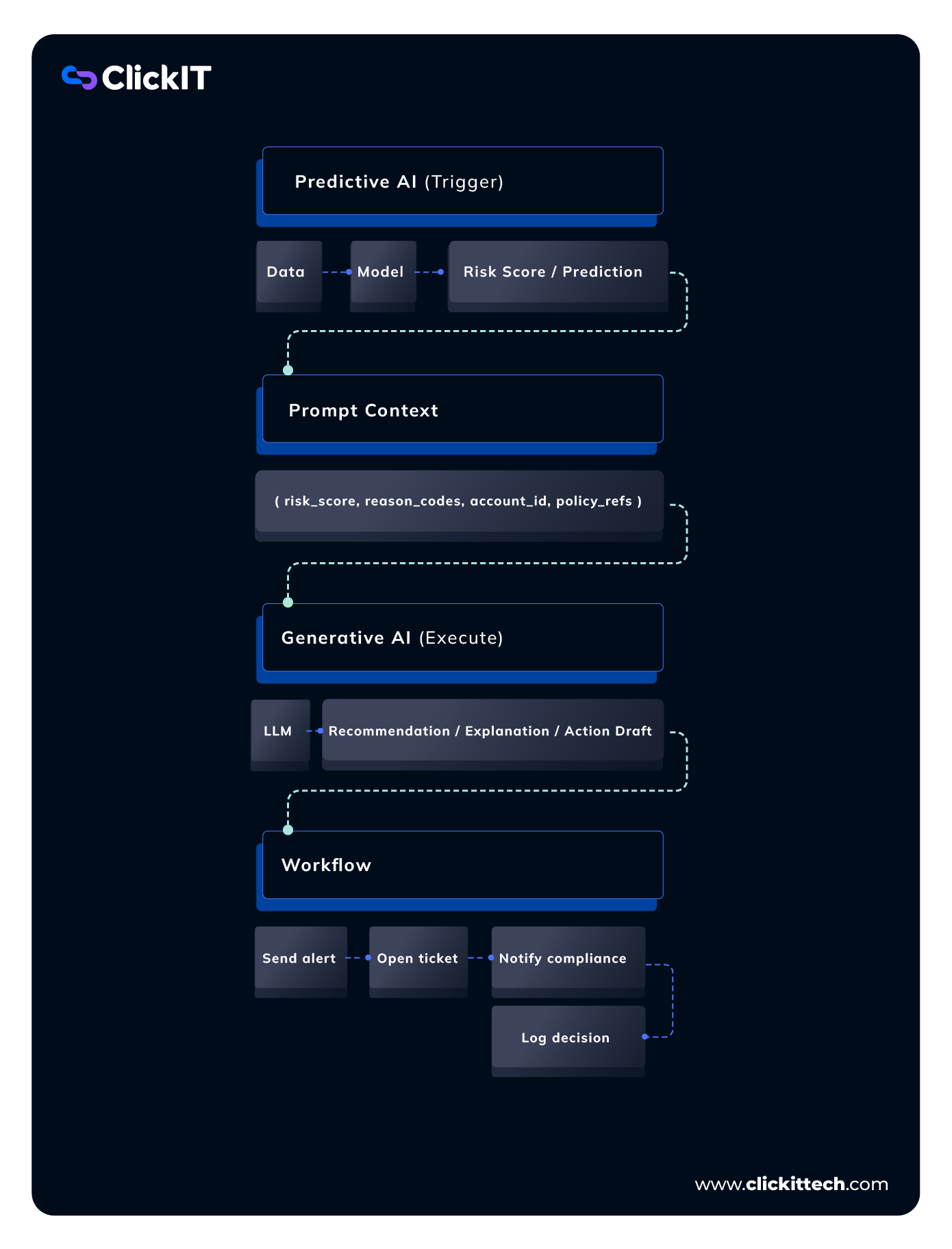
Enterprise takeaway: Predictive AI tells you what is happening (or what should happen next). Generative AI turns that signal into actionable execution, the message, the process, the code, or the decision narrative.
Types of Generative AI
Instead of thinking of Generative AI as “just LLMs,” it’s more accurate to see it as a toolbox of modalities. These represent how AI interacts with the world: through language, visuals, sound, and even executable code.
For your organization, understanding these modalities is like a strategic map. Each one unlocks unique use cases, requires different infrastructure, and carries distinct risks.
To mention an example, a healthcare company might use Automatic Speech Recognition to transcribe doctor notes, while a retailer relies on diffusion models for product visuals.
The key is aligning each modality to the business value it can create, whether that’s automating communication, scaling design, or accelerating software delivery.
Each of these modalities extends the boundaries of what machines can create,but language remains the connective tissue across them all. Whether it’s speech transcribed into text, images described in captions, or code generated from instructions, language models sit at the core of this ecosystem.
That’s why the next section explores the evolution from traditional NLP to LLMs, showing how this transformation enabled the unified, multimodal AI systems we rely on today.
LLM vs NLP: Evolution, Not Replacement
As we saw in the previous section, language is the thread connecting all modalities of Generative AI.
That’s why it’s important to refresh how Large Language Models (LLMs) evolved from Natural Language Processing (NLP).
For years, NLP defined how machines processed human language: classifying text, extracting entities, or identifying sentiment. But NLP systems were task-specific and rigid. Each new capability required a new model, new data, and a new pipeline.
LLMs changed that paradigm. Instead of specifically trained systems, they introduced general-purpose language intelligence capable of understanding, reasoning, and generating across tasks.
For enterprises, this shift means fewer models to maintain, faster adaptation to new use cases, and the ability to integrate language understanding directly into applications, workflows, and even other modalities like vision or audio.
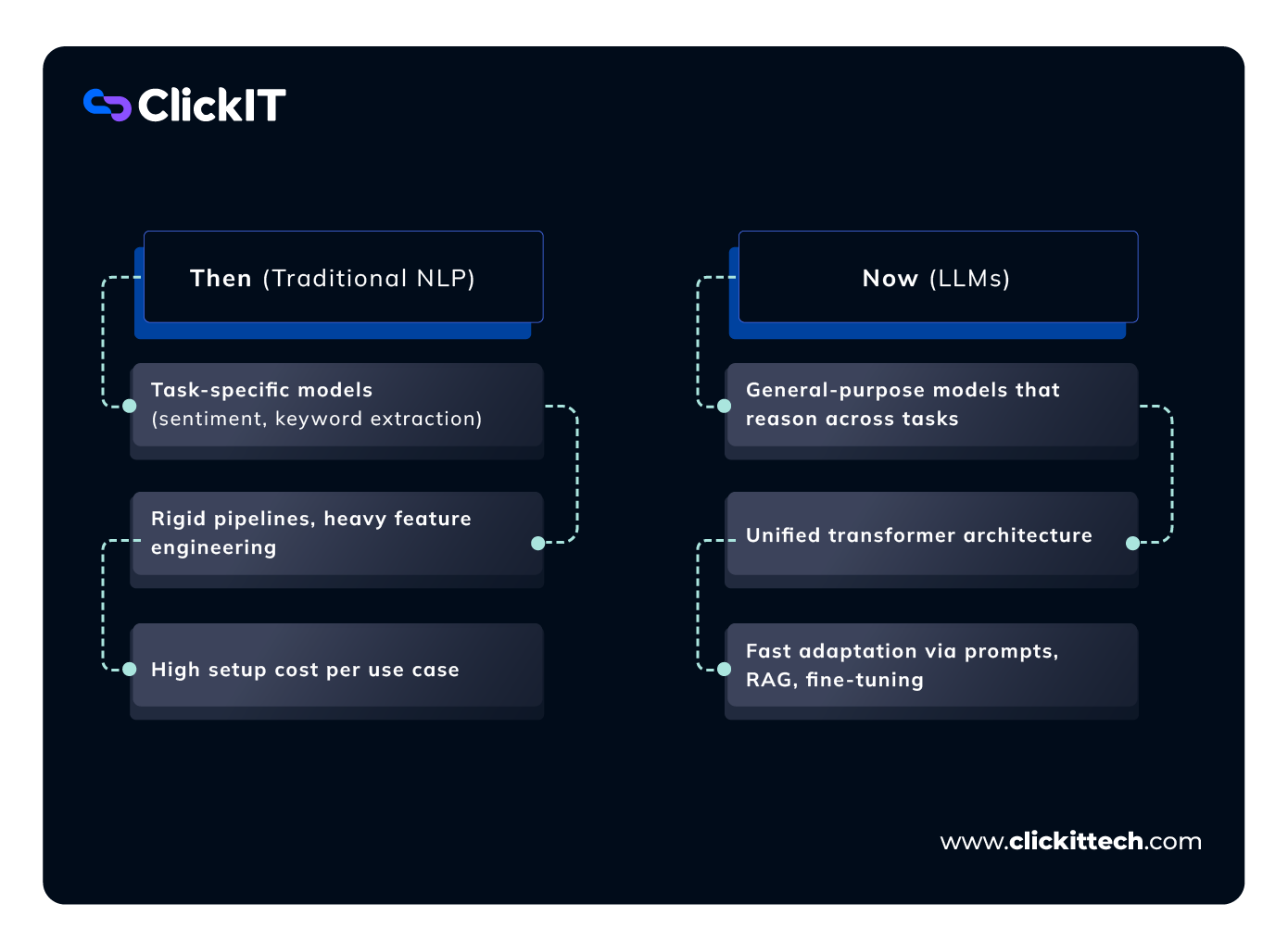
LLMs are not replacing NLP, they are the next stage of it, bringing scale, flexibility, and generalization.
Comparing LLM Options: Balancing Control, Cost, and Capability
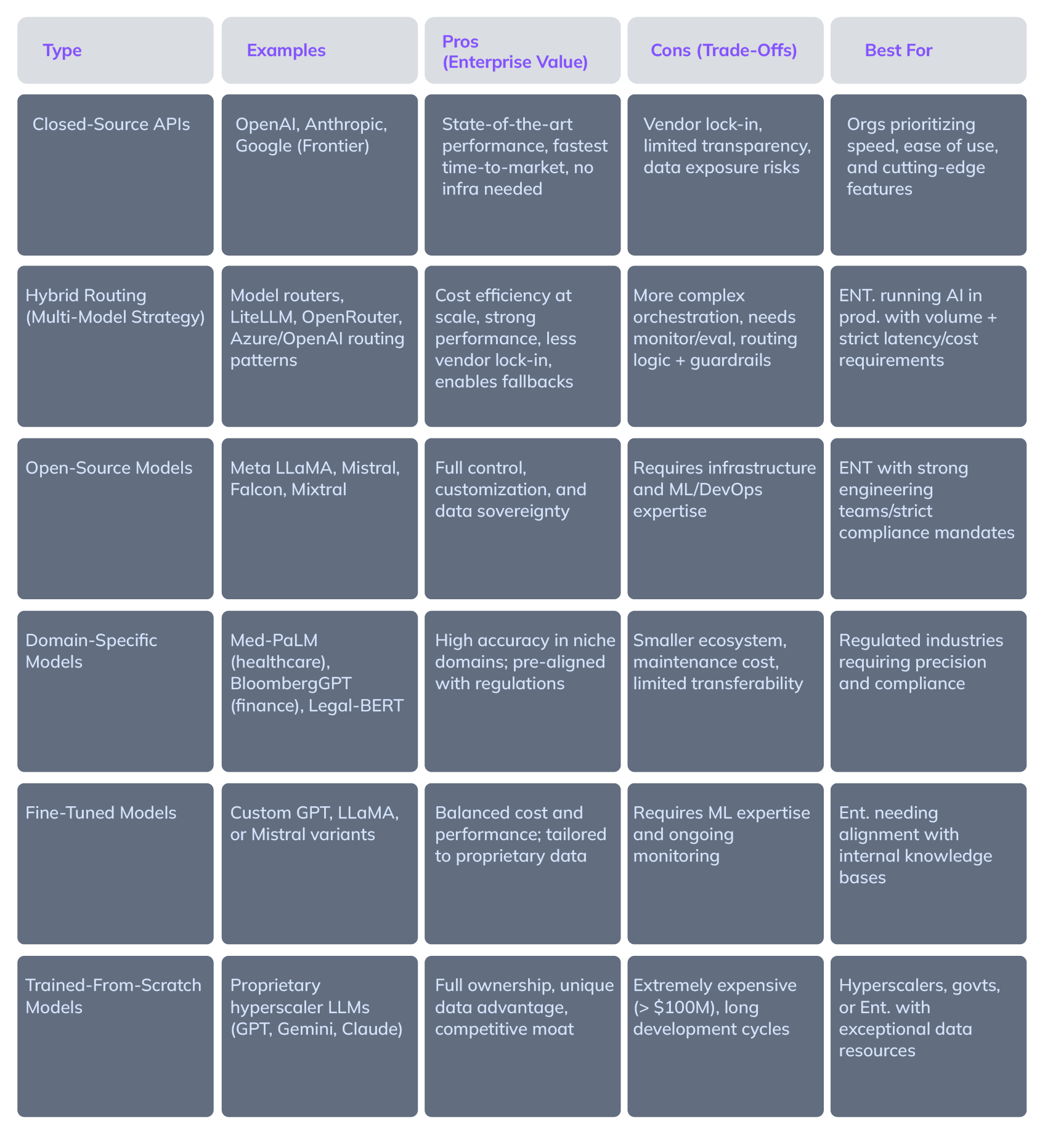
The next strategic question becomes: Which type of LLM should your enterprise build on?
This is where many AI initiatives stall. Every choice impacts cost, security, scalability, and flexibility. Whether you license a closed API, adopt open-source models, or fine-tune your own, your decision defines how quickly you can innovate and how much control you retain over your data and IP.
For most organizations, the ideal path is about building a balanced portfolio: combining commercial APIs for agility, open-source models for compliance, and fine-tuned variants for domain accuracy.
| Type | Examples | Pros (Enterprise Value) | Cons (Trade-Offs) | Best For |
|---|---|---|---|---|
| Closed-Source APIs | OpenAI, Anthropic, Google (Frontier) | State-of-the-art performance, fastest time-to-market, no infra needed | Vendor lock-in, limited transparency, data exposure risks | Orgs prioritizing speed, ease of use, and cutting-edge features |
| Hybrid Routing (Multi-Model Strategy) | Model routers, LiteLLM, OpenRouter, Azure/OpenAI routing patterns | Cost efficiency at scale, strong performance, less vendor lock-in, enables fallbacks | More complex orchestration, needs monitor/eval, routing logic + guardrails | ENT. running AI in prod. with volume + strict latency/cost requirements |
| Open-Source Models | Meta LLaMA, Mistral, Falcon, Mixtral | Full control, customization, and data sovereignty | Requires infrastructure and ML/DevOps expertise | ENT with strong engineering teams/strict compliance mandates |
| Domain-Specific Models | Med-PaLM (healthcare), BloombergGPT (finance), Legal-BERT | High accuracy in niche domains; pre-aligned with regulations | Smaller ecosystem, maintenance cost, limited transferability | Regulated industries requiring precision and compliance |
| Fine-Tuned Models | Custom GPT, LLaMA, or Mistral variants | Balanced cost and performance; tailored to proprietary data | Requires ML expertise and ongoing monitoring | Ent. needing alignment with internal knowledge bases |
| Trained-From-Scratch Models | Proprietary hyperscaler LLMs (GPT, Gemini, Claude) | Full ownership, unique data advantage, competitive moat | Extremely expensive (> $100 M), long development cycles | Hyperscalers, govts, or Ent. with exceptional data resources |
Leader’s Lens:
Before committing to an LLM strategy, ask:
- What level of data control do we require (public cloud, private, or on-prem)?
- Can our team operate and monitor models in-house, or do we rely on vendors?
- How fast do we need to prototype new use cases, and what risk are we willing to accept for speed?
No single LLM is a perfect and universal choice. Closed APIs deliver unmatched power but limited transparency. Open-source models provide autonomy but demand operational maturity. Fine-tuned and hybrid approaches hit the balance, optimizing for control, cost, and adaptability.
In the next section, we’ll explore how enterprises transform these model choices into true platforms, systems that combine security, scalability, and governance into a single operational foundation.
Enterprise LLMs
For most organizations, adopting an LLM means building an internal platform for intelligence.
An enterprise LLM should be secure, observable, compliant, and adaptable to your data and workflows. In other words, it must behave like infrastructure, not like a one-off experiment.
Enterprises that succeed with AI do so because they design for trust and scale from day one. They treat the model as one component in a larger system, one that includes security, compliance, observability, and human oversight.
A production-grade LLM platform typically includes five layers:
- Adaptation (fine-tuning, RAG pipelines).
- Scalability (auto-scaling to handle peak workloads).
- Compliance (HIPAA, SOC2, GDPR).
- Observability (monitor prompts, responses, failures).
- Secure deployment (private endpoints, role-based access).
Enterprises should think of LLM adoption not as buying a model, but as building a platform.
How to Adopt an LLM Strategy
Starting to work with an LLM is a strategic trade-off between control, cost, and time-to-value. Enterprises must decide how much ownership they need over the model versus how fast they need to deploy it.
Every option (commercial APIs, open-source fine-tuning, or full custom training) comes with its own operational, financial, and governance implications.
It’s important to mention that probably around 99% of organizations will go for APIs or Fine-Tuning (PEFT/LoRA mainly). Training an LLM from scratch is a more suitable options for spaces like government or Big Tech.
Understanding these up front ensures your AI initiative doesn’t stall halfway between pilot and production.
Free Strategic Tool for Leaders
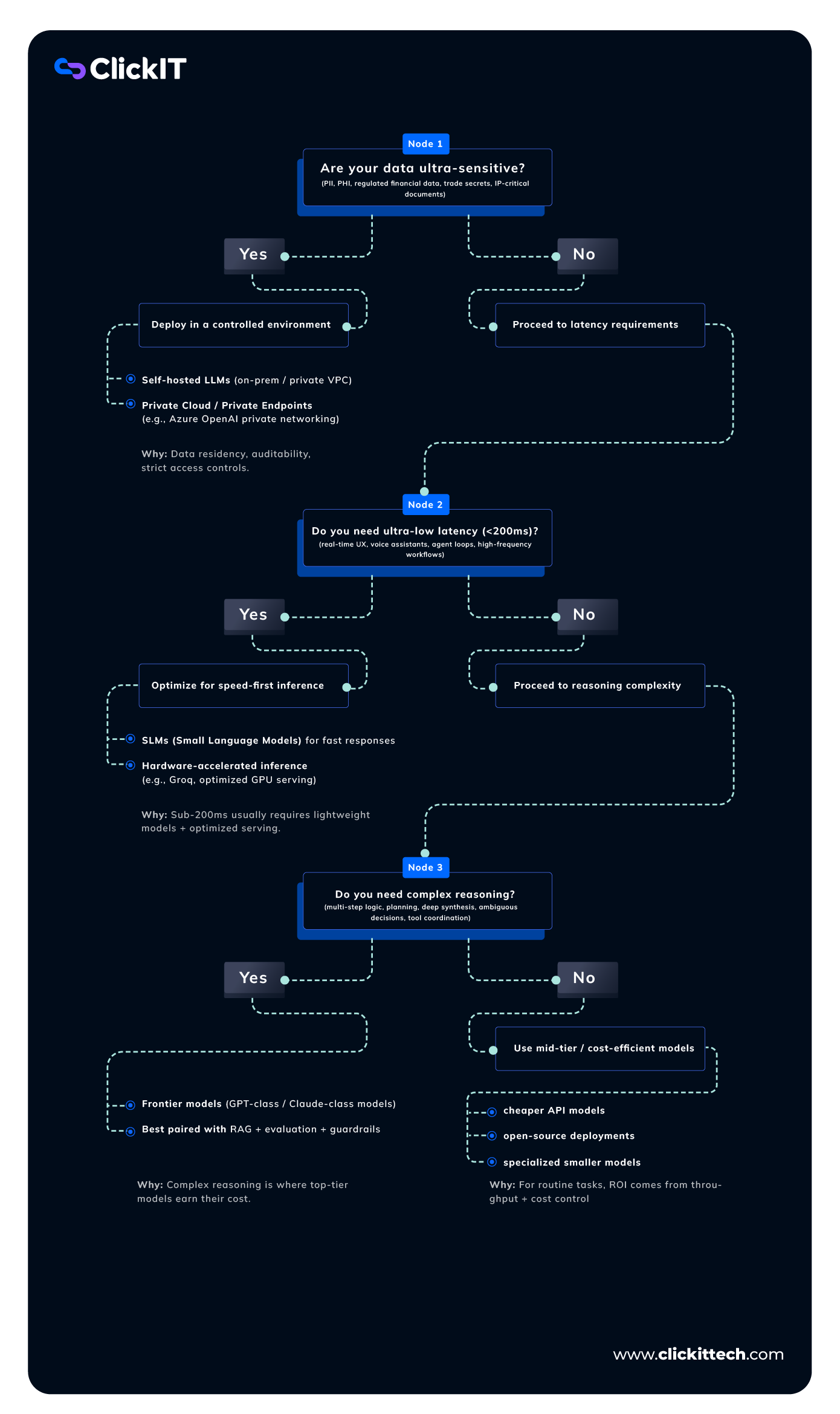
Choosing the right model is the most consequential architectural decision you will make. To help you navigate the trade-offs between cost, latency, and data sovereignty, we have developed The Enterprise AI Model Selection & Readiness Matrix.
This high-level worksheet includes our proprietary Decision Tree and a 5-minute Production Readiness Audit to help you justify your technical roadmap to stakeholders.
Get your free Strategic Selection Matrix
Free Download

© ClickIT DevOps & Software Development | 2015 – 2023 | All Rights Reserved
Privacy Policy · Terms of Service · Cookies Policy